


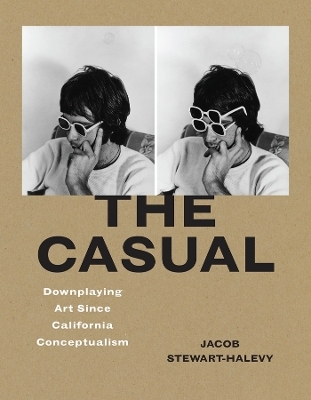
The Casual
Downplaying Art Since California Conceptualism
Seiten
2026
University of Chicago Press (Verlag)
978-0-226-84394-0 (ISBN)
University of Chicago Press (Verlag)
978-0-226-84394-0 (ISBN)
- Noch nicht erschienen (ca. Januar 2027)
- Versandkostenfrei
- Auch auf Rechnung
- Artikel merken
Considers the enduring legacy of California Conceptualism, known for its lax approaches to creating, writing about, and exhibiting art.
Moving away from making objects, and turning instead to staging scenes, the artists associated with California Conceptualism—including Eleanor Antin, John Baldessari, David Lamelas, Tony Ramos, Ilene Segalove, and William Wegman—behaved indifferently toward their art, denied making it and knowing what it was about, and displayed a lack of concern for its future. Their casual attitude and aesthetic transformed relationships between artists, critics, and viewers, separating those who could recognize these practices from those who could not.
Contemporary artists have continued this trajectory, finding new ways to act casually through their “stance.” In the humanities, this term is often taken to mean the beliefs, values, and intentions of authors, and it has offered a useful way to think about how artists position themselves toward their work and audiences. Jacob Stewart-Halevy builds on recent social theory to show how artists, critics, and other members of the art world wield stance to make sense of artworks and their social circumstances, arguing that, through the rise of conceptual art, stance has come to supplement—and in some cases replace—the aesthetic quality of artworks.
Moving away from making objects, and turning instead to staging scenes, the artists associated with California Conceptualism—including Eleanor Antin, John Baldessari, David Lamelas, Tony Ramos, Ilene Segalove, and William Wegman—behaved indifferently toward their art, denied making it and knowing what it was about, and displayed a lack of concern for its future. Their casual attitude and aesthetic transformed relationships between artists, critics, and viewers, separating those who could recognize these practices from those who could not.
Contemporary artists have continued this trajectory, finding new ways to act casually through their “stance.” In the humanities, this term is often taken to mean the beliefs, values, and intentions of authors, and it has offered a useful way to think about how artists position themselves toward their work and audiences. Jacob Stewart-Halevy builds on recent social theory to show how artists, critics, and other members of the art world wield stance to make sense of artworks and their social circumstances, arguing that, through the rise of conceptual art, stance has come to supplement—and in some cases replace—the aesthetic quality of artworks.
Jacob Stewart-Halevy is associate professor of art history at Tufts University. He is the author of Slant Steps: On the Art World’s Semi-Periphery.
Introduction
Part I: Stance
1. Signed Signs
2. Agreements and Disputes
Part II: Genre Questions
3. Naive Allegories
4. Productionless Design
Part III: Sociocultural Styles
5. Covert Prestige
6. Encounter Group Art
7. California Casual
Acknowledgments
Notes
Index
| Erscheint lt. Verlag | 6.1.2027 |
|---|---|
| Zusatzinfo | 16 color plates, 54 halftones |
| Sprache | englisch |
| Maße | 178 x 229 mm |
| Gewicht | 966 g |
| Themenwelt | Kunst / Musik / Theater ► Kunstgeschichte / Kunststile |
| ISBN-10 | 0-226-84394-7 / 0226843947 |
| ISBN-13 | 978-0-226-84394-0 / 9780226843940 |
| Zustand | Neuware |
| Informationen gemäß Produktsicherheitsverordnung (GPSR) | |
| Haben Sie eine Frage zum Produkt? |
Mehr entdecken
aus dem Bereich

aus dem Bereich
kleine Kulturgeschichte einer brillanten Allianz
Buch | Softcover (2025)
Iudicium (Verlag)
CHF 33,90


