


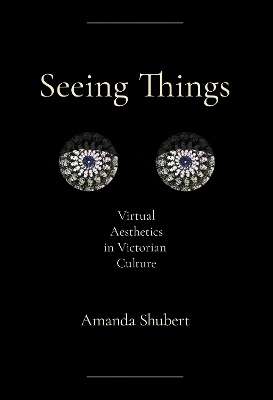
Seeing Things
Virtual Aesthetics in Victorian Culture
Seiten
2025
Cornell University Press (Verlag)
978-1-5017-8494-1 (ISBN)
Cornell University Press (Verlag)
978-1-5017-8494-1 (ISBN)
A cultural history of nineteenth-century media imaginaries, Seeing Things tells the story of how Victorians experienced the virtual images created by modern optical technologies – magic lanterns, stereoscopes, phenakistoscopes, museum displays, and illusionistic stage magic. Amanda Shubert argues that interactions with these devices gave rise to a new virtual aesthetics – an understanding of visual and perceptual encounters with things that are not really there.
The popularization of Victorian optical media redefined visuality as a rational mode of spectatorship that taught audiences to distinguish illusion from reality. As an aesthetic expression of a civilizational ideal that defined the capacity to see but not believe, to be entertained without being deceived, it became a sign of western supremacy. By tracing the development of virtual aesthetics through nineteenth-century writings, from the novels of George Eliot and Charles Dickens to popular science writing and imperial travelogues, Seeing Things recovers a formative period of technological and literary innovation to explain how optical media not only anticipated cinema but became a paradigmatic media aesthetic of western modernity.
The popularization of Victorian optical media redefined visuality as a rational mode of spectatorship that taught audiences to distinguish illusion from reality. As an aesthetic expression of a civilizational ideal that defined the capacity to see but not believe, to be entertained without being deceived, it became a sign of western supremacy. By tracing the development of virtual aesthetics through nineteenth-century writings, from the novels of George Eliot and Charles Dickens to popular science writing and imperial travelogues, Seeing Things recovers a formative period of technological and literary innovation to explain how optical media not only anticipated cinema but became a paradigmatic media aesthetic of western modernity.
Amanda Shubert is Teaching Faculty in English at the University of Wisconsin–Madison.
Introduction: What Was the Virtual?
1. Magic Panic: The Pedagogy of Disenchantment
2. The Mirror of Ink: Realism, Orientalism, and Vision at a Distance
3. Mountains of Light: The Koh-i-Noor at the Great Exhibition
4. Recalled to Life: Phantasmagoria as the History of the French Revolution
5. Spinning in Place: Trapped in the Moving Picture Machine
Epilogue: Arrival of a Train
| Erscheinungsdatum | 17.10.2025 |
|---|---|
| Zusatzinfo | 7 b&w halftones, 16 color halftones - 7 Halftones, black and white - 16 Halftones, color |
| Verlagsort | Ithaca |
| Sprache | englisch |
| Maße | 152 x 229 mm |
| Gewicht | 454 g |
| Themenwelt | Kunst / Musik / Theater |
| Geisteswissenschaften ► Geschichte ► Regional- / Ländergeschichte | |
| Geisteswissenschaften ► Sprach- / Literaturwissenschaft ► Anglistik / Amerikanistik | |
| Geisteswissenschaften ► Sprach- / Literaturwissenschaft ► Literaturgeschichte | |
| ISBN-10 | 1-5017-8494-3 / 1501784943 |
| ISBN-13 | 978-1-5017-8494-1 / 9781501784941 |
| Zustand | Neuware |
| Informationen gemäß Produktsicherheitsverordnung (GPSR) | |
| Haben Sie eine Frage zum Produkt? |
Mehr entdecken
aus dem Bereich


aus dem Bereich
Träume und Macht : eine Biografie
Buch | Hardcover (2025)
C.H.Beck (Verlag)
CHF 61,60
die Geschichte meiner Urgroßmutter
Buch | Hardcover (2025)
C.H.Beck (Verlag)
CHF 32,15


