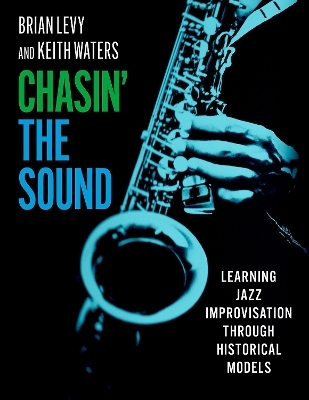
Chasin' the Sound
Oxford University Press Inc (Verlag)
978-0-19-764353-2 (ISBN)
In addition to exploring the mechanics of what to play, Levy and Waters offer ideas on how to play the essential roles of timekeeping, comping, and soloing, and how to develop routines within these roles. Supported by classroom-tested exercises and hundreds of original annotated music examples, students will learn the core rhythmic and melodic tenets of jazz while studying and playing along with the improvised solos and accompaniments of Charlie Parker, Louis Armstrong, Lester Young, Sarah Vaughan, Bud Powell, Clifford Brown, Wes Montgomery, Miles Davis, Red Garland, Max Roach, Philly Joe Jones, Paul Chambers, John Coltrane, and Sonny Rollins, among many others. Throughout, Levy and Waters show that great soloists and accompanists do not in fact have an unlimited vocabulary but rather use limited melodic and rhythmic resources as modules for infinite recombination.
Written for all experience levels, Chasin' the Sound is a substantial workout for students and instructors to build chops and knowledge along the way.
Brian Levy is Director and Associate Professor of Jazz Studies at San Diego State University (SDSU). Prior to this role, he was a full-time member of the faculty at The New England Conservatory of Music (NEC) from 2013-23, where he held joint appointments in the Department of Jazz Studies and the Department of Music History and Musicology. In 2021, he received the prestigious Louis Krasner Teaching Award. As a saxophonist, Levy performs regularly in the US and Europe. Keith Waters is Professor of Music at the University of Colorado Boulder. As a professional jazz pianist, he has recorded and performed with jazz artists such as James Moody, Bobby Hutcherson, Eddie Harris, Dave Liebman, Janis Siegel, and many others. As an author, Waters is the author of The Studio Recordings of the Miles Davis Quintet, 1965-68; Postbop Jazz in the 1960s: The Compositions of Wayne Shorter; Herbie Hancock and Chick Corea; and Jazz: The First Hundred Years (with co-author Henry Martin).
How to Use this Book
About the Companion Website
Preface
Acknowledgements
Introduction
Chapter 1: Pulse and Syncopation
Chapter 2: Horizontal and Vertical Approaches to Improvisation
Chapter 3: Introduction to Charlie Parker: Rhythm and Pitch
Chapter 4: Rhythmic Shapes
Chapter 5: "Groovin' High": The Upsurge
Chapter 6: Descending Pathways and Underlying Thirds
Chapter 7: Techniques for Connecting and Expanding Melodies
Chapter 8: Cross Rhythms
Chapter 9: "Klaunstance" and "Ko Ko": the Vocabulary of Bebop
Chapter 10: Vertical Approaches: Harmonic Spaces
Chapter 11: Flexibility of Harmonic Rhythm
Chapter 12: Hard Bop Approaches
Chapter 13: Soloing with Comping Rhythms
Chapter 14 (Online): Practical Applications
Chapter 15 (Online): Learning Tunes, Harmonic Progressions, and Lines in 12 Transpositions
Chapter 16 (Online): Other Bop Players
Chapter 17 (Online): Rhythm Changes Routines
Chapter 18 (Online): John Coltrane and Harmonic Third Relations
Index
| Erscheinungsdatum | 17.06.2025 |
|---|---|
| Zusatzinfo | 379 annotated music examples |
| Verlagsort | New York |
| Sprache | englisch |
| Maße | 216 x 19 mm |
| Gewicht | 885 g |
| Themenwelt | Kunst / Musik / Theater ► Musik ► Jazz / Blues |
| ISBN-10 | 0-19-764353-1 / 0197643531 |
| ISBN-13 | 978-0-19-764353-2 / 9780197643532 |
| Zustand | Neuware |
| Informationen gemäß Produktsicherheitsverordnung (GPSR) | |
| Haben Sie eine Frage zum Produkt? |
aus dem Bereich