


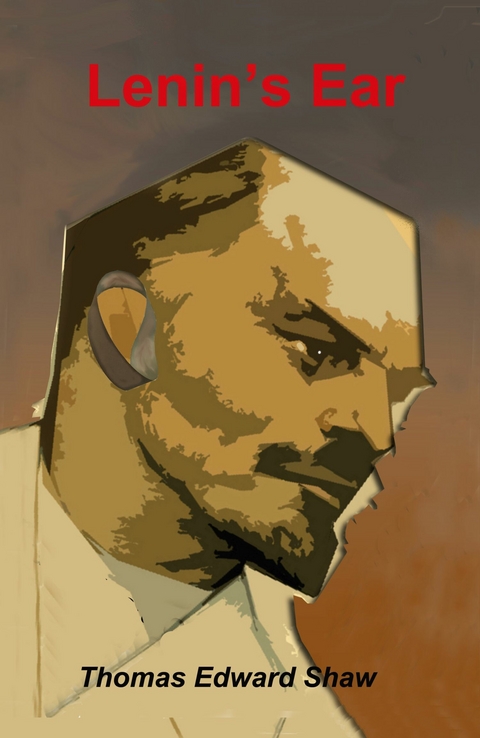
Lenin's Ear (eBook)
244 Seiten
Bookbaby (Verlag)
9780996096881 (ISBN)
BIOGRAPHY OF THOMAS EDWARD SHAW - aka 'Eddie' Published Books and publications: •A COWBOY LIKE ME (book of short stories); Out of print •BLACK MONK TIME (memoir) a solid seller with many movie inquiries •BLACK MONK TIME TOO - RESURRECTION (memoir of 2002-2005 tours made by The Monks) •BELTRAMI'S RIVER (historical novel); •A FRIENDLY GAME OF POKER, Contributing author in the book 52 Tales of the Neighborhood Game, published by Chicago Review Press, Sept. 2003; •PASSING THROUGH MINNESODA AND OTHER ALTERED STATES; a musician's tale. •NEVADA POETRY SOCIETY; two different books of poetry by the Nevada Poetry Society. Ebooks: •COWBOY LIKE ME, Volume 2; •ART, GUNS AND FISH FOR SALE (novella); •BELTRAMI'S RIVER; & BLACK MONK TIME (re-edited) - on Kindle and Smashwords (removed because the author received no royalties). Movie Soundtracks: •THE LOST TAPES OF ELIZABETH TAYLOR; 2024 Biographical film (song: How To Do Now) •BIG LEBOWSKI; Coen Bros movie, (song; 'I Hate You') •TAILLIGHTS FADING; Canadian movie, •POWERADE; sports drink commercials, 7 different versions aired on national U.S. TV stations; •WHO GETS TO CALL IT ART; 2006 documentary film by Peter Rosen. •TRANSATLANTIC FEEDBACK: by Playloud Productions (Berlin, Germany), a documentary film featuring Thomas Shaw & The Monks Recordings: •BLACK MONK TIME; LP on Polydor (producer Jimmy Bowien - Hamburg, Germany) •COMPLICATION, CUCKOO, and LOVE CAN TAME THE WILD; 45 singles on Polydor (producer Jimmy Bowien - Hamburg, Germany) •BLACK MONK TIME - American release - producer, Rick Rubin (website: http://www.the-monks.com) •BLACK MONK TIME and MONKS, EARLY YEARS on Light in the Attic Records, Seattle Washington; Retribution Records •LP 'MINNESODA' on Capitol Records (Producer Bob Johnston - Nashville). •EP four Hamburg recorded Monks songs with Jack White's label, Third Man Records - Nashville.
Lenin's Ear is the story of a Russian artist, who grew up in the post-Stalin era. His early years are a partly true account of a boy growing up in Post World War II Russia. Being an independent thinker, he found many ways to get into trouble. His mother, a costume designer for the Kirov Ballet, worked hard to provide him with the benefits one could get by being a good Socialist. After having studied at the prestigious Art Academy of Leningrad, he was expected to fulfill the requirements assigned to him by the Soviet government. He refused and then had to work his way around the barriers set up to hinder his ambitions. "e;I just want to be an artist,"e; was his mantra. When his wishes did not work well for him, he found a way to leave Russia. He arrived in Holland where he painted the struggle and perplexity of the human condition. His portrayals were realistic because they represented the fight, the pain, and the price. He knows how it feels because he says he has personally experienced the need for freedom. His work is easily recognizable. He paints bodies blackened from the expended heat, generated from within. They are as black as the fecund earth from whence they came . . . seared by the inner fire of their struggle. Painted bodies are locked in combat and suffering. Only the strongest survive. As life ends in suffering, the soul lives. As the flickering flame of the almighty's fire, the eyes appear luminous. The soul is locked in combat, either winning or losing the fight. The color of blood underlines the price. "e;I'm trying to channel it . . . to describe the numbed, hardened, blackened soul."e; That's when he had the chance to go to the USA where his works got him into more trouble. Freedom expression was available but one had to be careful how it was used. He did not stay long, After gaining notoriety for the wrong reasons, to this day he claims, "e;As an artist I know this . . . freedom is not accomplished by those who only dream about it. Freedom is earned. Some think they get it as a birthday present. In most cases that's not true. It's a struggle for everyone. I'm just painting it as an artist."e;
CHAPTER 1
When Lena, Sacha Alkaev's mother came home after a day's work, she found her mother in the living room sitting on the couch and moaning, “I don’t know what happened to him. He was here and now he’s gone.”
“What are you talking about?”
“Sacha!” replied the elderly woman.
“Sasha? Where is he? Oh my God, Babushka!”
“I fell asleep and when I woke up, he was gone”
“Oh no! We have to find him before he ends up on someone's dinner plate.”
Babushka means grandmother in Russian. It was her daily job to take care of her four-year-old grandson while her daughter Lena worked. In this case as she slept, the boy took the opportunity to slip out of the small apartment; thinking he might explore the world.
Late in the evening, the sun of white summer nights casts long shadows over the cityscape, resembling a painting by de Chirico. The summer days are long, unlike the winter days when the sun never seems to rise. Only for a few hours does the sun go below the horizon, and yet there is neither daylight nor darkness, only a glowing shadowless twilight. It's as if the day never ends. It's also easy, depending on a person's circumstances, to get confused about when the real day begins. Peter The Great claimed a long time ago that Russia is a country where things that don't just happen do happen.
“My God. My God. Where can he be?” Babushka wrung her hands. She put a kerchief around her head and slipped on her drab brown woolen coat. Hurrying out the door, behind Lena, the women rushed out of the building onto the Leningrad Street. “I’ll go this way. You go that way,” Lena commanded.
The streets still showed signs of devastation from the recent war It would take years to repair all the damage. Historic landmarks were looted and destroyed in the 872-day Siege of Leningrad. When it was over, national treasures, like priceless Russian art collections were taken to Nazi Germany.
According to those who managed to survive, “Everyone died”, not only from the bombings but afterwards from starvation. The siege of Leningrad is known as the most destructive siege in world history with millions of Russians dead, more victims on both sides of this battle than the Battle of Stalingrad, the Battle of Moscow and the atomic bombings of Hiroshima and Nagasaki. Some historians called it an act of genocide.
After the Germans were driven out of the city, those who wandered the pulverized neighborhoods found themselves desperate to find any means to survive. They suffered from extreme starvation, and reports of cannibalism began to circulate. Once the rodents, the birds, wild animals, and pets were had, hungry gangs roamed the streets looking anything else to eat. Unaccompanied children were easy targets. Once the Germans had been driven out of Russia and control was reasserted, at least 250 Leningrad citizens were found guilty of cannibalism; and the fear of it remained for years afterwards. By now, the city was rebuilding and order being reinstated. As Stalin administered his brutal policies to maintain order, it was proudly spoken by many - Russia is for Russians.
According to all official accounts, the Soviet recovery was successful, even as almost everyone was relieved when Stalin died. The newest generation of Russians would certainly have a better experience than the last.
As a child, Sacha Alkaev appeared as a small black-haired boy with dimples, large expressive eyes and an inquisitive nature. He had always worn his hair long, even after he became an adult. Everyone who knew him, talked about his vivid imagination, always thinking that surely he would become some kind of artist.
And later when he was a student, those opinions became validated. His ambition was visible. Almost everyday, Sacha would wear the same paint spattered clothing to school.
On this frightful day, still traumatized from prior experience, the grandmother ran down the streets moaning, “Oh God! Oh God! God save us. I saw him playing by the door, and then the next time I looked, he was gone.” Babushka's voice began to tremble. “He's been missing for over two hours.”
But then there he was. Lena saw him a few streets away, running and crying. she called to him. He stopped running. She ran to him and picked him up, while scolding. “My God, where have you been?”
It was Sacha's first time alone on his own and it scared him. Between sobs he tried to explain that he just wanted to look around, not get lost. “I didn't know where I was. There was an old woman following me, so I ran.”
“You silly boy. Don't you know that terrible things can happen to a boy who is alone on the streets?”
“Mama, I was lost.”
“You don't have to cry now. You're safe.”
“Are you mad at me?”
“It wasn't that long ago when children used to disappear.” She tightly held his hand as she quickly hurried him back to the small apartment.
“Why did they disappear?
“Because people had no food.”
“But what does that have to do with kids?”
“When children were found walking the street without a grown-up, they could be kidnapped and end up in someone's soup; especially the babies.”
“Really?”
“Yes, people were hungry. All the chickens were gone. There was no meat. Even the horses had been eaten. People were dying of starvation. If a young child was seen on the street and no one was with him, some desperate, sick person would follow him. When the child was by himself. . . maybe behind a large building, or in a field, he would be hit over the head and wrapped in a sack so no one would see him. He would be carried to somewhere. His throat would be cut. He would be gutted, skinned, cut up, and cooked. Do you want that to happen to you?”
With tears on his frightened face the boy shook his head indicating no.
“Don't ever leave the apartment alone again. Do you hear me?”
It was 1964. Lena was a costumes designer who worked behind the stage of the Kirov Ballet. The memory of Stalin was quickly being replaced by the reality of Leonid Brezhnev. Surely things would get better.
Because of Lena's position at the famous Kirov Ballet, Sacha was considered lucky to be raised in such an acclaimed environment. He was often at the theater with his mother, while the dancers and staff hustled about rehearsing, arguing, doing things that theatrical people do backstage. At a young age, he was aware of the conflicts involved in the Soviet art world, especially between the arbiters of Soviet officialdom, the corruption of the ballet director, and the idealism of his mother.
His mother was a Don Quixote figure, filled with anxiety for the misfortunes of herself and her fellow workers. The war had been over for more than ten years, but still there was trauma. Not all things were as good as people wished. She was in her forties, medium height, with dark brown hair. She was a devoted mother, a hard worker with a somewhat short round figure wearing simple clothing. She once dreamed of becoming a painter of canvas, but it was thwarted by Sacha's birth, the major disappointment in her life . . . not Sacha's birth . . . but her inability to continue her studies. Receiving no help from the father, a businessman who had no intention of marriage, Lena just barely survived. Luckily she found work at the Kirov Theater. To address her own frustrations, she took up the causes of her co-workers and in time became an elected union shop steward.
A loyal party member, she constantly preached the values of Socialist doctrine. Immersed in the day-to-day ballet company environment, her life contained enough financial support to make her more comfortable than many. She lived frugally. There wasn't much one could buy anyway.
It was Babushka's job to do the shopping. She stood in different lines throughout the day, just to buy sausage, bread, and vegetables that were in season. When Lena got home at night, supper was always ready and little Sacha would be sitting in his chair waiting for it to be served.
Lena Alkaev was a worried looking woman. The main source of her apprehension was caused by the director of the ballet company. She often found herself being pitted against him by angry stage workers who wanted changes in their working conditions. Kuznetsov was the director's name, and they didn't like him. What could she do? It was her job to represent them.
Kuznetsov's position as head of the administration depended upon the approval of the party and the commissioners who controlled the ballet company. He was not a purest in terms of good socialist behavior and ideology. “Who do they think they are?” he would say if one of the staff mentioned some criticism made by the production crew. A common complaint was the lack of time given to finish a late planned project. “They're here to do work. They're called workers, aren't they?”
“Yes sir.”
“Then let them work! Tell them to get to it now!”
A staff helper, clipboard in hand, always ran behind him as he strode through the workshops on rare visits. The area in which the props were built was in a complex of huts outdoors behind the theatre. Here, costumes were designed, sewn, and painted. There was a strong smell of musty props that were stored for a long time. Costumes hung on rows of racks. Some workshops had the heavy odor of paint and chemicals.
The director's staff helper sometimes tried to defend the production workers, telling him, “They don't have enough time to do it, sir. This should have been planned earlier.”
“Don't cry to me. They must work all night if they have to. Get it...
| Erscheint lt. Verlag | 3.2.2025 |
|---|---|
| Sprache | englisch |
| Themenwelt | Kunst / Musik / Theater ► Malerei / Plastik |
| ISBN-13 | 9780996096881 / 9780996096881 |
| Informationen gemäß Produktsicherheitsverordnung (GPSR) | |
| Haben Sie eine Frage zum Produkt? |
 EPUB (Ohne DRM)
Größe: 451 KB
Digital Rights Management: ohne DRM
Dieses eBook enthält kein DRM oder Kopierschutz. Eine Weitergabe an Dritte ist jedoch rechtlich nicht zulässig, weil Sie beim Kauf nur die Rechte an der persönlichen Nutzung erwerben.
Dateiformat: EPUB (Electronic Publication)
EPUB ist ein offener Standard für eBooks und eignet sich besonders zur Darstellung von Belletristik und Sachbüchern. Der Fließtext wird dynamisch an die Display- und Schriftgröße angepasst. Auch für mobile Lesegeräte ist EPUB daher gut geeignet.
Systemvoraussetzungen:
PC/Mac: Mit einem PC oder Mac können Sie dieses eBook lesen. Sie benötigen dafür die kostenlose Software Adobe Digital Editions.
eReader: Dieses eBook kann mit (fast) allen eBook-Readern gelesen werden. Mit dem amazon-Kindle ist es aber nicht kompatibel.
Smartphone/Tablet: Egal ob Apple oder Android, dieses eBook können Sie lesen. Sie benötigen dafür eine kostenlose App.
Geräteliste und zusätzliche Hinweise
Buying eBooks from abroad
For tax law reasons we can sell eBooks just within Germany and Switzerland. Regrettably we cannot fulfill eBook-orders from other countries.
aus dem Bereich


