Marvel Comics For Dummies (eBook)
427 Seiten
For Dummies (Verlag)
978-1-394-29930-0 (ISBN)
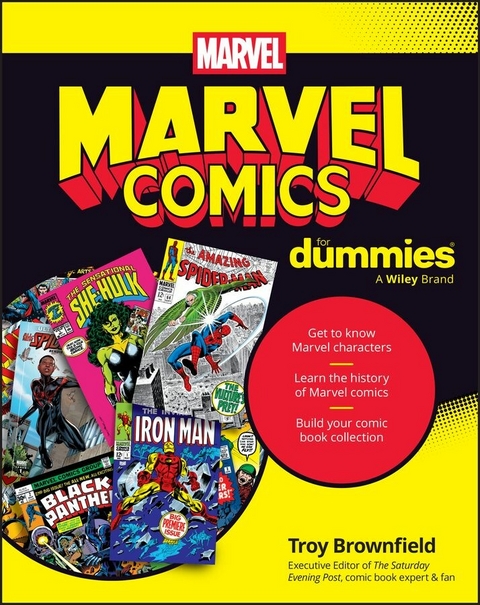
Explore the iconic super heroes and storylines from Marvel Comics
You may be familiar with heroic characters from Marvel Comics like Black Panther, Iron Man, and Wolverine, or villains like Loki and Thanos. But how much do you know about Squirrel Girl, Cyclops, or the Leader? With over 85 years of comics published since their founding, the Marvel Comics archive is a vast universe of iconic stories and legendary characters. Marvel Comics For Dummies is your shortcut to navigating this immense collection of heroes and their adventures. Learn the background of key characters, explore essential storylines, and discover the interconnectedness of the Marvel universe. Created in collaboration with Marvel Comics, this full-color guide contains striking comic book artwork along with interesting insights that serve as an exciting map to the Marvel universe.
- Uncover Marvel's origin story
- Get to know iconic Marvel super heroes and villains
- Tour the Marvel Comics Multiverse
- Make sense of Marvel's many super-hero teams
- Explore definitive storylines that span the history of Marvel Comics
From curious newbie to long-time reader, Marvel Comics For Dummies brings the Marvel Multiverse to life.
Troy Brownfield is Executive Editor of the The Saturday Evening Post and kid's magazines Jack & Jill and Humpty Dumpty. He has written and created content for DC Comics, Comiccon.com, Fangoria Comics/Graphix, and comics for Zenescope Entertainment.
Explore the iconic super heroes and storylines from Marvel Comics You may be familiar with heroic characters from Marvel Comics like Black Panther, Iron Man, and Wolverine, or villains like Loki and Thanos. But how much do you know about Squirrel Girl, Cyclops, or the Leader? With over 85 years of comics published since their founding, the Marvel Comics archive is a vast universe of iconic stories and legendary characters. Marvel Comics For Dummies is your shortcut to navigating this immense collection of heroes and their adventures. Learn the background of key characters, explore essential storylines, and discover the interconnectedness of the Marvel universe. Created in collaboration with Marvel Comics, this full-color guide contains striking comic book artwork along with interesting insights that serve as an exciting map to the Marvel universe. Uncover Marvel s origin story Get to know iconic Marvel super heroes and villains Tour the Marvel Comics Multiverse Make sense of Marvel s many super-hero teams Explore definitive storylines that span the history of Marvel Comics From curious newbie to long-time reader, Marvel Comics For Dummies brings the Marvel Multiverse to life.
Chapter 1
Getting to Know Marvel Comics
IN THIS CHAPTER
Recognizing what sets Marvel Comics apart
Breaking down the variety of character types
Previewing the legendary sagas
Existing in today’s modern media landscape without hearing or knowing something about Marvel Comics is pretty much impossible. Whether you’ve heard of them through movies or online or from literally thousands of people wearing Marvel T-shirts, you know that Marvel Comics is a major presence in the world. What you probably don’t know is how long Marvel has been around, how vast its universe is, and how many heroes and villains have roamed its pages. If you’re already a little acquainted with Marvel, that’s great! You may run into some familiar faces while you pick up some new things. But if you’re new here, I sort of envy you because you’re about to embark an amazing journey loaded with strange alien worlds, mythic landscapes, diabolical villains, and a colorful army of heroes ready to save the day.
What’s Unique About Marvel Comics
Comic books have been one of America’s favorite art forms for decades. They’re a marriage of art and dialogue assembled by talented creators to tell all kinds of stories. Since the beginning, readers have had as many kinds of comics available as they have types of prose literature. You can find humor, horror, action, mystery, and more. One of the most enduringly popular branches of comic book storytelling has been the super-hero story. Masked individuals with exceptional powers and abilities have been a major part of comics’ appeal since the 1930s. And one of the most popular makers of those kinds of comics has long been Marvel Comics.
A shared universe
The first thing to understand about Marvel Comics in particular is that they take place in the Marvel Universe. It’s an ongoing story that started, appropriately enough, in Marvel Comics #1, shown in Figure 1-1. Released on August 31, 1939, when the company was still called Timely Comics, that issue set the stage for everything that follows. It introduced two major heroes: the original Human Torch (in a story by writer/artist Carl Burgos) and Sub-Mariner (by writer/artist Bill Everett). That their adventures took place in the same shared universe soon became clear.
Cover art by Frank Paul.
FIGURE 1-1: It all starts here: the cover to Marvel Comics #1.
A shared universe means that the characters all live in the same fictional world. Events that affect one character’s city affect other characters who live in that city, too. The shared universe also allows characters to meet up, team up, and even do battle against each other. Early on, Human Torch and Namor the Sub-Mariner found themselves at odds and had an epic battle in New York City, resulting in a kind of story now known as a crossover (see Figure 1-2). In the comics world, that’s what you call a meeting between two characters who have their own ongoing stories. Marvel was building a whole universe around its interconnected characters.
But perhaps even more important is that — despite the fact that Marvel was telling stories about people from under the sea and heroic androids — it was telling stories that were set in the real world. Yes, heroes and villains may visit other planets or mythical locations like Atlantis, but New York City was New York City. In other comics, the creators frequently created fictional settings and hometowns for their characters. Not Marvel. The Big Apple was the hub around which the universe eventually turned. Real locations, real city streets, and even real people were easily identifiable in the stories. That attention to detail created the sense that the Marvel Universe was really “the world outside your window,” meaning that you could almost be part of the stories, too.
That real world setting became one of the two biggest things that made Marvel Comics unique in the great tapestry of the comics world. I cover the second in the following section.
Amazing, relatable heroes
Alongside the shared universe (see the preceding section), the other half of Marvel’s unique magic came in the form of the heroes themselves. Whether they come from the realms of Norse myth or are created by amazingly advanced science, every Marvel hero shares a quality with all human beings: They have flaws. In the old myths and legends from cultures around the world, and in very early mass entertainment, heroes were often presented as flawless paragons of virtue. They always did the right thing and made the right choice, and very little seemed to get in the way of that rightness. Their perfection may have made those characters seem larger than life and extremely heroic, but it didn’t make them seem real.
Story and Art by Bill Everett.
FIGURE 1-2: When titans clash: Human Torch and Namor first meet in Marvel Mystery Comics #8.
Marvel Heroes always have relatable issues that make readers sympathetic while allowing them to see themselves in the characters.
- Captain America has always strived to uphold the ideals of the United States, but occasionally he finds himself at odds with people who don’t share his vision or, worse, people who try to corrupt the system from within. So Cap often finds himself struggling to maintain his idealism in a cynical world.
- The Hulk’s alter ego, Bruce Banner, experienced a childhood full of trauma that left him with a boiling rage beneath an intellectual (occasionally even meek) personality. But after the accident that turned him into the Hulk, all Bruce’s repressed anger exploded into his green-skinned form, leading him into an ongoing struggle to balance his emotions and maintain control.
- The mutant members of the X-Men have found themselves feared and hated by the people they try to protect just because they were born different, a situation that’s strikingly familiar to people from marginalized backgrounds around the world.
That identification between the heroes and the readers — that relatability — is the secret ingredient that has been the engine of Marvel Comics all along. It’s not just the real world setting. It’s the real world problems that make the Marvel Universe unique, and it’s what continued to drive the bond between the fans and the characters for almost a century.
Spider-Man: Marvel’s most relatable hero
Perhaps no Marvel Comics hero has ever been more like the readers than Peter Parker, the Amazing Spider-Man (see Figure 1-3), created by Stan Lee and Steve Ditko. After losing his parents at a young age and going to live with his Aunt May and Uncle Ben, Peter struggled with a number of things that the readership could easily understand. His family never had very much money, which created social problems at school. Apart from that, Peter was also brilliant — a budding genius — making him a target for bullies like his high school nemesis (but later friend) Flash Thompson. Even though Peter grew up a good kid with loving surrogate parents, high school life was a struggle.
However, being bitten by that radioactive spider created an entirely new dimension to Peter’s problems. He confronted a jarring life lesson when Uncle Ben died as the indirect result of Peter’s refusal to stop a criminal. That tragedy drove home an earlier lesson that Uncle Ben had tried to teach him: that great responsibility must accompany great power. Trying to live his life by that creed, Peter Parker used his abilities as Spider-Man to protect his city and, quite often, the world.
That moment of realization didn’t make anything easier for Peter. Far from it. The perpetual juggling of school, work, financial struggles, friendships, and romantic relationships was hard enough; then he had to balance that with all the extra complications that came from his role as Spider-Man. Peter also knew that his very existence as a hero could put the lives of his friends and loved ones in danger, a frequent issue he couldn’t always avoid.
The readers saw themselves in Peter from all kinds of angles. Who can’t identify with money problems? Who hasn’t felt alone in a room full of people or felt isolation because something about them was different from the others? No one’s family or love life ever sailed completely smoothly. And although the readers probably didn’t understand what fighting Doctor Octopus in Midtown Manhattan would be like, they got that feeling you get in the pit of your stomach when you’re late for work or mess up a date.
For more on Spider-Man's origins, check out Chapter 4.
Cover Art by Jack Kirby and Steve Ditko.
FIGURE 1-3: Introducing the Amazing Spider-Man!
A Universe of Iconic Characters
The Marvel Universe is populated by … billions of regular people. But in and among the everyday citizens, you find an incredible array of heroes, antiheroes (or, people who do heroic things by questionable means), and villains. Some of them have their origins in advanced science, while others draw their special abilities from magic or the far reaches of space. Whether they’re champions or criminals, these iconic characters exist right...
| Erscheint lt. Verlag | 22.1.2025 |
|---|---|
| Sprache | englisch |
| Themenwelt | Literatur |
| Kunst / Musik / Theater ► Allgemeines / Lexika | |
| Schlagworte | Ant Man • Black Panther • Black Widow • blade cable • Captain America • Captain Marvel • COSMO • Cyclops • Daredevil • Days of Future Past • Deadpool • doctor doom • Doctor Octopus • Doctor Strange • Dogpool • Elektra • Galactus • Ghost Rider • Green Goblin • Gwen Stacy • Hawkeye • Hela • Herbie • Hulk • Invaders • Iron Fist • Ironheart • Iron Man • Kang the Conqueror • Killmonger • Kingpin • Lockheed • Lockjaw • Loki • Luke Cage • Magneto • Marvel Cinematic Universe • Marvel Comics • MCU • Mephisto • Miles Morales • mister sinister • MODOK • Monica Rambeau • Moon Knight • Morbius • Ms. Marvel • Multiverse • Namor • Punisher • Red Skull • redwing • ronan • Sam Wilson • Sandman • Sauron • Scarlet Witch • Secret Wars • Shang Chi • she hulk • Shield • S.H.I.E.L.D. • Silver Surfer • Spider Man • SpiderVerse • Stan Lee • Steve Rogers • Stingray • Storm • super heroes • Thanos • The Avengers • the brood • The Defenders • the eternals • The Fantastic Four • the guardians of the galaxy • the sub mariner • Thor • Throg • Tony Stark • Ultron • Venom • Vision • vulture • war machine • Wasp • Wendigo • Werewolf by Night • Whiplash • Winter Soldier • Wolverine • X-Men |
| ISBN-10 | 1-394-29930-3 / 1394299303 |
| ISBN-13 | 978-1-394-29930-0 / 9781394299300 |
| Informationen gemäß Produktsicherheitsverordnung (GPSR) | |
| Haben Sie eine Frage zum Produkt? |
 EPUB (Adobe DRM)
Kopierschutz: Adobe-DRM
Adobe-DRM ist ein Kopierschutz, der das eBook vor Mißbrauch schützen soll. Dabei wird das eBook bereits beim Download auf Ihre persönliche Adobe-ID autorisiert. Lesen können Sie das eBook dann nur auf den Geräten, welche ebenfalls auf Ihre Adobe-ID registriert sind.
Details zum Adobe-DRM
Dateiformat: EPUB (Electronic Publication)
EPUB ist ein offener Standard für eBooks und eignet sich besonders zur Darstellung von Belletristik und Sachbüchern. Der Fließtext wird dynamisch an die Display- und Schriftgröße angepasst. Auch für mobile Lesegeräte ist EPUB daher gut geeignet.
Systemvoraussetzungen:
PC/Mac: Mit einem PC oder Mac können Sie dieses eBook lesen. Sie benötigen eine
eReader: Dieses eBook kann mit (fast) allen eBook-Readern gelesen werden. Mit dem amazon-Kindle ist es aber nicht kompatibel.
Smartphone/Tablet: Egal ob Apple oder Android, dieses eBook können Sie lesen. Sie benötigen eine
Geräteliste und zusätzliche Hinweise
Buying eBooks from abroad
For tax law reasons we can sell eBooks just within Germany and Switzerland. Regrettably we cannot fulfill eBook-orders from other countries.
aus dem Bereich