


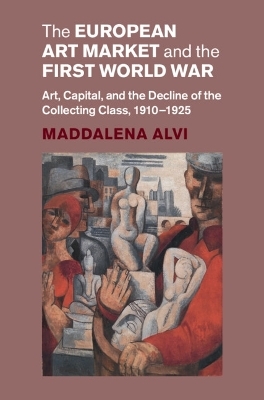
The European Art Market and the First World War
Art, Capital, and the Decline of the Collecting Class, 1910–1925
Seiten
2025
Cambridge University Press (Verlag)
978-1-009-60081-1 (ISBN)
Cambridge University Press (Verlag)
978-1-009-60081-1 (ISBN)
The outbreak of the First World War shattered the European art market. In its place, Maddalena Alvi argues, can be found the origins of a recognisably modern market of nationalised spheres driven by capitalist investment and speculation, yet open to wider social strata.
The outbreak of the First World War shattered the established European art market. Amidst fighting, looting, confiscations, expropriation fears and political and economic upheaval, an integrated marketplace shaped by upper-class patrons broke down entirely. In its place, Maddalena Alvi argues, can be found the origins of a recognisably modern market of nationalised spheres driven by capitalist investment and speculation, yet open to wider social strata. Delving into auction records, memoirs, newspaper articles, financial and legal documents in six languages, Alvi explores these cultural and socio-economic developments across the British, French, and German markets, as well as trade spheres such as Russia and Scandinavia. 1914 marked the end of the European art market and cemented the connection between art and finance.
The outbreak of the First World War shattered the established European art market. Amidst fighting, looting, confiscations, expropriation fears and political and economic upheaval, an integrated marketplace shaped by upper-class patrons broke down entirely. In its place, Maddalena Alvi argues, can be found the origins of a recognisably modern market of nationalised spheres driven by capitalist investment and speculation, yet open to wider social strata. Delving into auction records, memoirs, newspaper articles, financial and legal documents in six languages, Alvi explores these cultural and socio-economic developments across the British, French, and German markets, as well as trade spheres such as Russia and Scandinavia. 1914 marked the end of the European art market and cemented the connection between art and finance.
Maddalena Alvi completed her Ph.D. in history at the University of Cambridge and has worked as a lecturer in Modern European History at the University of Manchester.
Introduction; 1. The European market before 1914; 2. The great conflagration (1914–1918); 3. 'Wartime cultural changes' (1914–1918); 4. Post-war markets (1918–1925); 5. 'The challenges of new markets'; 6. Cementing nationalisation (1918–1925); Conclusion: the end of the European art market.
| Erscheinungsdatum | 10.04.2025 |
|---|---|
| Reihe/Serie | Studies in the Social and Cultural History of Modern Warfare |
| Zusatzinfo | Worked examples or Exercises; 27 Halftones, black and white |
| Verlagsort | Cambridge |
| Sprache | englisch |
| Maße | 159 x 235 mm |
| Gewicht | 560 g |
| Themenwelt | Kunst / Musik / Theater ► Kunstgeschichte / Kunststile |
| Geschichte ► Allgemeine Geschichte ► Neuzeit (bis 1918) | |
| Geisteswissenschaften ► Geschichte ► Regional- / Ländergeschichte | |
| ISBN-10 | 1-009-60081-8 / 1009600818 |
| ISBN-13 | 978-1-009-60081-1 / 9781009600811 |
| Zustand | Neuware |
| Informationen gemäß Produktsicherheitsverordnung (GPSR) | |
| Haben Sie eine Frage zum Produkt? |
Mehr entdecken
aus dem Bereich

aus dem Bereich
Geschichte einer wilden Handlung
Buch | Hardcover (2024)
C.H.Beck (Verlag)
CHF 47,60


