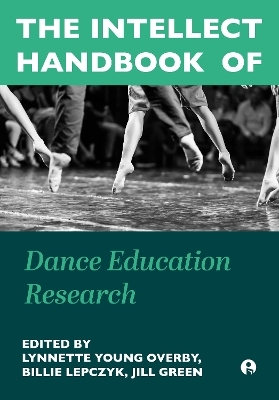
The Intellect Handbook of Dance Education Research
Intellect Books (Verlag)
978-1-83595-134-7 (ISBN)
The editors recognized the need for a book of this type – one that would not only provide examples of a variety of dance education research projects, but also present a broad look at methodologies. In addition, the book would not only focus on Dance Education research in the U.S, but more broadly with examples of dance research from several different countries. The curated book includes the voices of both seasoned professionals and newer scholars in the field, with examples of dance research from a number of different countries. The contributions represent several countries including Korea, South Africa, United States of America, Jamaica, India, United Kingdom, Brazil, and Slovenia, underscore the global relevance and significance of research in dance education.
This book is divided into 5 parts. The first part focuses on dance education research and methodologies and is divided into three sections. With an introduction by Jill Green, the chapters that follow provide an overview of research types including the more traditional, qualitative, quantitative and mixed, and other methods such as portraiture and a/r/tography.
Part II, introduced by Lynnette Young Overby, includes examples of dance education research that incorporate qualitative, quantitative, and/or mixed methods. Three sections covering dance education research applications in the areas of history and culture, dance teaching and choreography, and community based research follow.
Part III of the Handbook of Dance Education Research provides insight into dance education that takes place in several countries. This part is introduced by Peter Cook, Associate Deputy Chancellor, Southern Cross University, Australia. The collection of chapters within this part of the Handbook of Dance Education Research provides snapshots of research practices from contrasting international areas, and with a variety of approaches and paradigms.
The final Part IV includes chapters focused on Social Justice dance education practice and research. This part is introduced by Alfdaniel Mivule Basibye Mabingo, Makerere University, Uganda. These chapters push the boundaries of dance education research to promote meaning and social change. They provide substantive examples of the impact dance education research can have in response to social and cultural issues.
This book will be a key resource for university students, professors, practitioners and policy makers in organizations and in school systems. It will inspire future dance education researchers to conduct research that is collaborative, impactful, inclusive and diverse– research that will solidify the place of dance as an integral part of each person’s education.
Lynnette Young Overby, Ph.D. sits on the National Council for the Humanities and was a Professor of Theatre and Dance at the University of Delaware. She currently serves as a Research Associate with the Arnhold Institute for Dance Education, Research, Policy & Leadership, Teachers College, Columbia University. Dr. Billie Lepczyk , Professor of Dance and member of the Academy of Teaching Excellence at Virginia Tech, is a Teacher College Fellow of Columbia University and holds Dance Notation Bureau Certifications as Professional Notator, Movement Analyst and Labanotation Teacher. Her research and publications concern movement analysis and dance style and her forthcoming book outlines the creative dance curriculum she developed where floorplans serve as a composition tool in dance-making. Jill Green, Ph.D., taught dance and somatics for over forty years. She served the School of Dance at UNCG as professor, researcher, and Director of Graduate Studies, and Interim Director, and received a number of teaching and researcher awards.
List of Figures
List of Tables
Foreword – Susan Stinson
Acknowledgments
Introduction – Lynnette Young Overby, Billie Lepczyk and Jill Green
PART I DANCE EDUCATION RESEARCH, METHODOLOGIES AND THEORIES
Part I: Introduction – Jill Green
1. Qualitative Research as Creative and Critical Bricolage – Matthew Henley
2. Qualitative Research Methods in Interdisciplinary Arts Projects – Ali Duffy
3. The Privilege of Portraiture Methodology – Susan Pope
4. A/r/tography as Research Methodology: Explorations and Impact on Understanding Choreographic Practice – Peter J. Cook
5. Dance Education Research with Oral History: Practice and Potential – Caroline Sutton Clark
6. Quantitative Dance Education Research: Issues, Details and Procedures to Consider – Sandra Cerny Minton
7. Quantitative Research with a Focus on Dance Science – M. Virginia Wilmerding and Donna H. Krasnow
8. When Qualitative Narratives and Quantitative Numbers Work Together: Making Sense of Mixed Methods Design in Dance Education Research – Jennifer McNamara and Doug Risner
9. Methods for Researching Group Activity in Dance and Dance Education – Miriam Giguere
10. Tap Dance Research: An Interdisciplinary Approach to Mixed Methods Research with Collaboration in the Areas of Dance, Early Childhood Development, Kinesiology, Family Studies and Nutrition – Julie L. Pentz, Katie M. Heinrich and Blake Cremin
PART II DANCE EDUCATION RESEARCH EXEMPLARS
Part II: Introduction – Lynnette Young Overby
11. Dance Education Literature and Research Descriptive Index: A Body of Knowledge in and about Dance Education – Rima Faber
12. Moving between Competitive and College Dance: Students’ Experiences Bridging the Gaps – Karen Schupp
13. Shaped by the American Pageantry Movement in Forceful and Forgotten Ways: Dance Education, History and Culture, 1911–24 – Naima Prevots
14. Why Focus on Children and Dance? – Judith Lynne Hanna
15. Research Your Pedagogy Using Two Methods – Teresa Heiland and Kaitlyn Whitaker
16. Pathways to Pedagogical Diversity: Dance and Disability in Education – Sarah Whatley
17. Assessment as a Pedagogical Tool and Research Method for Programmatic Evaluation – Dale Schmid
18. Unraveling Embodied Terrains: Scrutinizing Choreographic Process – Nadra Assaf and Heather Harrington
19. Bubble Dance: Visualizing Microscopic Acoustic Phenomena – Billie Lepczyk
20. Youth Participatory Action Research: Generating Knowledge Together for Social Change – Rachel Swenson
21. Developing Dance Students as Active Citizens Through Civic and Community Engagement – Joy Guarino and Enya-Kalia Jordan
22. Building a Dance Community in Lebanon: An Introspection on the Journey to the International Dance Day Festival in Lebanon (IDDFL) – Nadra Assaf and Rain Ross
23. Planning Relevant Dance Interventions Through Logic Modeling – Lucie Beaudry and Sylvie Fortin
PART III INTERNATIONAL DANCE EDUCATION RESEARCH
Part III: Introduction – Peter J. Cook
24. The Invisible Dance Teacher: Frameworks for Precarity of the K12 Dance Teacher in India – Aadya Kaktikar
25. Analysis of Research Trends in Dance Education in Korea: Focusing on Dance Research Journal of Korea – Young Moon
26. The Importance of Dance Integration for the Educational Process in Kindergartens, Primary Schools and Secondary Schools in Slovenia – Vesna Geršak
27. Dancing Videoletters Between a Mehin (Indigenous Krahô) and a Supposed Cupē (Nonindigenous): An Expanded Notion of Embodiment – Alba Pedreira Vieira and Francisco Hyjnõ Krahô
28. A Snapshot of Dance Education Research in South Africa – Gerard M. Samuel
29. Dance AND …: Dance Education Research in the United States – Susan R. Koff
30. Addressing “Value” Concerns with Advocacy Research: Dance Education in the United Kingdom – Kathryn Stamp
31. Dancing to a Different Beat: The Distinctive Evolution of Dance Education Research in Jamaica and Its Resonance Throughout the Caribbean – Nicholeen DeGrasse-Johnson and Christopher A. Walker
PART IV DANCE EDUCATION SOCIAL JUSTICE RESEARCH AND PRACTICE
Part IV: Introduction – Alfdaniels Mabingo
32. A Qualitative Methodology for Social Justice in Dance Education and Somatic Research – Jill Green
33. Plática, Testimonio y Convivencia: Centering Chicana/Latina Feminist Pedagogies and Research Methodologies in Dance Education – Kiri Avelar and Franchesca Marisol Cabrera
34. Using Hip Hop Pedagogy to Create Equitable Dance Spaces – Ariyan Johnson
35. Beyond Consumption: The Power of Dance to Transform – Elana Denise Anderson
36. Disrupting and Reimagining the Archives: Interdisciplinary and Chicana/Latina Feminist Interventions as Decolonial Praxis – Kiri Avelar and Michaela Summers
Final Reflections and Next Steps – Lynnette Young Overby
Appendix: Dance Education Resources – Emily Uhler and Lynnette Young Overby
Contributor Biographies
Index
| Erscheinungsdatum | 27.08.2025 |
|---|---|
| Zusatzinfo | 22 Tables, black and white; 33 Halftones, black and white |
| Sprache | englisch |
| Maße | 170 x 244 mm |
| Gewicht | 1114 g |
| Themenwelt | Kunst / Musik / Theater |
| Sachbuch/Ratgeber ► Sport ► Tanzen / Tanzsport | |
| ISBN-10 | 1-83595-134-1 / 1835951341 |
| ISBN-13 | 978-1-83595-134-7 / 9781835951347 |
| Zustand | Neuware |
| Informationen gemäß Produktsicherheitsverordnung (GPSR) | |
| Haben Sie eine Frage zum Produkt? |
aus dem Bereich