


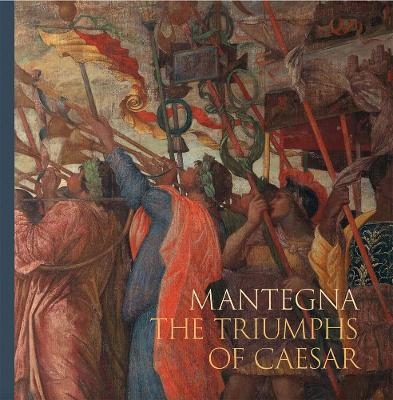
Mantegna: The Triumphs of Caesar
Seiten
2025
National Gallery Company Ltd (Verlag)
978-1-85709-735-1 (ISBN)
National Gallery Company Ltd (Verlag)
978-1-85709-735-1 (ISBN)
An introduction to Mantegna’s monumental series of canvases that depict a magnificent procession in honour of Julius Caesar’s victories over Gaul.
Andrea Mantegna painted The Triumphs of Caesar between the mid-1480s and 1506. The series of nine canvases reconstructs the magnificent procession held in 46 bc celebrating the victories of the Roman general – and later dictator – Julius Caesar.
This introduction to the series begins by exploring Andrea Mantegna’s career and artistic production in Mantua between 1460 and 1506. During this period, his output included altarpieces and frescoes, as well as portraits and paintings of pagan and devotional subjects. Obsessive in his attention to detail and expert in illusionistic representations of space, Mantegna transformed Mantua into a ‘modern’ avant-garde centre whose influence spread all over Italy and beyond.
A second chapter focuses specifically on the Triumphs. Mantegna took on this highly ambitious project when he was working as a court painter for the ruling Gonzaga family in Mantua. He drew on ancient and contemporary writings for this powerful and sustained evocation of the classical world, incorporating imagery from Roman antiquities.
Published by National Gallery Global/Distributed by Yale University Press
Andrea Mantegna painted The Triumphs of Caesar between the mid-1480s and 1506. The series of nine canvases reconstructs the magnificent procession held in 46 bc celebrating the victories of the Roman general – and later dictator – Julius Caesar.
This introduction to the series begins by exploring Andrea Mantegna’s career and artistic production in Mantua between 1460 and 1506. During this period, his output included altarpieces and frescoes, as well as portraits and paintings of pagan and devotional subjects. Obsessive in his attention to detail and expert in illusionistic representations of space, Mantegna transformed Mantua into a ‘modern’ avant-garde centre whose influence spread all over Italy and beyond.
A second chapter focuses specifically on the Triumphs. Mantegna took on this highly ambitious project when he was working as a court painter for the ruling Gonzaga family in Mantua. He drew on ancient and contemporary writings for this powerful and sustained evocation of the classical world, incorporating imagery from Roman antiquities.
Published by National Gallery Global/Distributed by Yale University Press
Caroline Elam is an art historian and former editor of the Burlington Magazine. Guido Rebecchini is Professor of Renaissance and Early Modern Art at the Courtauld Institute of Art, London.
| Erscheinungsdatum | 28.03.2025 |
|---|---|
| Zusatzinfo | 40 Colour llust |
| Verlagsort | London |
| Sprache | englisch |
| Maße | 218 x 229 mm |
| Themenwelt | Kunst / Musik / Theater ► Kunstgeschichte / Kunststile |
| Kunst / Musik / Theater ► Malerei / Plastik | |
| ISBN-10 | 1-85709-735-1 / 1857097351 |
| ISBN-13 | 978-1-85709-735-1 / 9781857097351 |
| Zustand | Neuware |
| Informationen gemäß Produktsicherheitsverordnung (GPSR) | |
| Haben Sie eine Frage zum Produkt? |
Mehr entdecken
aus dem Bereich



aus dem Bereich
kleine Kulturgeschichte einer brillanten Allianz
Buch | Softcover (2025)
Iudicium (Verlag)
CHF 33,90


