


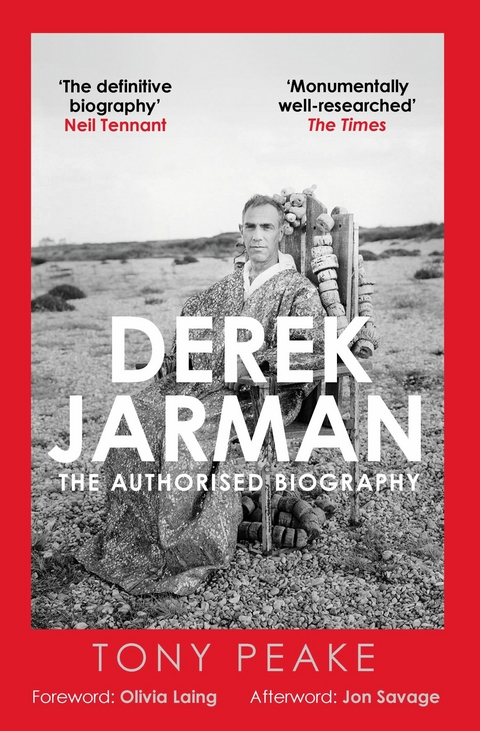
Derek Jarman: The Authorised Biography (eBook)
913 Seiten
Allison & Busby (Verlag)
978-0-7490-3295-1 (ISBN)
Tony Peake is a novelist, short story writer, biographer and was a celebrated literary agent. He became friends with Derek Jarman, during the last seven years of Jarman's life. He currently spends most of his time, when not travelling, in London and Essex, where he lives with his civil partner and enjoys being grandfather to his five grandchildren. Tony has written three novels. He is a patron of the Jarman Award which supports the most innovative UK-based artists working with moving image.
Tony Peake enjoyed unprecedented access to the visionary artist's archives in order to bring the extraordinary life of Derek Jarman to the page. This authorised and unique biography covers Jarman's story from the bleakness of post-war Britain and his RAF childhood, to student life at The Slade and his work as a designer, painter and filmmaker. It tells how energetic home filmmaking with dazzling friends led to distinctive feature films including Sebastiane, The Tempest, and Caravaggio. There were collaborations with the likes of Sir John Gielgud and Tilda Swinton and Jarman was also at the forefront of popular culture, producing distinctive music videos for Pet Shop Boys and The Smiths. Alongside his art and a significant body of writing, Jarman created a singular garden in the shingle surrounding Prospect Cottage at Dungeness in Kent, which has become a site of memorial, celebration and pilgrimage. He became known as an impassioned and provocative spokesperson not only for gay men, but for anyone oppressed by bigotry. Derek Jarman died of AIDS-related causes in February 1994 and Peake describes his inimitable courage and grace in the face of painful death, and the legacies Jarman left behind. With new contributions from Olivia Laing and Jon Savage.
Tony Peake is a novelist, short story writer, biographer and was a celebrated literary agent. He became friends with Derek Jarman, during the last seven years of Jarman's life. He currently spends most of his time, when not travelling, in London and Essex, where he lives with his civil partner and enjoys being grandfather to his five grandchildren. Tony has written three novels. He is a patron of the Jarman Award which supports the most innovative UK-based artists working with moving image.
As I write this, some thirty years have elapsed since Derek Jarman died, while over twenty-five will separate the moment when my biography first appeared and this re-issue. Such a distance allows of course for new perspectives; the chance to comment afresh on what I originally wrote. But then I ask myself: where would I stop? And anyway, to my way of thinking, new perspectives are best delineated by new eyes.
I’ve therefore decided to leave what’s written (apart from some minor changes to the end matter) exactly as is. And so we begin, now as then, with:
The picture on the front page of the Independent was of an unequivocally bespectacled man photographed against a hazy bank of flowers in Monet’s garden at Giverny. Wearing a cap, scarf and rumpled tweed jacket, he had a book clasped tightly in his left hand, a walking stick in the other, and was confronting the camera with a steady gaze subtly suggestive of a smile.
The caption read: ‘Gay champion dies on eve of new age.’ It might have added a number of other epithets: painter, designer, film-maker, writer and gardener. The ‘new age’ (prematurely announced) was a reference to the parliamentary vote being taken that evening, 21st February 1994, to give homosexuals parity with heterosexuals by lowering the age of consent for homosexual sex to sixteen.
Later that night, as Parliament settled on a compromise age of eighteen, disappointed protesters on the pavement outside fell momentarily silent in the dead man’s honour. The doorstep of Phoenix House, the block of flats in Charing Cross Road where Derek Jarman had latterly lived when in London, was adorned with candles, as was the exterior of the nearby Waterstones bookshop, where copies of Chroma, Jarman’s most recent book, graced the window. Shipley’s, a bookshop that took particular care to stock everything he had ever written, created a small shrine to his memory. So did Maison Bertaux, the coffee shop in Greek Street where he had been a devoted regular, and Presto in Old Compton Street, where he often ate. Soho was saluting one of its denizens – though, as coverage in the national papers indicated, Jarman’s fame stretched far beyond the nexus of streets where he had lived. By the time his other home, a simple cottage at the tip of Romney Marsh, came to witness his funeral, news of his death had circled the world.
It was 2nd March 1994, the most perfect of early spring days. The sky was clear, the viridescent fields dotted with tentative lambs and occasionally splashed with the red of budding willows. Those who arrived in good time went first to Dungeness where, on the windswept shingle between the looming ugliness of the nearby power station, the fishing huts and the slate-grey sea, Jarman had famously created a sculptural garden of great unusualness and beauty. Passing through the cottage’s dark wooden rooms, more redolent of a Russian dacha than of anything English, one arrived at the newly constructed ‘west wing’, a plain room overlooking the rear garden. The curtains were drawn, candles guttered, a small grapefruit tree filled the air with its scent. One of Jarman’s most treasured possessions – a plaster cast of the head of Mausolus, the ancient king whose tomb gave the world the word ‘mausoleum’ – locked unseeing eyes with the room’s central occupant. The plain oak coffin was open. Jarman was dressed in a robe of glittering gold. The cap on his head proclaimed him a ‘controversialist’. People came and stood in silence over the coffin. They hugged and spoke quietly with Keith Collins, Jarman’s companion, and with Howard Sooley, the photographer friend who had faithfully recorded the last years of Jarman’s life. Earlier that day, Collins had placed a number of carefully chosen effects in the coffin. The designer Christopher Hobbs, one of Jarman’s oldest friends, now added a small brass wreath similar to the one he had last fashioned as a prop for Jarman’s filmic account of the painter Caravaggio. The actress Jill Balcon, who had appeared in two of Jarman’s later films, Edward II and Wittgenstein, supplied a second wreath, of laurel. As the mourners left this temporary mausoleum, they encountered another line of people in the passage outside, queuing to use the bathroom, whose walls of blue stood testament to Jarman’s final film, an imageless journey into a blue void.
In the garden people wondered whether the silent, sightless, shrunken form in the coffin could possibly be Jarman. The face was familiar and, no doubt, the feet – absurdly huge and pale in comparison with the tenuous, umber features above them. Yet the talkative, excitable Jarman had never been that small, that Mandarin-like, that still. The only thing that felt right was that he should be the centre of so much attention.
Spilling from the garden into the road, groups of black-clad people came and went, talking in hushed tones. Many had ribbons on their lapels, some red to acknowledge support for AIDS-related charities, the majority blue, the colour of that final film: acknowledgement less of a disease than of a particular victim. Equally unusual were the flapping habits of the Sisters of Perpetual Indulgence, men who dressed as nuns in order to expiate homosexual guilt and promulgate universal joy. Three years previously, these same sisters had come to Prospect Cottage to canonise Jarman. Then, the occasion had been a party and some of the sisters had taken their new saint for a paddle in the sea. Today there was no paddling. It had not been easy for Jarman, an avowed atheist and relative newcomer to the area, to obtain permission to be buried locally. When permission was obtained, it was on condition that proprieties were observed. The Sisters of Perpetual Indulgence were on notice to behave with uncharacteristic decorum.
To those more familiar with the rebellious side of Jarman’s persona, the controversialist in him as opposed to the traditionalist, the service that followed was as puzzling as it was inappropriate. Conducted by Canon Peter Ford in the Church of St Nicholas in nearby New Romney, it consisted of prayers, readings and two hymns, both chosen by Jarman: George Herbert’s ‘Teach Me, My God and King’ and ‘Abide With Me’. Also at Jarman’s request there were four addresses. Nicholas Ward-Jackson, the producer of Caravaggio, remembered the almost feverish excitement with which Jarman had made the announcement that he was HIV positive. Norman Rosenthal of the Royal Academy recalled the dead man’s gift for friendship. Sarah Graham, herself a political activist, detailed his contribution to the cause of gay politics. The journalist and critic Nicholas de Jongh referred memorably to the ‘significant mischief’ inherent in Jarman’s attitude to life.
Since it was Lent, there were no flowers in the church, but Jarman’s sister Gaye had supplied a single bouquet of mimosa, a flower of particular importance to her brother. This lay on the now sealed coffin and, as the coffin was carried from the church after the closing hymn, its scent hung in the still air.
The congregation dispersed, some covertly complaining that they had not been invited to join the immediate family and select coterie of friends who made the short journey to Old Romney and the small churchyard of St Clement, where final prayers were said and the coffin was lowered into the ground in the shade of the ancient and venerable yew tree of which Jarman had been so fond.
Had he died seven years previously, on completion of Caravaggio, although almost as many people might have attended his funeral, and from as many walks of life, he would never have made the front page of a national newspaper. Then, if he was known at all, it was principally to dedicated filmgoers and cognoscenti of the artistic avant garde. In the interim, his diagnosis as HIV positive and his decision to be open about his disease, his ineluctable Englishness and the extraordinary grace and courage with which he faced death, all led to his achieving iconic status in the eyes not only of his most obvious constituency, gay men, but of almost anyone with a care for the human spirit.
The commemorations continued, one within days of the funeral. Glitterbug, a compilation of Jarman’s super-8 footage put together for BBC Two’s Arena, was hastily scheduled for broadcast on 5th March. Channel 4 responded with A Night with Derek, a repeat of a profile entitled You Know What I Mean, plus four of Jarman’s features. There were three exhibitions, the first in Portland at the Chesil Gallery and Portland Lighthouse, the second at Manchester’s Whitworth Gallery, the third at the Drew Gallery in Canterbury. A dramatisation of Jarman’s journal Modern Nature was performed at the Edinburgh Festival. Richard Salmon, Jarman’s art dealer, produced a limited edition of the text of Blue. There was a season of his films at the National Film Theatre. Making magnificent use of Howard Sooley’s photographs, Thames and Hudson published derek jarman’s garden. The steady trickle of visitors to Dungeness become a flow. Keith Collins began to joke darkly about establishing a company called Prospect Products.
As in life,...
| Erscheint lt. Verlag | 20.3.2025 |
|---|---|
| Co-Autor | Olivia Laing, Jon Savage |
| Verlagsort | London |
| Sprache | englisch |
| Themenwelt | Literatur ► Biografien / Erfahrungsberichte |
| Literatur ► Romane / Erzählungen | |
| Kunst / Musik / Theater | |
| Schlagworte | ART • Artist • Biography • Derek Jarman • film-maker • Garden • gardener • gay • LGBT • Tony Peake |
| ISBN-10 | 0-7490-3295-2 / 0749032952 |
| ISBN-13 | 978-0-7490-3295-1 / 9780749032951 |
| Informationen gemäß Produktsicherheitsverordnung (GPSR) | |
| Haben Sie eine Frage zum Produkt? |
 EPUB (Adobe DRM)
Kopierschutz: Adobe-DRM
Adobe-DRM ist ein Kopierschutz, der das eBook vor Mißbrauch schützen soll. Dabei wird das eBook bereits beim Download auf Ihre persönliche Adobe-ID autorisiert. Lesen können Sie das eBook dann nur auf den Geräten, welche ebenfalls auf Ihre Adobe-ID registriert sind.
Details zum Adobe-DRM
Dateiformat: EPUB (Electronic Publication)
EPUB ist ein offener Standard für eBooks und eignet sich besonders zur Darstellung von Belletristik und Sachbüchern. Der Fließtext wird dynamisch an die Display- und Schriftgröße angepasst. Auch für mobile Lesegeräte ist EPUB daher gut geeignet.
Systemvoraussetzungen:
PC/Mac: Mit einem PC oder Mac können Sie dieses eBook lesen. Sie benötigen eine
eReader: Dieses eBook kann mit (fast) allen eBook-Readern gelesen werden. Mit dem amazon-Kindle ist es aber nicht kompatibel.
Smartphone/Tablet: Egal ob Apple oder Android, dieses eBook können Sie lesen. Sie benötigen eine
Geräteliste und zusätzliche Hinweise
Buying eBooks from abroad
For tax law reasons we can sell eBooks just within Germany and Switzerland. Regrettably we cannot fulfill eBook-orders from other countries.
aus dem Bereich


