


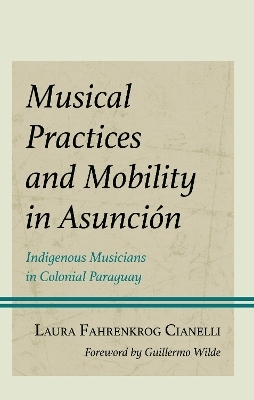
Musical Practices and Mobility in Asunción
Indigenous Musicians in Colonial Paraguay
Seiten
2025
Lexington Books (Verlag)
978-1-6669-5276-6 (ISBN)
Lexington Books (Verlag)
978-1-6669-5276-6 (ISBN)
This book focuses on the musical practices of Indigenous musicians in colonial Asunción (Paraguay). By transcending the city limits imposed by urban approaches, it enables a novel reading of musical practices in a city connected with its hinterland, revealing the different musical physiognomies of the empire in distant contexts.
The Indigenous musicians from the surrounding pueblos de indios took on a leading role in urban musical activity. Musical Practices and Mobility in Asunción: Indigenous Musicians in Colonial Paraguay sheds light on dynamics that go beyond the studies centered on the doing of Jesuits in missionary contexts and provides a more thorough comprehension of the urban musical models that were imposed and adapted. Indigenous musicians were transferred to the city from the Jesuit reductions and the pueblos under the care of secular and Franciscan priests for festivals and celebrations. Without them, and without the mobilities that placed them in both contexts, Laura Fahrenkrog Cianelli argues the urban institutional-musical model would not have been possible to maintain in that distant corner of the empire. By transcending the city limits imposed by urban approaches, this book enables a novel reading of musical practices in a city connected with its hinterland, revealing the different musical physiognomies of the empire in distant contexts.
The Indigenous musicians from the surrounding pueblos de indios took on a leading role in urban musical activity. Musical Practices and Mobility in Asunción: Indigenous Musicians in Colonial Paraguay sheds light on dynamics that go beyond the studies centered on the doing of Jesuits in missionary contexts and provides a more thorough comprehension of the urban musical models that were imposed and adapted. Indigenous musicians were transferred to the city from the Jesuit reductions and the pueblos under the care of secular and Franciscan priests for festivals and celebrations. Without them, and without the mobilities that placed them in both contexts, Laura Fahrenkrog Cianelli argues the urban institutional-musical model would not have been possible to maintain in that distant corner of the empire. By transcending the city limits imposed by urban approaches, this book enables a novel reading of musical practices in a city connected with its hinterland, revealing the different musical physiognomies of the empire in distant contexts.
Laura Fahrenkrog Cianelli is associate professor of History at the Universidad Adolfo Ibáñez (Chile).
Chapter 1. Asunción: Society and Musical Practices (16th and 17th Centuries)
Chapter 2. Music in Pueblos de Indios
Chapter 3. Institutions, Music, and Mobilities
Chapter 4. Mobilities and Musical Practices of Indios Cantores
Chapter 5. Indios cantores after the Expulsion of the Jesuits
Chapter 6. No Han Concurrido Mas Los Indios Que Acostumbraban de Tiempo Inmemorial
| Erscheinungsdatum | 28.02.2025 |
|---|---|
| Reihe/Serie | Music, Culture, and Identity in Latin America |
| Vorwort | Guillermo Wilde |
| Zusatzinfo | 12 BW Illustrations, 7 Tables |
| Sprache | englisch |
| Maße | 152 x 229 mm |
| Themenwelt | Kunst / Musik / Theater ► Musik |
| Geisteswissenschaften ► Geschichte ► Regional- / Ländergeschichte | |
| Sozialwissenschaften ► Ethnologie | |
| Sozialwissenschaften ► Soziologie | |
| ISBN-10 | 1-6669-5276-1 / 1666952761 |
| ISBN-13 | 978-1-6669-5276-6 / 9781666952766 |
| Zustand | Neuware |
| Informationen gemäß Produktsicherheitsverordnung (GPSR) | |
| Haben Sie eine Frage zum Produkt? |
Mehr entdecken
aus dem Bereich


aus dem Bereich
die Geschichte meiner Urgroßmutter
Buch | Hardcover (2025)
C.H.Beck (Verlag)
CHF 32,15
Träume und Macht : eine Biografie
Buch | Hardcover (2025)
C.H.Beck (Verlag)
CHF 61,60


