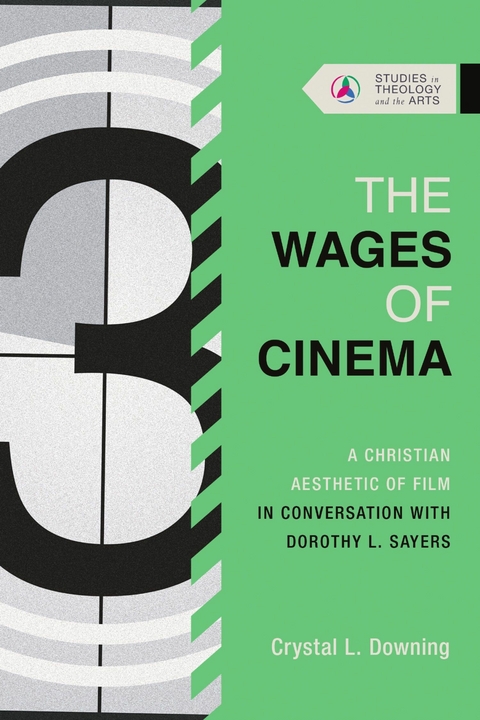
The Wages of Cinema (eBook)
256 Seiten
IVP Academic (Verlag)
978-1-5140-0881-2 (ISBN)
Crystal L. Downing (PhD, University of California, Santa Barbara), an award-winning author, has published five books, including Subversive: Christ, Culture, and the Shocking Dorothy L. Sayers, which received a Publishers Weekly starred review, and Salvation from Cinema: The Medium Is the Message.
Crystal L. Downing (PhD, University of California, Santa Barbara), an award-winning author, has published five books, including Subversive: Christ, Culture, and the Shocking Dorothy L. Sayers, which received a Publisher's Weekly starred review, and Salvation from Cinema: The Medium Is the Message.
1
The Religious Origins of Cinema
Christians who write about film often fail to consider its connection to the stage—an oversight especially problematic for those who talk about movies in terms of the stories they tell.1 After all, theater presented stories for viewing audiences millennia before moving images were a glint on the lenses of nineteenth-century cameras. Greek theater even preceded the gospel message, influencing it in multiple ways. This chapter therefore argues that a full appreciation for the relation between Christianity and film necessitates knowledge about the history of theater. Oxford-educated Dorothy L. Sayers, who not only read classical drama but also wrote scripts for both stage and screen, can help us see theater with new eyes.
THE SEEDS OF CINEMA
Without a doubt, the seeds of narrative cinema were incubated on theatrical stages.2 In the silent era, filmmakers often adapted stage plays, such as those starring Sarah Bernhardt (1844–1923), who reprised her famed theatrical roles for the screen. When “talkies” took off in 1927, studios recruited Broadway stage writers to compose dialogue. French filmmaker Marcel Pagnol went so far as to argue, in 1933, that “talking films” demonstrate “the art of recording, preserving, and diffusing theater.” Even into the 1960s, as James Monaco notes, “Much of the best British cinema . . . was closely connected with the vital theater of that period.” In addition to common words borrowed from theater—protagonist, prop, scenery—one of the most important terms in film scholarship comes from the French stage: mise-en-scène. Meaning “the fact of putting into the scene,” mise-en-scène originally referred to everything theater audiences saw on the stage in any one scene.3 In film it means everything cinema audiences see on the screen in any one shot.
We should not be too surprised, then, that significant figures in the history of cinema had direct ties to theater:
-
Louis Daguerre (1787–1851), one of the fathers of photography, was a theatrical set designer.
-
D. W. Griffith (1875–1948), sometimes called “the man who invented Hollywood,” started out as a stage actor and playwright.
-
Another founding father of Hollywood cinema, Cecil B. DeMille (1881–1959), began his career acting, directing, and writing for the stage, from which he borrowed lighting devices for his films.
-
Soviet filmmaker Sergei Eisenstein (1898–1948), originally a theatrical set designer, argued that cinema was an extension of theater.
-
In addition to directing what many regard as the finest films ever made—The Grand Illusion (1937) and The Rules of the Game (1939)—Jean Renoir (1894–1979) wrote and directed plays, and his film The Golden Coach (1953) “pays homage to Italian classical theater.”4
-
George Cukor (1899–1983), director of Hollywood classics such as Philadelphia Story (1940) and My Fair Lady (1964), started out as a stage manager and theater director.
-
As artistic director and vice president of MGM studios, Irving Thalberg (1899–1936) filmed staged performances of every Broadway play the studio purchased in order “to provide a blueprint of the pacing and diagramming of scenes, the timing of individual lines for laughter and dramatic impact.”5
-
Howard Koch (1901–1995), a playwright who received an Oscar for his contributions to Casablanca (1942), published an essay about the similarities between writing for the stage and writing for the screen.6
-
Sir Laurence Olivier (1907–1989), founding director of Britain’s National Theater, appeared in over fifty movies, several of which he directed.
-
Elia Kazan (1909–2003), Turkish-born director of film classics such as A Streetcar Named Desire (1951) and On the Waterfront (1954), was also considered “the preeminent stage director of his generation.”7
-
Orson Welles (1915–1985) cofounded the Mercury Theater, where he directed Broadway stage productions before directing and starring in one of the greatest films in history: Citizen Kane (1941).
-
Originally a playwright and theater director, Sweden’s greatest filmmaker, Ingmar Bergman (1918–2007), once commented, “I am much more a man of the theatre than a man of the film.”8
-
Rainer Werner Fassbinder (1945–1982), who helped energize new German cinema, was active in the theatrical scene as actor, director, and playwright.
We could add to the list Dorothy L. Sayers and her close friend Muriel St Clare Byrne, a specialist in Elizabethan drama, both of whom wrote for the stage as well as trying their hands at screenwriting. As famous film theorist André Bazin summarizes, “the relations between theater and cinema are much older and closer than is generally thought.”9
Even denouncers of theater and cinema have much in common. In his magisterial work Theo-drama, Hans Urs von Balthasar outlines the antitheater teachings of Christian theologians such as Tertullian (160–220 CE) and Augustine (354–430 CE), polemics that anticipate the antimovie attitudes of Christians in the twentieth century. When bishops at the Fourth Council of Carthage (399 CE) wanted to excommunicate anyone attending theater on a Sunday, they foreshadowed followers of Canon William Sheafe Chase, pastor of Brooklyn’s Christ Episcopal Church, who proclaimed in 1908 that attending cinema on Sunday was a “desecration.”10
This genealogical connection between stage and screen is essential to The Wages of Cinema because theater, having nurtured narrative cinema from its very start, was developed in response to the wages of sin. As Sayers succinctly puts it, “All drama is religious in origin,” initially watched not simply for “entertainment” but as “an act of communal worship.”11
THE RELIGIOUS ORIGINS OF DRAMA
While the Hebrews were sacrificing lambs on their altars to Yahweh, the Greeks were sacrificing goats on their altars to Dionysus, the god of wine and fertility. Both forms of sacrifice were about new life: the sacrifice of the Jewish lamb for reconciliation with God, the sacrifice of the Greek goat to guarantee the resurrection of crops in spring. Furthermore, like the Hebrews, who sang and danced in honor of Yahweh (Ex 15:20-21), the Greeks performed hymns called dithyrambs in honor of Dionysus.12
Theater began with the embellishment of these dithyrambs, as choruses of up to fifty males danced around the sacrificial goat while singing stories about the life of Dionysus. The event became known as “the goat song,” from which we get our word tragedy: tragos = male goat; ōdē = song, or “ode.” A tragedy, then, establishes that a sacrificial goat (or lamb) must shed its blood for human life to continue. This explains the plots of classical tragedies, in which powerful individuals, having defied the gods and/or human laws, must die so that harmony can be restored to society.
A key development in Greek theater occurred in 534 BCE, when a dithyramb singer named Thespis began to “answer” the rest of the chorus in the guise of a character from one of the Dionysian myths. Thespis thus created the first known actor, which explains why stage actors to this day are sometimes called thespians. Several decades later, Aeschylus (ca. 525–ca. 456 BCE) added a second “answerer” to a play, inventing costumes to distinguish the two.13 Sophocles (ca. 497–ca. 406 BCE) not only added a third answerer but also invented scenery—a word that comes from the Greek skēnē: the closed space at the back of the open-air Athenian stage. The most dramatic development, however, was initiated by Euripides (ca. 480–ca. 406 BCE), who separated the chorus from the action, making character portrayals seem more lifelike. The greater the realism, of course, the easier it was for audiences to see thespians as people acting out a story rather than as mere celebrants of religious rites.
FROM GREEK THEATER TO THE GREEK NEW TESTAMENT
The Greek language changed considerably in the four hundred–plus years between Euripides and the Gospel writers, just as the English language changed considerably in the four hundred–plus years between Chaucer (d. 1400) and Jane Austen (d. 1817). Nevertheless, in both instances numerous words from one culture helped shape messages to follow, if even with considerably different spelling and/or alphabet systems.
For example, during the height of classical theater (500–300 BCE), the Greek word for “answerer” was hypokritēs. Jesus would have been very aware of the hypokritai (plural) performing on stages in his own day. According to Carsten Peter Thiede, “There were theatres all over Galilee, Judaea, Samaria, and in Jerusalem. One of them, the theatre of Sepphoris in Galilee, was actually built while Jesus was living a mere four miles away in Nazareth.” Some scholars go so far as to suggest that Jesus, trained as a “builder,” may have even aided in its construction.14
Whether or not he ever saw a theatrical performance, Jesus clearly knew that hypokritai wore distinctive masks by which audiences could identify characters on stage. The Greek...
| Erscheint lt. Verlag | 27.5.2025 |
|---|---|
| Reihe/Serie | Studies in Theology and the Arts Series |
| Verlagsort | Lisle |
| Sprache | englisch |
| Themenwelt | Kunst / Musik / Theater |
| Religion / Theologie ► Christentum ► Kirchengeschichte | |
| Schlagworte | ART • Barbie • Beauty • Belief • Charlie Chaplin • Cinematography • craft • Creative • Detection Club • Doubt • Faith • Forgiveness • God • Hitchcock • Imagery • Making • Movie • Orthodoxy • Peter Pan • Reel • Religion • Screen • screenplay • Sin • Studio • Theater • Theology • Truth • Video • Visual |
| ISBN-10 | 1-5140-0881-5 / 1514008815 |
| ISBN-13 | 978-1-5140-0881-2 / 9781514008812 |
| Informationen gemäß Produktsicherheitsverordnung (GPSR) | |
| Haben Sie eine Frage zum Produkt? |
 EPUB (Wasserzeichen)
DRM: Digitales Wasserzeichen
Dieses eBook enthält ein digitales Wasserzeichen und ist damit für Sie personalisiert. Bei einer missbräuchlichen Weitergabe des eBooks an Dritte ist eine Rückverfolgung an die Quelle möglich.
Dateiformat: EPUB (Electronic Publication)
EPUB ist ein offener Standard für eBooks und eignet sich besonders zur Darstellung von Belletristik und Sachbüchern. Der Fließtext wird dynamisch an die Display- und Schriftgröße angepasst. Auch für mobile Lesegeräte ist EPUB daher gut geeignet.
Systemvoraussetzungen:
PC/Mac: Mit einem PC oder Mac können Sie dieses eBook lesen. Sie benötigen dafür die kostenlose Software Adobe Digital Editions.
eReader: Dieses eBook kann mit (fast) allen eBook-Readern gelesen werden. Mit dem amazon-Kindle ist es aber nicht kompatibel.
Smartphone/Tablet: Egal ob Apple oder Android, dieses eBook können Sie lesen. Sie benötigen dafür eine kostenlose App.
Geräteliste und zusätzliche Hinweise
Buying eBooks from abroad
For tax law reasons we can sell eBooks just within Germany and Switzerland. Regrettably we cannot fulfill eBook-orders from other countries.
aus dem Bereich