


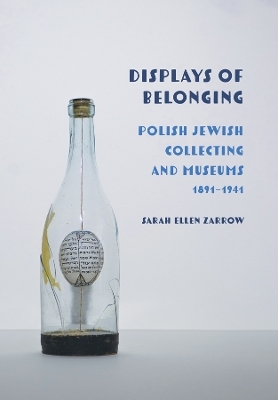
Displays of Belonging
Polish Jewish Collecting and Museums, 1891–1941
Seiten
2025
Cornell University Press (Verlag)
978-1-5017-8154-4 (ISBN)
Cornell University Press (Verlag)
978-1-5017-8154-4 (ISBN)
Offers a nuanced understanding of the multiplicity of ways in which Jews in Poland saw their present and dreamed of their future. It places Jewish ethnographic practice and art collection within a Polish context, and sheds light on ways in which ideas about belonging and national identity were negotiated in the space of museums.
Displays of Belonging illuminates the lives and work of Polish Jewish collectors and museologists, who sought to preserve the treasures of the Jewish past while demonstrating Jewish belonging on Polish soil. As Jews comfortable in the Polish language and within Polish artistic and academic society, they saw themselves as intermediaries between less-integrated Jews and the Polish cultural elite.
At the turn of the century, Jewish ethnographers and museum creators staked their claim to belonging to the civic nation though the display of Jewish folk art, fine art, and Judaica. After the First World War, the nearly three million Jews in the Second Polish Republic were suddenly challenged with finding a place for themselves in a state that increasingly defined itself as a creation of the ethnic Polish nation, to which Jews, by many accounts, did not belong.
By tracing emergent documentation and display practices in partitioned Poland and in the interwar Second Polish Republic, Sarah Ellen Zarrow offers a better understanding of how integrated Jews identified with Polish culture and history and with non-Jewish Poles, and how they conceived of, negotiated, and argued their collective place within Poland. This is not a case of assimilation, nor of acculturation, but rather of displaying a parallel culture that was at once similar and yet distinctive.
Displays of Belonging offers a nuanced understanding of the multiplicity of ways in which Jews in Poland saw their present and dreamed of their future. It places Jewish ethnographic practice and art collection within a Polish context, and sheds light on ways in which ideas about belonging and national identity were negotiated in the space of museums.
Displays of Belonging illuminates the lives and work of Polish Jewish collectors and museologists, who sought to preserve the treasures of the Jewish past while demonstrating Jewish belonging on Polish soil. As Jews comfortable in the Polish language and within Polish artistic and academic society, they saw themselves as intermediaries between less-integrated Jews and the Polish cultural elite.
At the turn of the century, Jewish ethnographers and museum creators staked their claim to belonging to the civic nation though the display of Jewish folk art, fine art, and Judaica. After the First World War, the nearly three million Jews in the Second Polish Republic were suddenly challenged with finding a place for themselves in a state that increasingly defined itself as a creation of the ethnic Polish nation, to which Jews, by many accounts, did not belong.
By tracing emergent documentation and display practices in partitioned Poland and in the interwar Second Polish Republic, Sarah Ellen Zarrow offers a better understanding of how integrated Jews identified with Polish culture and history and with non-Jewish Poles, and how they conceived of, negotiated, and argued their collective place within Poland. This is not a case of assimilation, nor of acculturation, but rather of displaying a parallel culture that was at once similar and yet distinctive.
Displays of Belonging offers a nuanced understanding of the multiplicity of ways in which Jews in Poland saw their present and dreamed of their future. It places Jewish ethnographic practice and art collection within a Polish context, and sheds light on ways in which ideas about belonging and national identity were negotiated in the space of museums.
Sarah Ellen Zarrow is Associate Professor of History and Endowed Professor in Jewish History at Western Washington University. She holds a doctorate in Hebrew & Judaic Studies and History from New York University.
Introduction: Jewish Collectors and the Political Imagination
1. Warsaw's Jews "Discover" the Provinces
2. Jewish Museums as Displays of Integration
3. The Jewish Museum as Polish and World Museum
4. Jewish Museums without Walls
5. Museums Open their Doors Wide
Conclusion: The Uses (and Abuses) of Jewish Collection and Display
| Erscheinungsdatum | 02.05.2025 |
|---|---|
| Zusatzinfo | 24 b&w halftones, 2 b&w line drawings, 1 map - 24 Halftones, black and white - 1 Maps - 2 Line drawings, black and white |
| Verlagsort | Ithaca |
| Sprache | englisch |
| Maße | 152 x 229 mm |
| Gewicht | 907 g |
| Themenwelt | Kunst / Musik / Theater |
| Geisteswissenschaften ► Geschichte ► Hilfswissenschaften | |
| Geisteswissenschaften ► Geschichte ► Regional- / Ländergeschichte | |
| Geschichte ► Teilgebiete der Geschichte ► Kulturgeschichte | |
| ISBN-10 | 1-5017-8154-5 / 1501781545 |
| ISBN-13 | 978-1-5017-8154-4 / 9781501781544 |
| Zustand | Neuware |
| Informationen gemäß Produktsicherheitsverordnung (GPSR) | |
| Haben Sie eine Frage zum Produkt? |
Mehr entdecken
aus dem Bereich
aus dem Bereich
Die Revolution des Gemeinen Mannes
Buch | Softcover (2024)
C.H.Beck (Verlag)
CHF 16,80
Eine Geschichte des Geschmacks
Buch | Hardcover (2025)
C.H.Beck (Verlag)
CHF 49,95
vom Mittelalter bis zur Gegenwart
Buch | Softcover (2024)
C.H.Beck (Verlag)
CHF 16,80


