


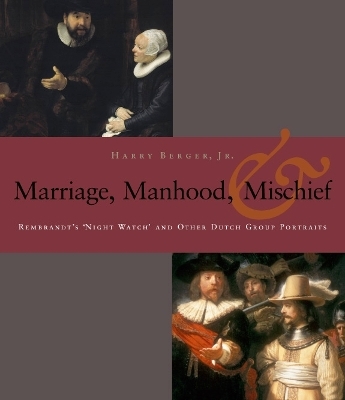
Manhood, Marriage, and Mischief
Rembrandt's 'Night Watch' and Other Dutch Group Portraits
Seiten
2006
Fordham University Press (Verlag)
978-0-8232-2556-9 (ISBN)
Fordham University Press (Verlag)
978-0-8232-2556-9 (ISBN)
A study of the theory and practice of seventeenth-century Dutch group portraits, this title offers an account of the genre's comic and ironic features, which it treats as comments on the social context of portrait sitters who are husbands and householders as well as members of civic and proto-military organizations.
A study of the theory and practice of seventeenth-century Dutch group portraits, Manhood, Marriage, and Mischief offers an account of the genre's comic and ironic features, which it treats as comments on the social context of portrait sitters who are husbands and householders as well as members of civic and proto-military organizations.
The introduction picks out anomalous touches with which Rembrandt problematizes standard group-portrait motifs in The Night Watch: a shooter who fires his musket into the company; two girls who appear to be moving through the company in the wrong direction; guardsmen who appear to be paying little or no attention to their leader's enthusiastic gesture of command.
Were the patrons and sitters aware of or even complicit in staging the anomalies? If not, did the painter get away with a subversive parody of militia portrait conventions at the sitters' expense? Parts One and Two respond to these questions at several levels: first, by analyzing the aesthetic structure of group portraiture as a genre; second, by reviewing the conflicting accounts modern scholars give of the civic guard company as an institution; third, by marking the effect on civic guardsmen of a mercantile economy that relied heavily on wives and mothers to keep the homefires burning. Two phenomena persistently recur in the portraits under discussion: competitive posing and performance anxiety.
Part Three studies these phenomena in portraits of married couples and families. Finally, Part Four examines them in The Night Watch in the light of the first three parts. The result is an interpretation that reads Rembrandt's painting both as a deliberate parody by the sitters and as the artist's covert parody of the sitters.
A study of the theory and practice of seventeenth-century Dutch group portraits, Manhood, Marriage, and Mischief offers an account of the genre's comic and ironic features, which it treats as comments on the social context of portrait sitters who are husbands and householders as well as members of civic and proto-military organizations.
The introduction picks out anomalous touches with which Rembrandt problematizes standard group-portrait motifs in The Night Watch: a shooter who fires his musket into the company; two girls who appear to be moving through the company in the wrong direction; guardsmen who appear to be paying little or no attention to their leader's enthusiastic gesture of command.
Were the patrons and sitters aware of or even complicit in staging the anomalies? If not, did the painter get away with a subversive parody of militia portrait conventions at the sitters' expense? Parts One and Two respond to these questions at several levels: first, by analyzing the aesthetic structure of group portraiture as a genre; second, by reviewing the conflicting accounts modern scholars give of the civic guard company as an institution; third, by marking the effect on civic guardsmen of a mercantile economy that relied heavily on wives and mothers to keep the homefires burning. Two phenomena persistently recur in the portraits under discussion: competitive posing and performance anxiety.
Part Three studies these phenomena in portraits of married couples and families. Finally, Part Four examines them in The Night Watch in the light of the first three parts. The result is an interpretation that reads Rembrandt's painting both as a deliberate parody by the sitters and as the artist's covert parody of the sitters.
Harry Berger, Jr., is Professor Emeritus of Literature and Art History at the University of California, Santa Cruz. His most recent books include Figures of a Changing World: Metaphor and the Emergence of Modern Culture and A Fury in the Words: Love and Embarrassment in Shakespeare's Venice (both Fordham).
| Zusatzinfo | 58 Black & White Illustrations42 Color Illustrations |
|---|---|
| Verlagsort | New York |
| Sprache | englisch |
| Maße | 203 x 229 mm |
| Themenwelt | Kunst / Musik / Theater ► Kunstgeschichte / Kunststile |
| Kunst / Musik / Theater ► Malerei / Plastik | |
| ISBN-10 | 0-8232-2556-9 / 0823225569 |
| ISBN-13 | 978-0-8232-2556-9 / 9780823225569 |
| Zustand | Neuware |
| Informationen gemäß Produktsicherheitsverordnung (GPSR) | |
| Haben Sie eine Frage zum Produkt? |
Mehr entdecken
aus dem Bereich

aus dem Bereich
kleine Kulturgeschichte einer brillanten Allianz
Buch | Softcover (2025)
Iudicium (Verlag)
CHF 33,90


