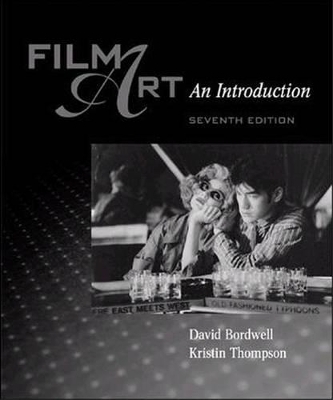
Film Art: An Introduction w/ Film Viewer's Guide and Tutorial CD-ROM
McGraw-Hill Professional
9780071118804 (ISBN)
- Titel ist leider vergriffen;
keine Neuauflage - Artikel merken
Film is an art form with a language and an aesthetic all its own. Since 1979, David Bordwell's and Kristin Thompson's Film Art has been the most respected introduction to the analysis of cinema. While continuing to provide the best introduction to the fundamentals of serious film study, the seventh edition has been extensively re-designed in full color greatly enhancing the text's visual appeal and overall accessibility to today's students. Throughout the text, all images presented are frame enlargements as opposed to production stills or advertising photos. Supported by a text-specific CD-ROM with video clips, an Instructor's Manual, and text-specific website, Film Art can also be packaged with the award-winning Film, Form, and Culture CD-ROM.
David Bordwell is Jacques Ledoux Professor Emeritus of Film Studies at the University of Wisconsin-Madison. He holds a master's degree and a doctorate in film from the University of Iowa. His books include The Films of Carl Theodor Dreyer (University of California Press, 1981), Narration in the Fiction Film (University of Wisconsin Press, 1985), Ozu and the Poetics of Cinema (Princeton University Press, 1988), Making Meaning: Inference and Rhetoric in the Interpretation of Cinema (Harvard University Press, 1989), The Cinema of Eisenstein (Harvard University Press, 1993), On the History of Film Style (Harvard University Press, 1997), Planet Hong Kong: Popular Cinema and the Art of Entertainment (Harvard University Press, 2000), Figures Traced in Light: On Cinematic Staging (University of California Press, 2005), The Way Hollywood Tells It: Story and Style in Modern Movies (University of California Press, 2006), and The Poetics of Cinema (Routledge, 2008). He has won a University Distinguished Teaching Award and was awarded an honorary degree by the University of Copenhagen. His we site is www.davidbordwell.net. Kristin Thompson is an Honorary Fellow at the University of Wisconsin-Madison. She holds a masters degree in film from the University of Iowa and a doctorate in film from the University of Wisconsin-Madison. She has published Eisenstein's Ivan the Terrible: A Neoformalist Analysis (Princeton University Press, 1981), Exporting Entertainment: America in the World Film Market 1907-1934 (British Film Institute, 1985), Breaking the Glass Armor: Neoformalist Film Analysis (Princeton University Press, 1988), Wooster Proposes, Jeeves Disposes, or, Le Mot Juste(James H. Heineman, 1992), Storytelling in the New Hollywood: Understanding Classical Narrative Technique (Harvard University Press, 1999), Storytelling in Film and Television (Harvard University Press, 2003), Herr Lubitsch Goes to Hollywood: German and American Film after World War I (Amsterdam University Press, 2005), and The Frodo Franchise: The Lord of the Rings and Modern Hollywood (University of California Press, 2007). She blogs with David at www.davidbordwell.net/blog. She maintains her own blog, "The Frodo Franchise," at www.kristinthompson.net/blog. In her spare time she studies Egyptology.
Part One:Film Production, Distribution, and Exhibition Chapter One – Film Production, Distribution, and ExhibitionMechanics of the MoviesBringing the Film to the SpectatorIndependent Production and Mainstream Hollywood: The Case of Good MachineMaking the Movie: Film ProductionModes of ProductionNotes and Queries Part Two:Film Form Chapter Two – The Significance of Film FormThe Concept of Form in FilmPrinciples of Film FormSummaryNotes and Queries Chapter Three – Narrative as a Formal SystemPrinciples of Narrative ConstructionPlaying Games with Story TimeNarration: The Flow of Story InformationThe Classical Hollywood CinemaNarrative Form in Citizen KaneSummaryNotes and Queries Part Three:Types of Films Chapter Four – Film GenresUnderstanding GenreThree GenresA Contemporary Genre: The Crime ThrillerSummaryNotes and Queries Chapter Five – Documentary, Experimental, and Animated FilmsDocumentaryExperimental FilmThe Animated FilmSummaryNotes and Queries Part Four:Film Style Chapter Six – The Shot: Mise-en-SceneWhat is Mise-en-SceneRealismThe Film Actor’s Tool KitThe Power of Mise-en-SceneAspects of Mise-en-ScenePutting It All Together: Mise-en-Scene in Space and TimeNarrative Function of Mise-en-Scene: Our HospitalitySummaryNotes and Queries Chapter Seven – The Shot: CinematographyThe Photographic ImageFrom Monsters to the Mundane: Computer-generated Imagery in The Lord of the RingsFramingDuration of the Image: The Long TakeSummaryNotes and Queries Chapter Eight – The Relation of Shot to Shot: EditingWhat Editing IsDimensions of Film EditingContinuity EditingIntensified Continuity: L.A. Confidential and Contemporary EditingAlternatives to Continuity EditingNotes and Queries Chapter Nine – Sound in the CinemaThe Powers of SoundRhythm on Two Tracks: A Dance of Death in The Last of the MohicansFundamentals of Film SoundDimensions of Film SoundFunctions of Film Sound: A Man EscapedSummaryNotes and Queries Chapter Ten – Style as a Formal SystemThe Concept of StyleAnalyzing Film StyleStyle in Citizen KaneStyle in Gap-Toothed WomenStyle in The RiverStyle in Ballet MecaniqueStyle in A MovieNotes and Queries Part Five:Critical Analysis of Films Chapter Eleven – Film Criticism: Sample AnalysesThe Classical Narrative CinemaNarrative Alternatives to Classical FilmakingDocumentary Form and StyleForm, Style, and IdeologyNotes and Queries Part Six:Film History Chapter Twelve - Film Form and Film HistoryEarly Cinema (1893-1903)The Development of the Classical Hollywood Cinema (1908-1927)German Expressionism (1919-1926)French Impressionism and Surrealism (1918-1930)Soviet Montage (1924-1930)The Classical Hollywood Cinema after the Coming of SoundItalian Neorealism (1942-1951)The French New Wave (1959-1964)The New Hollywood and Independent FilmmakingContemporary Hong Kong CinemaBibliography for Chapter Twelve GlossaryInternet Resources: Selected Reference Sites in Film from the World Wide WebCreditsIndex
| Sprache | englisch |
|---|---|
| Maße | 203 x 254 mm |
| Gewicht | 1184 g |
| Themenwelt | Kunst / Musik / Theater ► Film / TV |
| ISBN-13 | 9780071118804 / 9780071118804 |
| Zustand | Neuware |
| Informationen gemäß Produktsicherheitsverordnung (GPSR) | |
| Haben Sie eine Frage zum Produkt? |
aus dem Bereich