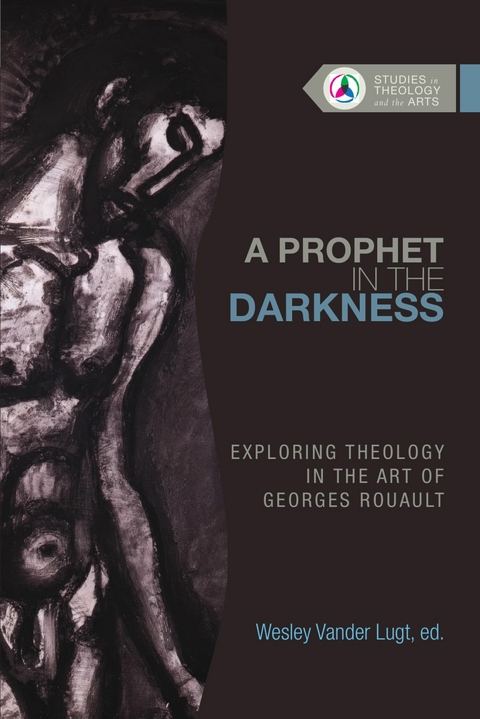
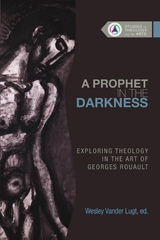
A Prophet in the Darkness (eBook)
192 Seiten
IVP Academic (Verlag)
978-1-5140-1106-5 (ISBN)
Wesley Vander Lugt (PhD, University of St Andrews) is adjunct professor of theology and acting director of the Leighton Ford Initiative for Theology, the Arts, and Gospel Witness at Gordon-Conwell Theological Seminary in Charlotte. His publications include Living Theodrama: Reimagining Theological Ethics and Beauty Is Oxygen: Finding a Faith That Breathes.
Wesley Vander Lugt (PhD, University of St Andrews) is adjunct professor of theology and acting director of the Leighton Ford Initiative for Theology, the Arts, and Gospel Witness at Gordon-Conwell Theological Seminary in Charlotte. His publications include Living Theodrama: Reimagining Theological Ethics and Beauty Is Oxygen: Finding a Faith That Breathes.
Preface
Encountering Rouault
Wesley Vander Lugt
One of the best things about setting up a gallery exhibit is the amount of time you get to spend with the art. In fall 2022, as a part of my role at Gordon-Conwell Theological Seminary, I had the privilege of spending numerous hours with Georges Rouault’s art through the process of unpacking, sorting, hanging, labeling, and then sitting back and enjoying dozens of works in “Seeing Christ in the Darkness: Georges Rouault as a Graphic Artist” from the Bowden Collections.1 Having such sustained proximity to Rouault’s art was a moving, formative, and expansive experience for me, especially since much of his work features marginalized subjects (clowns, prostitutes, refugees, laborers, and—most prominently—Jesus) presented in a simple, heavy style. If one is receptive, as I discovered, spending time with this artwork releases prayers of lament, longings for mercy, and empathy for the downtrodden.
Georges Rouault is unique among French modernist artists due to his deep Christian faith, emphasis on marginalized figures, heavy black contouring, and exploration of Christ’s suffering. Despite his unique style and spiritual depth, theological engagement with Rouault has been limited to a few studies that are either out of print or difficult to obtain. This book seeks to bring Rouault out of the shadows and show how his empathetic imagination, honest lament, and christological concentration are a gift to all those who have experienced the pain of existence, those who desire to express this pain while maintaining hope, and those seeking a deeper understanding of the theological impulse of modernist art and Rouault’s distinct contribution.
Each essay in this volume, except for Stephen Schloesser’s, began as a presentation at a symposium hosted by Gordon-Conwell Theological Seminary in Charlotte that corresponded with an exhibit of Rouault’s work. While these essays engage with Rouault’s work from different angles, one unifying theme is how Rouault’s work displays our need for mercy within a world of anguish and shadows. This emphasis is most evident in the Miserere series, a collection of fifty-eight plates that began as drawings during the First World War, were created as paintings and transferred onto copper plates in the 1920s, and finally were printed after a long delay in 1948. Rouault viewed these prints as his most significant and precious work, having imbued them with heartache, hope, and the mercy offered through the sacrifice of Jesus. In his preface to the Miserere series, Rouault confesses:
Plate 27 of the Miserere (see fig. P.1) conveys this lament by picturing the blind poet Orpheus with the title There are tears in things . . . (Sunt lacrymae rerum . . .) from Virgil’s Aeneid.3 The original context of this phrase and Rouault’s artistic rendering both communicate that there are tears, sorrow, and misery at the heart of reality, and for Rouault it was this state of things that led God in Christ to suffer on the cross. The next line of poetry in Rouault’s preface to the Miserere is, “Jesus on the cross will tell you better than I.”4 Jesus on the cross is both an expression of “this anguished world” and a gateway to refuge, hope, and new life. While Rouault rarely portrayed the resurrection directly, the reality of resurrection is nascent in the Miserere, especially in the plate directly after There are tears in things . . . , which affirms, “The one who believes in me, even should he die, will live” (M28; see web 2.1).5
Figure P.1. Georges Rouault, Sunt Lacrimae Rerum (There are tears in things . . . ), Miserere plate 27, 1922. Heliogravure with sugar-lift aquatint, drypoint, burnishing on paper, 22 7/8 × 16 9/16
Since Georges Rouault is often lesser known than his contemporaries Henri Matisse and Marc Chagall, it is fitting that the first essay in this volume is a biographical sketch by his great-grandson, Philippe Rouault. With insights passed down through generations, Philippe Rouault shows how Georges Rouault’s artistic subjects and style were influenced by the terror of war, the death of friends and family, and personal suffering. Despite these difficulties, his Christian faith played a decisive role in the development of his unique aesthetic, which integrates lament and hope through a focus on the Passion of Christ.
Thomas Hibbs situates the gift of Rouault’s art within the dynamics of our current ecological crisis and secular malaise. Drawing on the work on Jean-Luc Marion, he shows how within an anthropocentric paradigm, images typically operate as idols rather than icons, blocking our ability to encounter transcendence. In this environment, Rouault’s work can make us more attentive to our disorders and can habituate us into a new pedagogy of desire. Rouault gives us a way to “see, feel, and say” things that run counter to the nihilism of our culture while avoiding sentimentality and grappling with the evil and affliction of the world.
Soo Y. Kang focuses on the experience and theology of poverty within Rouault’s work as influenced by Rouault’s mentor and writer Léon Bloy. She explains how Rouault’s impoverished upbringing, combined with the power of Bloy’s work, created empathy with the lowliest, which included not only the poor but also clowns, prostitutes, and other outcasts. Rouault once stated, “I am a silent friend of those who struggle in the deep furrow,” whether that furrow is a literal furrow of mud, a social or vocational furrow of marginalization, or a spiritual furrow of despair. In this way, Kang demonstrates how Rouault’s art embodies and anticipates Catholic social teaching on poverty, presenting what we might consider a visual preferential option for the poor.
Joel Klepac engages with the art of Rouault as both an artist and a therapist, integrating the wisdom of ascetic and Orthodox theology, internal family systems therapy, and the healing power of Rouault’s images. He interprets the art of Rouault as a visual poetic that can evoke the viewer and hold them in dispassionate compassion (agape-apatheia), which makes possible the psychological integration of lost, abandoned, demonized, overworked, and exiled aspects of the self. As such, Klepac presents Rouault not only as a skilled artist but also as a psychological and spiritual healer who creates spaces for us as viewers to restore our own core, compassionate state.
Pamela Rossi-Keen draws on disparate disciplines of theology, art history, and community development to consider Rouault’s art and impact through the lens of Walter Brueggemann’s notion of prophetic imagination. By focusing on the abject of society and the dynamics of suffering, Rossi-Keen claims that Rouault’s art carries prophetic weight, that he helps us see what and who we tend to ignore, perceiving the dignity as well as the tragedy of the bedraggled and hinting at the hope found in solidarity and mutual care. Rossi-Keen shows how this same kind of community-centered art is being prophetically deployed in her own community of postindustrial Pennsylvania and is contributing to the reinvigoration of community health and vibrancy.
James Romaine explores an aesthetics of empathy in the work of Rouault and sets this alongside the similar aesthetic of Romare Bearden. Romaine shows numerous parallels between Bearden and Rouault, including their sense of moral purpose, artistic methods, and subject matter. Despite his not being a practicing Christian like Rouault, Bearden’s work bears similarity to Rouault’s by his transformation of scenes from the American South into heroic narratives, his compulsion to integrate Christian motifs and themes into his work, and his contribution to the development of sacred art in the twentieth century. Romaine contends that both Bearden and Rouault depict scenes that contain empathetic dynamics that in turn encourage and develop the viewer’s own sense of empathy.
William A. Dyrness addresses how many within the Christian tradition resist modern art and aesthetic shock, a dynamic present within Rouault’s art. Dyrness shows how the reticent acceptance of Rouault’s work within the Catholic Church and the lack of engagement within other religious traditions should be situated within broader antimodern trajectories. In addition, he investigates the irony of this resistance, especially given a growing awareness regarding the deeply religious roots and spiritual undercurrents of much modern art. Learning how to appreciate and engage with Rouault’s art both aesthetically and theologically, therefore, can create new habits of attentiveness and receptivity toward modern art as a whole, which is a compelling alternative to more cynical and alarmist approaches.
Stephen Schloesser also engages with Rouault’s art as quintessentially modern, with a focus on the Miserere series, which Rouault began in 1922, the year many scholars mark as the beginning of modernism. In doing so, Schloesser attends to the dynamics of appearance and reality in Rouault’s work and his desire to show the world and its inhabitants as they really are in all their anguish and dignity. Schloesser presents Rouault as a visionary who helps us to encounter the beauty of a wounded world that requires the beauty of a wounded Savior. Rouault...
| Erscheint lt. Verlag | 10.12.2024 |
|---|---|
| Reihe/Serie | Studies in Theology and the Arts Series |
| Verlagsort | Lisle |
| Sprache | englisch |
| Themenwelt | Kunst / Musik / Theater ► Kunstgeschichte / Kunststile |
| Religion / Theologie ► Christentum ► Kirchengeschichte | |
| Schlagworte | 20th century • academic • Art History • Artist • Artistic Expression • Biblical • Biography • Christ • Christian • christian artist • Christianity and the arts • Christian painter • Community • Contemporary • Emmaus • Empathy • Expression • Faith • Fine Art • Georges Rouault • History • images • Miserere • Modern • modern art • modernist • modernist artist • Painter • Passion • Poetry • Poverty • propaedeutic • Religious • response • Road • Studies in Theology and the Arts • Theme • Theology • theology and the arts |
| ISBN-10 | 1-5140-1106-9 / 1514011069 |
| ISBN-13 | 978-1-5140-1106-5 / 9781514011065 |
| Informationen gemäß Produktsicherheitsverordnung (GPSR) | |
| Haben Sie eine Frage zum Produkt? |
 EPUB (Wasserzeichen)
DRM: Digitales Wasserzeichen
Dieses eBook enthält ein digitales Wasserzeichen und ist damit für Sie personalisiert. Bei einer missbräuchlichen Weitergabe des eBooks an Dritte ist eine Rückverfolgung an die Quelle möglich.
Dateiformat: EPUB (Electronic Publication)
EPUB ist ein offener Standard für eBooks und eignet sich besonders zur Darstellung von Belletristik und Sachbüchern. Der Fließtext wird dynamisch an die Display- und Schriftgröße angepasst. Auch für mobile Lesegeräte ist EPUB daher gut geeignet.
Systemvoraussetzungen:
PC/Mac: Mit einem PC oder Mac können Sie dieses eBook lesen. Sie benötigen dafür die kostenlose Software Adobe Digital Editions.
eReader: Dieses eBook kann mit (fast) allen eBook-Readern gelesen werden. Mit dem amazon-Kindle ist es aber nicht kompatibel.
Smartphone/Tablet: Egal ob Apple oder Android, dieses eBook können Sie lesen. Sie benötigen dafür eine kostenlose App.
Geräteliste und zusätzliche Hinweise
Buying eBooks from abroad
For tax law reasons we can sell eBooks just within Germany and Switzerland. Regrettably we cannot fulfill eBook-orders from other countries.
aus dem Bereich