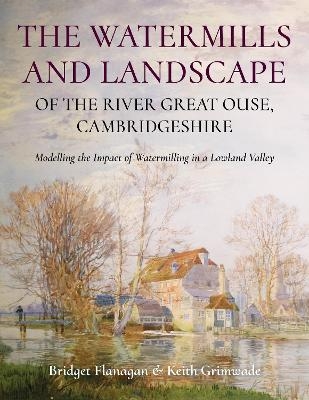
The Watermills and Landscape of the River Great Ouse, Cambridgeshire
Oxbow Books (Verlag)
978-1-914427-41-1 (ISBN)
The River Great Ouse in Cambridgeshire has a long history of watermilling, stretching back to at least the 10th century and possibly to the Roman period. The authors use remote sensing (LiDAR), cartographic analysis, fieldwork, documents (especially contemporary litigation) and literary sources to reveal new findings about this fascinating landscape. The Great Ouse’s watermills were recorded as the most valuable in England in the Domesday Survey. All their sites are located, several having been long lost, and a comprehensive explanation for their national pre-eminence is given. The expansion of activity in the Middle Ages is investigated through a detailed study of the disputes arising from the competing uses of the river and its floodplain for watermilling, navigation and farming. Channel features that, hitherto, have either been ignored or attributed to natural processes are shown to be the result of milling activity. The continuing impact of watermilling on the landscape until its decline in the second half of the 19th century is analysed. The authors’ findings have broader implications for the understanding of the development of watermilling in lowland river landscapes; the evolution of parish boundaries; and the development of multi-channel river forms. They conclude by advocating a mapping methodology that designates landscape features resulting from watermilling as heritage assets, to guide planning decisions.
Bridget Flanagan is a writer and researcher on local history of the old county of Huntingdonshire. She documented the history of the causeway to St Ives Bridge to achieve a Grade II* Listing, and ensure the retention and repair of the 55-arched structure. Her book ‘Artists along the Ouse, 1880-1930’ identified the artists’ colony around St Ives, described the artists’ work and examined their legacy. As a trustee of the Great Ouse Valley Trust she is active in promoting greater recognition of this outstanding area, and campaigns for its protection and conservation with AONB designation. KEITH GRIMWADE graduated in geography from the University of Oxford. He is the author of several school geography textbooks and is a Past President of the Geographical Association. He has been awarded an undergraduate certificate in Landscape History and Archaeology and an advanced diploma in Research Theory and Practice from the University of Cambridge Institute of Continuing Education. His research interests are historical geography and landscape history, and the use of geographical information systems to interpret landscapes.
List of Figures
List of Tables
Acknowledgements
1. Introduction
2. The Physical and Historical Background
3. The First Watermills: the Roman Period to 1066
4. A Water milling ‘powerhouse’: the Domesday Mills
5. The Age of Backwaters: 1086–1350
6. River Wars: 1515 – matters come to a head
7. The Age of Locks: a 17th century Technical Solution
8. Continuity, Disputes and Cooperation: 1700–1850
9. Decline and Romantic Appreciation: 1850 to the present day
10. Modelling and Managing the Watermilling Landscape
Primary Sources
Bibliography
Index
| Erscheinungsdatum | 17.06.2025 |
|---|---|
| Zusatzinfo | 50 b/w and color illustrations |
| Verlagsort | Oxford |
| Sprache | englisch |
| Maße | 185 x 246 mm |
| Themenwelt | Kunst / Musik / Theater |
| Geisteswissenschaften ► Archäologie | |
| Geisteswissenschaften ► Geschichte ► Hilfswissenschaften | |
| ISBN-10 | 1-914427-41-6 / 1914427416 |
| ISBN-13 | 978-1-914427-41-1 / 9781914427411 |
| Zustand | Neuware |
| Informationen gemäß Produktsicherheitsverordnung (GPSR) | |
| Haben Sie eine Frage zum Produkt? |
aus dem Bereich