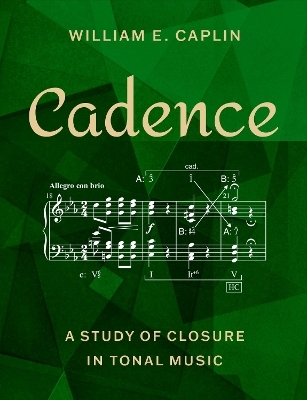
Cadence
Oxford University Press Inc (Verlag)
978-0-19-005644-5 (ISBN)
Cadence is a comprehensive examination of how formal units in European art music of the tonal era achieve closure. The book brings together the author's decades-long investigations into cadence, a compositional device that is readily experienced both by musicians and non-musicians, but one that has proven intractable to clear and precise theoretical formulation. Rooted in Caplin's broader theory of formal functions, the book first develops concepts of cadence for music of the high classical style and then extends these ideas to gauge cadential practice in earlier and later style periods. Throughout the study, various manifestations of cadence are defined in terms of their morphology (their harmonic and melodic profiles) as well as their function (the specific formal contexts in which they are deployed).
Cadence introduces a host of theoretical concepts illustrated by copious musical examples, all of which contain extensive analytical annotations of harmony, melody and form. Though the book is addressed primarily to music theorists, the many issues of compositional practice raised in this study will resonate with the interests of composers, historians, and performers alike.
Following graduate studies at the University of Chicago and the Technical University of Berlin, William Caplin joined the Faculty of Music at McGill University in 1978 and remained there until his retirement in 2022. Caplin specializes in the theory of musical form and the history of harmonic and metric theories. His ground-breaking treatise Classical Form (1998) won the Wallace Berry Book Award from the Society for Music Theory. He subsequently served that society as both Vice-President and President. In 2011, Caplin was awarded the prestigious Killam Research Fellowship and was elected a Fellow in the Royal Society of Canada in 2015.
TABLE OF CONTENTS
Preface
Guide to the Analytical Annotations
CHAPTER 1 IDEAS OF CLOSURE
1.1 Closure in Literature
1.2 Closure in Music
1.2.1 Leonard Meyer
1.2.2 Kofi Agawu
1.2.3 Robert Hatten
1.2.4 Patrick McCreless
1.2.5 Mark Anson-Cartwright
PART 1 THE CLASSICAL CADENCE
CHAPTER 2 GENERAL CONCEPTS OF THE CLASSICAL CADENCE
2.1 Traditional Notions of Cadence
2.2 Cadence as Formal Closure
2.2.1 Formal Units Closed by Cadence; Cadence and Phrase
2.2.2 Cadence and Higher-Level Formal Units
2.3 Cadence as Harmony; Harmony as Cadence
2.3.1 Progression Types
2.3.1.1 Prolongational Progressions
2.3.1.2 Sequential Progressions
2.3.1.3 Cadential Progressions
2.3.2 Ambiguity of Progression Types
2.4 Bass-Line Melody and Cadence
2.5 Cadential Arrival versus Cadential Function
2.6 Cadential Function versus Cadential Content
2.7 Limited Cadential Scope
2.8 Cadential Function versus Postcadential Function
2.8.1 Theoretical Background
2.8.2 Postcadential Function as "Confirmation"
2.8.3 Hepokoski and Darcy's Critique
2.8.4 Two "Registers" of Closure
2.8.5 Consecutive (Repeated) PACs
2.9 "End" versus "Stop"
2.10 Cadence as Punctuation
2.11 Cadential Strength-Syntactical versus Rhetorical
CHAPTER 3 BASIC CADENCE TYPES: MORPHOLOGY AND FUNCTION
3.1 Perfect Authentic Cadence
3.1.1 Morphology-Harmonic Content
3.1.1.1 Stages of the Cadence Schema
3.1.1.2 Stage 1-Initial Tonic
3.1.1.3 Stage 2-Pre-dominant
3.1.1.4 Stage 3-Dominant
3.1.1.5 Stage 4-Final Tonic
3.1.1.6 Complete versus Incomplete Cadential Progressions
3.1.1.7 Boundaries of the Cadential Progression
3.1.2 Morphology-Melodic Content
3.1.2.1 Basic Patterns
3.1.2.2 Varied Patterns
3.1.2.3 Combined Patterns
3.1.2.4 Additional Patterns
3.1.3 Function
3.1.3.1 Standard Functions of the PAC
3.1.3.2 Exceptional Situations
3.2 Imperfect Authentic Cadence
3.2.1 Morphology
3.2.1.1 Basic Tenor Stream (8/6/5/3); Varied (5/6/5/3)
3.2.1.2 Prinner Cadence
3.2.1.3 Other Patterns; Melodic Diversion
3.2.1.4 Combined Patterns
3.2.1.5 Ending on 5?
3.2.2 Function
3.2.2.1 Independent IAC
3.2.2.2 Way-Station IAC
3.2.2.3 Additional Functions of the IAC
3.3 Half Cadence
3.3.1 General Conditions for Half Cadence
3.3.2 Morphology-Harmonic Content
3.3.2.1 Stage 1-Initial Tonic
3.3.2.2 Stage 2-Pre-dominant
3.3.2.3 Stage 3-Dominant
3.3.3 Morphology-Melodic Content
3.3.3.1 Simple (L-K) HC
3.3.3.2 Converging HC
3.3.3.3 Expanding HC
3.3.3.4 Miscellaneous Issues
3.3.4 Function
3.3.4.1 Levels of Phrase Functionality
3.3.4.2 Levels of Thematic Functionality
3.3.4.3 Some Functional Generalizations
3.3.5 Special Cases
3.3.5.1 Reinterpreted HC
3.3.5.2 Reopened HC
3.4 Additional Aspects of the Basic Cadence Types
3.4.1 Meter
3.4.1.1 A Ratio Model of Metrical Strength
3.4.1.2 Metrically Weaker Cadences
3.4.1.3 Hypermetrical Considerations
3.4.1.4 Metrical Weighting-Syntactical or Rhetorical?
3.4.2 Texture
3.4.2.1 Textural Types
3.4.2.2 Texture and Cadence
3.4.2.3 Covered cadence
3.5 Other Cadence Types
3.5.1 "Contrapuntal Cadence"; Prolongational Closure
3.5.2 "Plagal Cadence"
CHAPTER 4 CADENTIAL DEVIATIONS
4.1 Deceptive Cadence
4.1.1 Morphology
4.1.2 Function
4.1.2.1 Way-Station Deceptive Cadence, Replacing a PAC
4.1.2.2 Way-Station Deceptive Cadence, Replacing an IAC
4.1.2.3 Way-Station Deceptive Cadence, Denied
4.1.2.4 Independent Deceptive Cadence
4.1.2.5 Noncadential Uses of a Deceptive Cadential Progression
4.1.2.6 Deceptive Resolutions of the Dominant in Noncadential Contexts
4.1.2.7 Elided Deceptive Cadence
4.2 Evaded Cadence
4.2.1 Morphology
4.2.1.1 Harmonic Content
4.2.1.2 Melodic Content
4.2.2 Function
4.2.2.1 Way Station
4.2.2.2 One-More-Time Technique
4.2.2.3 New Material
4.3 Abandoned cadence
4.3.1 Cadential Dominant Undermined by Inversion
4.3.2 Cadential Dominant Replaced by Inverted Dominant
4.3.2.1 Replaced by Lt
4.3.2.2 Replaced by Le
4.3.3 Cadential Dominant Replaced by Nondominant Harmony
4.3.4 Prolongational versus Cadential; Harmonic Expansion
4.3.5 Cadential Abandonment and Harmonic Reduction
4.4 Dominant Arrival
4.4.1 Arrival on a Final Dominant
4.4.2 Arrival on a Terminal Dominant
4.4.3 Premature Dominant Arrival
4.4.3.1 PDA on a Final Dominant
4.4.3.2 PDA on a Terminal Dominant
4.4.3.3 Hyperdominant Prolongations
4.4.4 Additional Issues
4.4.4.1 Dominant Arrival of Limited Scope
4.4.4.2 Reinterpreted Dominant Arrival
4.4.4.3 Reopened Dominant Arrival
4.4.4.4 Doppia PDA versus doppia HC
4.4.4.5 Burstein's Critique
4.5 Combinations of Deviations
4.6 Cadential Ambiguities
4.6.1 Evaded versus Deceptive (Elided)
4.6.2 Evaded versus Authentic (Elided)
4.6.3 Evaded versus IAC (Elided)
4.6.4 Evaded versus Covered PAC
4.6.5 Evaded versus HC (Dominant Arrival)
4.6.6 Abandoned versus Deceptive
4.6.7 Multiple Ambiguities
4.6.7.1 Mozart, Piano Sonata in A Minor, K. 310, i, mm. 1-10
4.6.7.2 Haydn, String Quartet in D, Op. 71, no 3, iii, 1-10
CHAPTER 5 CADENTIAL EXPANSION
5.1 Perfect Authentic Cadence
5.1.1 Harmonic Content
5.1.1.1 Stage 1-Initial Tonic
5.1.1.2 Stage 2-Pre-dominant
5.1.1.3 Stage 3-Dominant
5.1.1.4 Diversity of Harmonic Content; Bass-Line Complexities
5.1.1.5 Ambiguous Onset of an ECP
5.1.2 Melodic Content
5.1.2.1 Basic Simple (3/2/2/1); with Cadential Six-Four (3/2/3-2/1)
5.1.2.2 Basic Soprano (5/4/2/1); with Cadential Six-Four (5/4/3-2/1)
5.1.2.3 Basic Alto (3/2/7/1); with Cadential Six-Four (3/2/1-7/1)
5.1.2.4 Basic Tenor (8/6/5/1); with Cadential Six-Four (8/6/5-4/1)
5.1.2.5 Varied Simple (1/2/2/1); with Cadential Six-Four (1/2/3-2/1)
5.1.2.6 Varied Soprano (3/4/2/1); with Cadential Six-Four (3/4/3-2/1)
5.1.2.7 Varied Alto (1/2/7/1); with Cadential Six-Four (1/2/1-7/1)
5.1.2.8 Varied Tenor (5/6/5/1); with Cadential Six-Four (5/6/5-5 (4)/1)
5.1.2.9 Successive Combinations
5.1.2.10 Simultaneous Combinations
5.1.2.11 Additional Patterns
5.2 Imperfect Authentic Cadence
5.3 Half Cadence
5.3.1 Minimum Length
5.3.2 Harmonic Content
5.3.2.1 Stage 1
5.3.2.2 Stage 2
5.3.2.3 Stage 3
5.3.3 Melodic content
5.3.3.1 Simple HC
5.3.3.2 Converging HC
5.3.3.3 Expanding HC
5.3.3.4 Converging/Expanding; Expanding/Converging
5.4 Deviations
5.4.1 Minimum Size of Expansion
5.4.2 One-More-Time and Related Repetitions
5.4.3 Deceptive-Authentic Combinations (DCP-ACP); Melodic Content
5.4.4 Abandoned ECP
5.4.5 Dominant Arrival
5.5 A Cadential Conundrum
5.6 Expanded Cadential Progressions in Beethoven's Symphonies
5.6.1 Symphony No. 1 in C, Op. 21, i, Subordinate-Theme Group
5.6.2 Symphony No. 2 in D, Op. 36, iv, Coda
5.6.3 Symphony No. 3 in E-flat ("Eroica"), Op. 55, i, Second Subordinate Theme
5.6.4 Symphony No. 5 in C Minor, Op. 67, iv, Subordinate Theme, Coda Theme
5.6.5 Symphony No. 6 in F ("Pastoral"), Op. 68, iv, Subordinate Theme
5.6.6 Symphony No. 7 in A, Op. 92, i, Coda Theme
5.6.7 Symphony No. 9 in D Minor ("Choral"), Op. 125, i, Main Theme
5.6.8 Symphony No. 9 in D Minor ("Choral"), Op. 125, i, Coda
PART 2 CADENCE IN OTHER TONAL STYLES
CHAPTER 6 CADENCE IN THE HIGH BAROQUE
6.1 Authentic Cadence
6.1.1 Perfect Authentic Cadence
6.1.2 Harmonic Content
6.1.3 Imperfect Authentic Cadence
6.1.4 Cadential Deviations (Authentic Cadence)
6.1.4.1 Deceptive Cadence
6.1.4.2 Evaded Cadence
6.1.4.3 Abandoned Cadence
6.1.5 Cadential Extension and Expansion
6.1.5.1 Consecutive PACs
6.1.5.2 Expansion via Slower Tempo; Hemiola; Change of Tempo Marking
6.1.5.3 Expanded Cadential Progression
6.1.5.4 Deceptive-Authentic Combinations (DCP-ACP); Pulcinella
6.2 Half Cadence
6.2.1 Harmonic, Tonal, and Formal Functions
6.2.2 Dominant Arrival
6.2.3 Precadential Dominant Expansion
6.3 Miscellaneous Issues
6.3.1 Cadential Content versus Cadential Function; Cadences of Limited Scope
6.3.2 Prolongational Closure
6.3.3 "Plagal" Cadence; Tonic Arrival
6.4 Cadence in Fugue: J. S. Bach's Well-Tempered Clavier
6.4.1 General Concepts and Terminology
6.4.2 Tonal Functions of Cadence in Fugue
6.4.3 Formal Functions of Cadence in Fugue
6.4.4 Subject-Ending Cadences
6.4.5 Expositions Concluding with an S-Ending Cadence
6.4.6 Final Cadence as S-Ending
6.4.7 Cadential Deviations and Cadential Blurring
6.4.8 Three Case Studies
6.4.8.1 Fugue in D, WTC 1
6.4.8.2 Fugue in E-flat, WTC 1
6.4.8.3 Fugue in G-sharp Minor, WTC 1
CHAPTER 7 CADENCE IN THE GALANT ERA
7.1 Morphology of the Galant Cadence
7.1.1 Gjerdingen's Galant Clausulae
7.1.2 Prinner Cadence
7.1.3 Miscellaneous Variants
7.1.4 Melodic "Overhang"
7.2 Cadential Deviations
7.2.1 Evaded Cadence
7.2.2 Deceptive Cadence
7.2.3 Abandoned Cadence
7.2.4 Dominant Arrival
7.3 Extension and Expansion Techniques
7.3.1 Consecutive Cadences and Codettas
7.3.2 Expanded Cadential Progression
7.3.3 Pulcinella
7.3.4 Dominant Expansions-Penultimate, Ultimate, Precadential
7.3.4.1 Expanded Penultimate Dominant
7.3.4.2 Internal HC (or Dominant Arrival)
7.3.4.3 Precadential Dominant Expansion
7.4 Galant Cadence in Relation to Formal Functions
7.4.1 Main Theme
7.4.2 Transition; Fusion Processes
7.4.3 Subordinate Theme; Cadential Play
7.4.4 Development
7.4.5 Recapitulation
CHAPTER 8 CADENCE IN THE ROMANTIC ERA
8.1 Chromaticism and Dissonance
8.2 Root-Position Harmonies
8.3 Uniform Harmonic Rhythm and Density
8.4 Off-Tonic Openings; ECP Openings
8.5 Formal Circularity
8.6 Symmetrical Grouping Structures
8.7 Sequence versus Cadence
8.8 Prolongational Closure
8.9 Lack of Formal Closure
8.10 Cadential Deviations
8.10.1 Deceptive Cadence
8.10.1.1 "Mondnacht"
8.10.1.2 "Waldesgespräch"
8.10.2 Evaded Cadence
8.10.3 Dominant Arrival
8.11 Ultimate versus Penultimate Dominants; Dissipated Cadence
8.12 Prinner Cadence
8.13 Analytical Notes to Chopin's Preludes, Op. 28
8.13.1 Prelude No. 1 in C
8.13.2 Prelude No. 2 in A Minor
8.13.3 Prelude No. 3 in G
8.13.4 Prelude No. 4 in E Minor
8.13.5 Prelude No. 5 in D
8.13.6 Prelude No. 6 in B Minor
8.13.7 Prelude No. 7 in A
8.13.8 Prelude No. 8 in F-sharp Minor
8.13.9 Prelude No. 9 in E
8.13.10 Prelude No. 10 in C-sharp Minor
8.13.11 Prelude No. 11 in B
8.13.12 Prelude No. 12 in G-sharp Minor
8.13.13 Prelude No. 13 in F-sharp
8.13.14 Prelude No. 14 in E-flat Minor
8.13.15 Prelude No. 15 in D-flat
8.13.16 Prelude No. 16 in B-flat Minor
8.13.17 Prelude No. 17 in A-flat
8.13.18 Prelude No. 18 in F Minor
8.13.19 Prelude No. 19 in E-flat
8.13.20 Prelude No. 20 in C Minor
8.13.21 Prelude No. 21 in B-flat
8.13.22 Prelude No. 22 in G Minor
8.13.23 Prelude No. 23 in F
8.13.24 Prelude No. 24 in D Minor
CHAPTER 9 CADENCE IN THE MID TO LATE NINETEENTH CENTURY
9.1 Tonic Arrival
9.2 Pre-dominant Arrival; Subdominant Arrival
9.3 Plagal Cadence/Plagal Closure
9.3.1 Theoretical Speculations
9.3.1.1 Plagal Cadential Progression (PCP)
9.3.1.2 Plagal Cadential Progressions: Moment-to-Moment Listening Contexts
9.3.1.3 Plagal Cadence; Prolongational Closure; Plagal Closure
9.3.2 Analyses of Plagal Closure
9.3.2.1 Dependent Plagal Closure
9.3.2.2 Independent Plagal Closure
9.3.3 Plagal Closure versus Plagal Codetta
9.3.4 Additional Characteristics of Plagal Closure
9.3.4.1 6-5 Melodic Closure
9.3.4.2 Phrygian Modality
9.3.4.3 Home-Key Plagal Closure versus KL: HC.
9.3.4.4 Subdominant with Added Sixth; 1-2-3
9.3.4.5 "Diminished" Plagal Closure
9.3.5 Feigned Plagal Closure
9.4 Prolongational Closure
9.5 Detour Cadence
9.6 Iconic Cadence
9.7 Cadential Deviations
9.7.1 A Deceptive Half Cadence?
9.7.2 Evaded Cadence
9.8 Cadential Ambiguities
9.9 Four Case Studies
9.9.1 Grieg, String Quartet in G Minor, Op. 27, Finale
9.9.2 Dvorak, Symphony No. 7 in D Minor, Second Movement
9.9.3 Liszt, Sonata in B Minor
9.9.4 Wagner, Prelude to Tristan und Isolde
Glossary of Terms
Bibliography
Index of Musical Compositions
General Index
| Erscheinungsdatum | 25.10.2024 |
|---|---|
| Zusatzinfo | 2 halftone, 715 music examples |
| Verlagsort | New York |
| Sprache | englisch |
| Maße | 216 x 279 mm |
| Gewicht | 3720 g |
| Themenwelt | Kunst / Musik / Theater ► Musik |
| ISBN-10 | 0-19-005644-4 / 0190056444 |
| ISBN-13 | 978-0-19-005644-5 / 9780190056445 |
| Zustand | Neuware |
| Informationen gemäß Produktsicherheitsverordnung (GPSR) | |
| Haben Sie eine Frage zum Produkt? |
aus dem Bereich