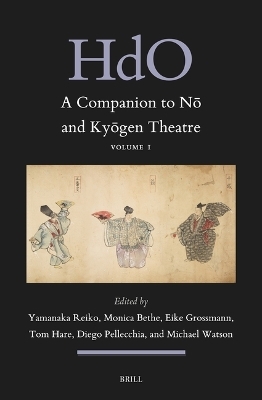
A Companion to Nō and Kyōgen Theatre (Vol. 1)
Brill (Verlag)
978-90-04-53966-2 (ISBN)
Nō and kyōgen theatre are among the longest continuously staged dramatic forms in the world and are deeply connected to Japanese arts, culture, society, and history. This richly illustrated two-volume set brings together the important elements of these traditions to offer new insights, with contributions by Japanese and non-Japanese experts from a broad range of disciplines. It represents the most ambitious and exhaustive exploration of nō and kyōgen to date, and is an invaluable resource for both scholars and enthusiasts. (This is volume1 out of 2). For volume 2 see: brill.com/edcollbook/title/71772.
Yamanaka Reiko, is professor at Hōsei University, Tokyo. She has published extensively on Zeami and on the history of the stage directions regarding individual nō plays. Monica Bethe, is director of the Medieval Japanese Studies Institute, Kyoto. Her research interprets nō as an interactive whole including the impact of masks and costumes. Eike Grossmann, is professor at the University of Hamburg. Her research areas include traditional theatre and folk performing arts, as well as the history of childhood and material culture. Tom Hare is professor at Princeton University. He has translated Zeami’s writings on training and performance, and publishes on medieval portrait inscriptions. Diego Pellecchia is associate professor at Kyoto Sangyō University. His research interests include nō training, performance, interactions between professionals and amateurs, and the reception of nō outside Japan. Michael Watson, is professor emeritus at Meiji Gakuin University, Tokyo. His research has centred on the Heike monogatari, nō drama, narratology, translation, and reception history.
Volume 1
Preface
Notes to Readers
List of Illustrations
Notes on Contributors
Introducing Nō and Kyōgen
Tom Hare and Yamanaka Reiko
1 The History of Nō
Edited by Eike Grossmann and Miyamoto Keizō
1.1 The Origins of Nō, Sangaku, and Sarugaku until the Fourteenth Century (Eike Grossmann and Miyamoto Keizō)
1.2 The Emergence of “Nō” and the Formation of Performers’ Organizations during the Fourteenth and Fifteenth Centuries (Eike Grossmann and Miyamoto Keizō)
1.3 Nō in Kyoto and Its Dispersion during the Fifteenth and Sixteenth Centuries (Eike Grossmann and Miyamoto Keizō)
1.4 Nō in the Age of Exploration (Patrick Schwemmer)
1.5 Nō and Political Leaders from the Late Sixteenth to the Early Eighteenth Century (Eike Grossmann and Miyamoto Keizō)
1.6 Nō Practices and Nō Culture during the Seventeenth and Eighteenth Centuries (Eike Grossmann and Miyamoto Keizō)
1.7 The Reorganization and Standardization of Nō Practices during the Eighteenth and Nineteenth Centuries (Eike Grossmann and Miyamoto Keizō)
1.8 The Crisis of Nō at the End of the Nineteenth and the Early Twentieth Centuries (Eike Grossmann and Miyamoto Keizō)
1.9 Nō from World War I until the 1980s (Eike Grossmann and Miyamoto Keizō)
References
2 Nō Performance
Edited by Monica Bethe and Diego Pellecchia
2.1 Fundamentals of Nō Performance (Monica Bethe)
2.2 The Stage (Monica Bethe, Yamanaka Reiko, and Diego Pellecchia)
2.3 Performance Conventions (Monica Bethe)
2.4 Movement (Monica Bethe with Diego Pellecchia)
2.5 Music (Takakuwa Izumi with Monica Bethe)
2.6 The History of Nō Chant (Takakuwa Izumi with Monica Bethe)
2.7 Shōdan: the Building Blocks of Nō (Monica Bethe and Takakuwa Izumi)
2.8 Masks (Monica Bethe)
2.9 Costumes (Monica Bethe)
2.10 Nō Fans (Diego Pellecchia)
2.11 Properties (Monica Bethe)
2.12 Interpreting Conventions for Standard and Variant Performances (Yamanaka Reiko)
2.13 Underlying Principles of Nō Dramaturgy (Monica Bethe)
References
3 Training, Practice, and Production
Edited by Diego Pellecchia and Yamanaka Reiko
3.1 Introduction (Diego Pellecchia and Yamanaka Reiko)
3.2 Training (Diego Pellecchia and Yamanaka Reiko)
3.3 Female Performers in Nō (Barbara Geilhorn)
3.4 Practice and Production (Diego Pellecchia and Yamanaka Reiko)
3.5 The Role of Amateur Practitioners (Diego Pellecchia and Yamanaka Reiko)
3.6 Kurokawa Nō (Eike Grossmann)
3.7 Recent Developments and Future Perspectives (Diego Pellecchia and Yamanaka Reiko)
References
4 Plays: Their Conventions and Backgrounds
Edited by Tom Hare, Takeuchi Akiko, Michael Watson, and Yamanaka Reiko
4.1 Introduction (Takeuchi Akiko)
4.2 Categories of Nō Plays (Yamanaka Reiko)
4.3 Sources of Nō Plays (Takeuchi Akiko)
4.4 Nō and Its Belief Systems (Tom Hare and Takahashi Yūsuke)
4.5 Reading Nō: Mugen nō and Genzai nō (Monogurui nō) (Yamanaka Reiko)
4.6 Aspects of Time and Character Relations (Paul S. Atkins)
4.7 Stylistics and Poetics (Takeuchi Akiko)
4.8 Narration and Ambiguous Voice (Takeuchi Akiko)
4.9 Religious and Political Allegory in Nō (Susan Blakeley Klein)
4.10 Medieval Commentaries and Nō Theatre (Susan Blakeley Klein)
4.11 Bangai kyoku and Shinsaku nō: Noncanonical Plays and Modern Nō Plays (Fukazawa Nozomi and Takeuchi Akiko)
4.12 Conclusion (Takeuchi Akiko)
4.13 Excursus: Dramaturgy in Nō and Greek Tragedy (Mae J. Smethurst)
References
5 Authors
Edited by Tom Hare and Yamanaka Reiko
5.1 Introduction (Tom Hare and Yamanaka Reiko)
5.2 Kan’ami (Tom Hare and Yamanaka Reiko)
5.3 Zeami (Tom Hare and Yamanaka Reiko)
5.4 Motomasa (Tom Hare and Yamanaka Reiko)
5.5 Zenchiku (Tom Hare and Takahashi Yūsuke)
5.6 Nobumitsu (Ikai Takamitsu and Lim Beng Choo)
5.7 Nagatoshi (Ikai Takamitsu and Lim Beng Choo)
5.8 Zenpō (Ikai Takamitsu and Lim Beng Choo)
5.9 Miyamasu (Ikai Takamitsu and Lim Beng Choo)
5.10 Amateurs (Ikai Takamitsu and Lim Beng Choo)
References
| Erscheinungsdatum | 01.02.2025 |
|---|---|
| Reihe/Serie | Handbook of Oriental Studies. Section 5 Japan ; 19/1 |
| Verlagsort | Leiden |
| Sprache | englisch |
| Maße | 155 x 235 mm |
| Gewicht | 1152 g |
| Themenwelt | Kunst / Musik / Theater ► Theater / Ballett |
| Geisteswissenschaften ► Geschichte ► Regional- / Ländergeschichte | |
| Geschichte ► Teilgebiete der Geschichte ► Kulturgeschichte | |
| ISBN-10 | 90-04-53966-2 / 9004539662 |
| ISBN-13 | 978-90-04-53966-2 / 9789004539662 |
| Zustand | Neuware |
| Informationen gemäß Produktsicherheitsverordnung (GPSR) | |
| Haben Sie eine Frage zum Produkt? |
aus dem Bereich