


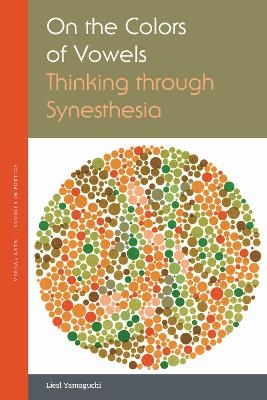
On the Colors of Vowels
Thinking Through Synesthesia
Seiten
2025
|
New edition
Fordham University Press (Verlag)
978-1-5315-0904-0 (ISBN)
Fordham University Press (Verlag)
978-1-5315-0904-0 (ISBN)
On the Colors of Vowels investigates the nineteenth-century emergence of discourses attributing visual properties (color, brightness) to vowels in linguistics, poetics, acoustics, opera, and experimental psychology.
Treatments of synesthesia in the arts and humanities generally assume a clear distinction between the neurological condition and the literary device. Synesthetes' descriptions of colors seen in connection with music, for example, are thought to differ fundamentally from common expressions that rely on transpositions across sensory dimensions ("bright vowels"). This has not always been the case. The distinction emerged over the course of the twentieth century, as scientists sought to constitute "synesthesia" as a legitimate object of modern science.
On the Colors of Vowels investigates the ambiguity of visual descriptions of vowels across a wide range of disciplines, casting several landmark texts in a wholly new light. The book traces the migration of sound-color correspondence from its ancient host (music) to its modern one (vowels), investigating the vocalic Klangfarben of Hermann von Helmholtz's monumental Sensations of Tone, the vowel colors reported in early psychology surveys into audition colorée (colored hearing), the mis-matched timbres that form poetry's condition of possibility in Stéphane Mallarmé's "Crisis of Verse," and the vowel-color analogy central to both the universal alphabets of the nineteenth century and the phonological universals of the twentieth. The book's final chapter turns to an intricately detailed account of vowel-color correspondence by Ferdinand de Saussure, suggesting how the linguist's sensitivity to vowel coloration may have guided his groundbreaking study of Indo-European vocalism.
Bringing out the diverse ways in which visual conceptions of vowels have inflected the arts and sciences of modernity, On the Colors of Vowels makes it possible to see how discourses of the nineteenth and twentieth centuries crafted the enigma we now readily recognize as "synesthesia."
Treatments of synesthesia in the arts and humanities generally assume a clear distinction between the neurological condition and the literary device. Synesthetes' descriptions of colors seen in connection with music, for example, are thought to differ fundamentally from common expressions that rely on transpositions across sensory dimensions ("bright vowels"). This has not always been the case. The distinction emerged over the course of the twentieth century, as scientists sought to constitute "synesthesia" as a legitimate object of modern science.
On the Colors of Vowels investigates the ambiguity of visual descriptions of vowels across a wide range of disciplines, casting several landmark texts in a wholly new light. The book traces the migration of sound-color correspondence from its ancient host (music) to its modern one (vowels), investigating the vocalic Klangfarben of Hermann von Helmholtz's monumental Sensations of Tone, the vowel colors reported in early psychology surveys into audition colorée (colored hearing), the mis-matched timbres that form poetry's condition of possibility in Stéphane Mallarmé's "Crisis of Verse," and the vowel-color analogy central to both the universal alphabets of the nineteenth century and the phonological universals of the twentieth. The book's final chapter turns to an intricately detailed account of vowel-color correspondence by Ferdinand de Saussure, suggesting how the linguist's sensitivity to vowel coloration may have guided his groundbreaking study of Indo-European vocalism.
Bringing out the diverse ways in which visual conceptions of vowels have inflected the arts and sciences of modernity, On the Colors of Vowels makes it possible to see how discourses of the nineteenth and twentieth centuries crafted the enigma we now readily recognize as "synesthesia."
Liesl Yamaguchi is Assistant Professor of French at the University of California, Berkeley.
Introduction: After "Voyelles" 1
1 Klangfarbe: Vowels in Helmholtz's Sensations of Tone 21
2 The Interaction of Color 49
3 Mallarmé and the Tension of Timbre 65
4 The Colors of the Universal Alphabet 84
5 L'être imaginaire: Saussure's Colored Vowels 103
Conclusion: Remarks on "Synesthesia" 121
Acknowledgments 141
Notes 143
Works Cited 185
Index 203
| Erscheinungsdatum | 10.12.2024 |
|---|---|
| Reihe/Serie | Verbal Arts: Studies in Poetics |
| Zusatzinfo | 2 color and 19 b/w illustrations |
| Verlagsort | New York |
| Sprache | englisch |
| Maße | 152 x 229 mm |
| Gewicht | 435 g |
| Themenwelt | Kunst / Musik / Theater ► Musik |
| Geisteswissenschaften ► Philosophie | |
| Geisteswissenschaften ► Sprach- / Literaturwissenschaft ► Anglistik / Amerikanistik | |
| Geisteswissenschaften ► Sprach- / Literaturwissenschaft ► Literaturwissenschaft | |
| ISBN-10 | 1-5315-0904-5 / 1531509045 |
| ISBN-13 | 978-1-5315-0904-0 / 9781531509040 |
| Zustand | Neuware |
| Informationen gemäß Produktsicherheitsverordnung (GPSR) | |
| Haben Sie eine Frage zum Produkt? |
Mehr entdecken
aus dem Bereich



aus dem Bereich
Poetik eines sozialen Urteils
Buch | Hardcover (2023)
De Gruyter (Verlag)
CHF 83,90


