


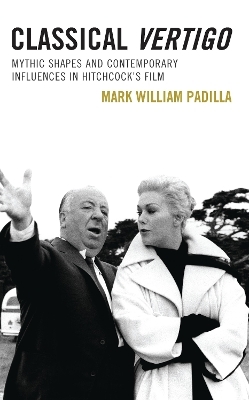
Classical Vertigo
Mythic Shapes and Contemporary Influences in Hitchcock’s Film
Seiten
2024
Lexington Books (Verlag)
978-1-6669-1591-4 (ISBN)
Lexington Books (Verlag)
978-1-6669-1591-4 (ISBN)
In Classical Vertigo, Padilla analyzes narrative figures and themes of classical mythology within Hitchock’s Vertigo to demonstrate that the film is a multifaceted work of intertextuality with artistic and cultural roots extending into antiquity itself.
Alfred Hitchcock’s Vertigo has dazzled and challenged audiences with its unique aesthetic design and startling plot devices since its release in 1958. In Classical Vertigo: Mythic Shapes and Contemporary Influences in Hitchcock’s Film, Mark William Padilla analyzes antecedents including: (1) the film’s source novel, D’entre les morts (Among the Dead), (2) the earlier symbolist novel, Rodenbach’s Bruges-la-morte, and (3) the first-draft screenplay of Maxwell Anderson, a prominent Broadway dramatist and Hollywood scenarist from the 1920s to the 1950s. The presence of Vertigo amid these texts reveals and clarifies how themes from Greco-Roman antiquity emerge in Hitchcock’s project. Padilla analyzes narrative figures such as Prometheus and Pandora, Persephone and Hades, and Pygmalion and Galatea, as well as themes like the dark plots of Greek tragedy, to reveal how Hitchcock used allusive form to construct an emotionally powerful experience with an often-minimalist script. This analysis demonstrates that Vertigo is a multifaceted work of intertextuality with artistic and cultural roots extending into antiquity itself.
Alfred Hitchcock’s Vertigo has dazzled and challenged audiences with its unique aesthetic design and startling plot devices since its release in 1958. In Classical Vertigo: Mythic Shapes and Contemporary Influences in Hitchcock’s Film, Mark William Padilla analyzes antecedents including: (1) the film’s source novel, D’entre les morts (Among the Dead), (2) the earlier symbolist novel, Rodenbach’s Bruges-la-morte, and (3) the first-draft screenplay of Maxwell Anderson, a prominent Broadway dramatist and Hollywood scenarist from the 1920s to the 1950s. The presence of Vertigo amid these texts reveals and clarifies how themes from Greco-Roman antiquity emerge in Hitchcock’s project. Padilla analyzes narrative figures such as Prometheus and Pandora, Persephone and Hades, and Pygmalion and Galatea, as well as themes like the dark plots of Greek tragedy, to reveal how Hitchcock used allusive form to construct an emotionally powerful experience with an often-minimalist script. This analysis demonstrates that Vertigo is a multifaceted work of intertextuality with artistic and cultural roots extending into antiquity itself.
Mark William Padilla serves as distinguished professor of classical studies at Christopher Newport University.
List of Illustrations
Preface
Introduction
Chapter One: Locating Vertigo's Themes in the Corpus of Maxwell Anderson
Chapter Two: Maxwell Anderson’s Influences on Vertigo
Chapter Three: Four Mythic Couples
Chapter Four: Argonauts and Underworld Journeyers
Chapter Five: Mythic Personae
Conclusion
Appendix: Synopses of Mythic Figures
Bibliography
About the Author
| Erscheinungsdatum | 09.03.2024 |
|---|---|
| Zusatzinfo | 18 BW Photos, 1 Table |
| Sprache | englisch |
| Maße | 159 x 237 mm |
| Gewicht | 635 g |
| Themenwelt | Kunst / Musik / Theater |
| Geisteswissenschaften ► Philosophie ► Philosophie Altertum / Antike | |
| Geisteswissenschaften ► Sprach- / Literaturwissenschaft ► Anglistik / Amerikanistik | |
| Geisteswissenschaften ► Sprach- / Literaturwissenschaft ► Literaturwissenschaft | |
| ISBN-10 | 1-6669-1591-2 / 1666915912 |
| ISBN-13 | 978-1-6669-1591-4 / 9781666915914 |
| Zustand | Neuware |
| Informationen gemäß Produktsicherheitsverordnung (GPSR) | |
| Haben Sie eine Frage zum Produkt? |
Mehr entdecken
aus dem Bereich
aus dem Bereich
Anleitung zu einer Lektüre Mark Aurels
Buch | Hardcover (2025)
FinanzBuch Verlag
CHF 27,95
Die Philosophie der Antike als Lebensweise in der modernen Welt
Buch | Hardcover (2025)
FinanzBuch Verlag
CHF 25,20


