


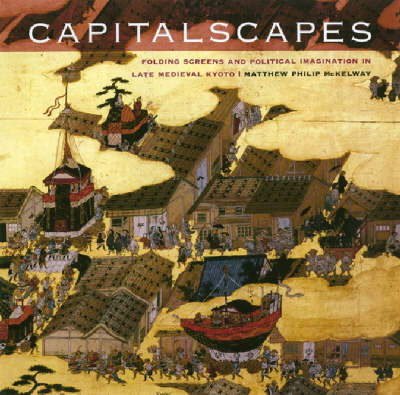
Capitalscapes
Folding Screens and Political Imagination in Late Medieval Kyoto
Seiten
2006
University of Hawai'i Press (Verlag)
978-0-8248-2900-1 (ISBN)
University of Hawai'i Press (Verlag)
978-0-8248-2900-1 (ISBN)
- Titel ist leider vergriffen;
keine Neuauflage - Artikel merken
Following the destruction of Kyoto during the civil wars of the late 15th century, large-scale panoramic paintings of the city began to emerge. This study of the Kyoto screens examines their inception in the 16th to early 17th centuries, focusing on the political motivations that sparked their creation.
Following the destruction of Kyoto during the civil wars of the late fifteenth century, large-scale panoramic paintings of the city began to emerge. These enormous and intricately detailed depictions of the ancient imperial capital were unprecedented in the history of Japanese painting and remain unmatched as representations of urban life in any artistic tradition. Capitalscapes, the first book-length study of the Kyoto screens, examines their inception in the sixteenth to early seventeenth centuries, focusing on the political motivations that sparked their creation.
Close readings of the Kyoto screens reveal that they were initially commissioned by or for members of the Ashikaga shogunate and that urban panoramas reflecting the interests of both prevailing and moribund political elites were created to underscore the legitimacy of the newly ascendant Tokugawa regime. Matthew McKelway’s analysis of the screens exposes their creators’ masterful exploitation of ostensibly accurate depictions to convey politically biased images of Japan’s capital. His overarching methodology combines a historical approach, which considers the paintings in light of contemporary reports (diaries, chronicles, ritual accounts), with a thematic one, isolating individual motifs, deciphering their visual language, and comparing them with depictions in other works.
McKelway’s combined approach allows him to argue that the Kyoto screens were conceived and perpetuated as a painting genre that conveyed specific political meanings to viewers even as it provided textured details of city life. Students and scholars of Japanese art will find this lavishly illustrated work especially valuable for its insights into the cityscape painting genre, while those interested in urban and political history will appreciate its bold exploration of Kyoto’s past and the city’s late-medieval martial elite.
Following the destruction of Kyoto during the civil wars of the late fifteenth century, large-scale panoramic paintings of the city began to emerge. These enormous and intricately detailed depictions of the ancient imperial capital were unprecedented in the history of Japanese painting and remain unmatched as representations of urban life in any artistic tradition. Capitalscapes, the first book-length study of the Kyoto screens, examines their inception in the sixteenth to early seventeenth centuries, focusing on the political motivations that sparked their creation.
Close readings of the Kyoto screens reveal that they were initially commissioned by or for members of the Ashikaga shogunate and that urban panoramas reflecting the interests of both prevailing and moribund political elites were created to underscore the legitimacy of the newly ascendant Tokugawa regime. Matthew McKelway’s analysis of the screens exposes their creators’ masterful exploitation of ostensibly accurate depictions to convey politically biased images of Japan’s capital. His overarching methodology combines a historical approach, which considers the paintings in light of contemporary reports (diaries, chronicles, ritual accounts), with a thematic one, isolating individual motifs, deciphering their visual language, and comparing them with depictions in other works.
McKelway’s combined approach allows him to argue that the Kyoto screens were conceived and perpetuated as a painting genre that conveyed specific political meanings to viewers even as it provided textured details of city life. Students and scholars of Japanese art will find this lavishly illustrated work especially valuable for its insights into the cityscape painting genre, while those interested in urban and political history will appreciate its bold exploration of Kyoto’s past and the city’s late-medieval martial elite.
| Erscheint lt. Verlag | 30.7.2006 |
|---|---|
| Zusatzinfo | Colour and black & white illustrations |
| Verlagsort | Honolulu, HI |
| Sprache | englisch |
| Maße | 234 x 236 mm |
| Gewicht | 1225 g |
| Themenwelt | Kunst / Musik / Theater ► Kunstgeschichte / Kunststile |
| Kunst / Musik / Theater ► Malerei / Plastik | |
| ISBN-10 | 0-8248-2900-X / 082482900X |
| ISBN-13 | 978-0-8248-2900-1 / 9780824829001 |
| Zustand | Neuware |
| Informationen gemäß Produktsicherheitsverordnung (GPSR) | |
| Haben Sie eine Frage zum Produkt? |
Mehr entdecken
aus dem Bereich


aus dem Bereich
kleine Kulturgeschichte einer brillanten Allianz
Buch | Softcover (2025)
Iudicium (Verlag)
CHF 33,90


