


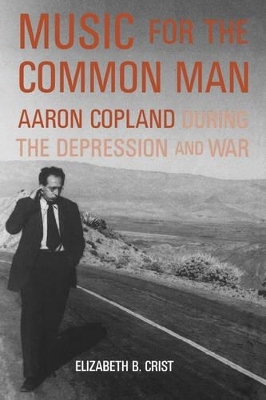
Music for the Common Man
Aaron Copland during the Depression and War
Seiten
2005
Oxford University Press Inc (Verlag)
978-0-19-515157-2 (ISBN)
Oxford University Press Inc (Verlag)
978-0-19-515157-2 (ISBN)
Music for the Common Man examines Copland's most celebrated music in the context of progressive politics during the 1930s and 1940s, arguing that such works as El Salon Mexico, Billy the Kid, and Appalachian Spring represent the aesthetic expression of leftwing cultural currents.
In the 1930s, Aaron Copland began to write in an accessible style he described as "imposed simplicity." Works like El Salón México, Billy the Kid, Lincoln Portrait, and Appalachian Spring feature a tuneful idiom that brought the composer unprecedented popular success and came to define an American sound. Yet the cultural substance of that sound--the social and political perspective that might be heard within these familiar pieces--has until now been largely overlooked.
While it has long been acknowledged that Copland subscribed to leftwing ideals, Music for the Common Man is the first sustained attempt to understand some of Copland's best-known music in the context of leftwing social, political, and cultural currents of the Great Depression and Second World War. Musicologist Elizabeth Crist argues that Copland's politics never merely accorded with mainstream New Deal liberalism, wartime patriotism, and Communist Party aesthetic policy, but advanced a progressive vision of American society and culture. Copland's music can be heard to accord with the political tenets of progressivism in the 1930s and '40s, including a fundamental sensitivity toward those less fortunate, support of multiethnic pluralism, belief in social democracy, and faith that America's past could be put in service of a better future. Crist explores how his works wrestle with the political complexities and cultural contradictions of the era by investing symbols of America--the West, folk song, patriotism, or the people--with progressive social ideals.
While much has been written on the relationship between politics and art in the 1930s and '40s, very little of that attention has been aimed at the world of concert music. Music for the Common Man offers fresh insights on familiar pieces and the political context in which they emerged.
In the 1930s, Aaron Copland began to write in an accessible style he described as "imposed simplicity." Works like El Salón México, Billy the Kid, Lincoln Portrait, and Appalachian Spring feature a tuneful idiom that brought the composer unprecedented popular success and came to define an American sound. Yet the cultural substance of that sound--the social and political perspective that might be heard within these familiar pieces--has until now been largely overlooked.
While it has long been acknowledged that Copland subscribed to leftwing ideals, Music for the Common Man is the first sustained attempt to understand some of Copland's best-known music in the context of leftwing social, political, and cultural currents of the Great Depression and Second World War. Musicologist Elizabeth Crist argues that Copland's politics never merely accorded with mainstream New Deal liberalism, wartime patriotism, and Communist Party aesthetic policy, but advanced a progressive vision of American society and culture. Copland's music can be heard to accord with the political tenets of progressivism in the 1930s and '40s, including a fundamental sensitivity toward those less fortunate, support of multiethnic pluralism, belief in social democracy, and faith that America's past could be put in service of a better future. Crist explores how his works wrestle with the political complexities and cultural contradictions of the era by investing symbols of America--the West, folk song, patriotism, or the people--with progressive social ideals.
While much has been written on the relationship between politics and art in the 1930s and '40s, very little of that attention has been aimed at the world of concert music. Music for the Common Man offers fresh insights on familiar pieces and the political context in which they emerged.
Elizabeth B. Crist is Assistant Professor of Musicology at The University of Texas at Austin. Her writings on Copland have appeared in American Music, The Musical Quarterly, and Journal of Musicology. She won an ASCAP Deems Taylor award for her article "Aaron Copland and the Popular Front," published earlier this year in the Journal of the American Musicological Society. She is co-editor (with Wayne Shirley) of The Selected Correspondence of Aaron Copland.
| Erscheint lt. Verlag | 3.11.2005 |
|---|---|
| Zusatzinfo | Halftones, music examples, tables |
| Verlagsort | New York |
| Sprache | englisch |
| Maße | 242 x 164 mm |
| Gewicht | 508 g |
| Themenwelt | Kunst / Musik / Theater ► Musik ► Klassik / Oper / Musical |
| ISBN-10 | 0-19-515157-7 / 0195151577 |
| ISBN-13 | 978-0-19-515157-2 / 9780195151572 |
| Zustand | Neuware |
| Informationen gemäß Produktsicherheitsverordnung (GPSR) | |
| Haben Sie eine Frage zum Produkt? |
Mehr entdecken
aus dem Bereich


aus dem Bereich
Essays und Gespräche
Buch | Hardcover (2025)
Wallstein Erfolgstitel (Verlag)
CHF 29,90


