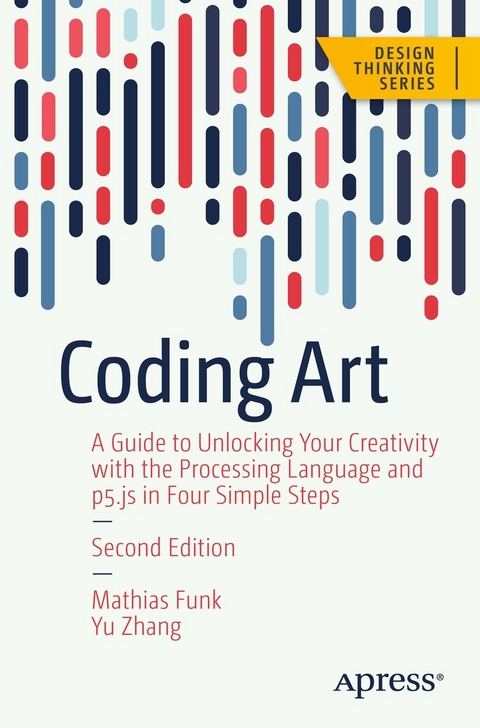
Coding Art (eBook)
333 Seiten
Apress (Verlag)
978-1-4842-9780-3 (ISBN)
What You’ll Learn
- Review ideas and approaches from creative programming to different professional domains
- Work with computational tools like the Processing language
- Understand the skills needed to move from static elements to animation to interaction
- Use interactivity as input to bring creative concepts closer to refinement and depth
- Simplify and extend the design of aesthetics, rhythms, and smoothness with data structures
- Leverage the diversity of art code on other platforms like the web or mobile applications
- Understand the end-to-end process of computation art through real world use cases
- Study best practices, common pitfalls, and challenges of the creative process
Finally, a book on creative programming, written directly for artists and designers! This second edition offers expanded and updated content incorporating the latest advancements and trends in the field of creative programming, also for creatives who want to work directly with P5.js and online. It delves deeper into the intricacies of computational art. It includes fresh case studies that explore real-world applications of coding art, inspiring readers to think beyond traditional boundaries.Rather than following a computer science curriculum, this book is aimed at creatives who are working in the intersection of design, art, and education. Following a real-world use case of computation art, you'll see how it relates back to the four key pillars, and addresses potential pitfalls and challenges in the creative process. All code examples are presented in a fully integrated Processing example library, making it easy for readers to get started. This unique and finely balanced approach between skill acquisition and development makes Coding Art, Second Edition the ideal reference book for both creative programming and the creative process for professors and students alike.What You'll LearnReview ideas and approaches from creative programming to different professional domainsWork with computational tools like the Processing languageUnderstand the skills needed to move from static elements to animation to interactionUse interactivity as input to bring creative concepts closer to refinement and depthSimplify and extend the design of aesthetics, rhythms, and smoothness with data structuresLeverage the diversity of art code on other platforms like the web or mobile applicationsUnderstand the end-to-end process of computation art through real world use casesStudy best practices, common pitfalls, and challenges of the creative processWho This Book Is ForThose looking to see what computation and data can do for their creative expression; learners who want to integrate computation and data into their practices in different perspectives; creative technologists, educators, digital artists and those who already know how to program, seeking creativity and inspiration in the context of computation and data.
| Erscheint lt. Verlag | 17.11.2023 |
|---|---|
| Reihe/Serie | Design Thinking | Design Thinking |
| Zusatzinfo | XVII, 333 p. 45 illus., 37 illus. in color. |
| Sprache | englisch |
| Themenwelt | Kunst / Musik / Theater ► Design / Innenarchitektur / Mode |
| Mathematik / Informatik ► Informatik ► Grafik / Design | |
| Mathematik / Informatik ► Informatik ► Programmiersprachen / -werkzeuge | |
| Mathematik / Informatik ► Informatik ► Software Entwicklung | |
| Technik ► Architektur | |
| Schlagworte | Art education • Computing Art • Creative Coding • Creative Computation • Design • Design education • Interactivity • Practitioner • Processing • Processing Software • Textbook • visual art |
| ISBN-10 | 1-4842-9780-6 / 1484297806 |
| ISBN-13 | 978-1-4842-9780-3 / 9781484297803 |
| Informationen gemäß Produktsicherheitsverordnung (GPSR) | |
| Haben Sie eine Frage zum Produkt? |
 PDF (Wasserzeichen)
Größe: 6,8 MB
DRM: Digitales Wasserzeichen
Dieses eBook enthält ein digitales Wasserzeichen und ist damit für Sie personalisiert. Bei einer missbräuchlichen Weitergabe des eBooks an Dritte ist eine Rückverfolgung an die Quelle möglich.
Dateiformat: PDF (Portable Document Format)
Mit einem festen Seitenlayout eignet sich die PDF besonders für Fachbücher mit Spalten, Tabellen und Abbildungen. Eine PDF kann auf fast allen Geräten angezeigt werden, ist aber für kleine Displays (Smartphone, eReader) nur eingeschränkt geeignet.
Systemvoraussetzungen:
PC/Mac: Mit einem PC oder Mac können Sie dieses eBook lesen. Sie benötigen dafür einen PDF-Viewer - z.B. den Adobe Reader oder Adobe Digital Editions.
eReader: Dieses eBook kann mit (fast) allen eBook-Readern gelesen werden. Mit dem amazon-Kindle ist es aber nicht kompatibel.
Smartphone/Tablet: Egal ob Apple oder Android, dieses eBook können Sie lesen. Sie benötigen dafür einen PDF-Viewer - z.B. die kostenlose Adobe Digital Editions-App.
Buying eBooks from abroad
For tax law reasons we can sell eBooks just within Germany and Switzerland. Regrettably we cannot fulfill eBook-orders from other countries.
aus dem Bereich