


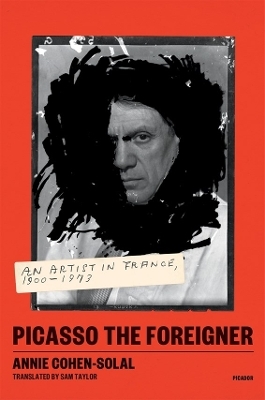
Picasso the Foreigner
An Artist in France, 1900-1973
Seiten
2026
Picador USA (Verlag)
978-1-250-32186-2 (ISBN)
Picador USA (Verlag)
978-1-250-32186-2 (ISBN)
- Noch nicht erschienen (ca. März 2026)
- Versandkostenfrei
- Auch auf Rechnung
- Artikel merken
Before Picasso became Picasso—the iconic artist now celebrated as one of France’s leading figures—he was constantly surveilled by the French police.
Soon after his arrival in 1901, he was flagged as an anarchist by the security services—the first of many entries in an extensive case file. Though he became increasingly wealthy as his reputation grew worldwide, Picasso’s art was largely excluded from public collections in France for the next four decades. The genius who conceived Guernica in 1937 as a visceral statement against fascism was even denied French citizenship three years later, on the eve of the Nazi occupation. In France, Picasso faced a triple stigma—as a foreigner, a political radical, and an avant-garde artist.
Picasso the Foreigner approaches the artist from an entirely new angle, making use of long-overlooked archival sources. In this groundbreaking narrative, Picasso emerges as an artist who ignored national modes in favor of contemporary cosmopolitan forms. Annie Cohen-Solal reveals how Picasso strategized and fought to preserve his agency, eventually leaving Paris for good in 1955. He chose the south over the north and craftspeople over academicians, while simultaneously achieving widespread fame. The artist never became a citizen of France, yet he dynamized the country’s culture like few other figures in its history. This book, for the first time, explains how.
Soon after his arrival in 1901, he was flagged as an anarchist by the security services—the first of many entries in an extensive case file. Though he became increasingly wealthy as his reputation grew worldwide, Picasso’s art was largely excluded from public collections in France for the next four decades. The genius who conceived Guernica in 1937 as a visceral statement against fascism was even denied French citizenship three years later, on the eve of the Nazi occupation. In France, Picasso faced a triple stigma—as a foreigner, a political radical, and an avant-garde artist.
Picasso the Foreigner approaches the artist from an entirely new angle, making use of long-overlooked archival sources. In this groundbreaking narrative, Picasso emerges as an artist who ignored national modes in favor of contemporary cosmopolitan forms. Annie Cohen-Solal reveals how Picasso strategized and fought to preserve his agency, eventually leaving Paris for good in 1955. He chose the south over the north and craftspeople over academicians, while simultaneously achieving widespread fame. The artist never became a citizen of France, yet he dynamized the country’s culture like few other figures in its history. This book, for the first time, explains how.
| Erscheint lt. Verlag | 16.3.2026 |
|---|---|
| Verlagsort | New York |
| Sprache | englisch |
| Maße | 137 x 211 mm |
| Themenwelt | Literatur ► Biografien / Erfahrungsberichte |
| Kunst / Musik / Theater | |
| Technik ► Architektur | |
| ISBN-10 | 1-250-32186-7 / 1250321867 |
| ISBN-13 | 978-1-250-32186-2 / 9781250321862 |
| Zustand | Neuware |
| Informationen gemäß Produktsicherheitsverordnung (GPSR) | |
| Haben Sie eine Frage zum Produkt? |
Mehr entdecken
aus dem Bereich


aus dem Bereich
unser Eingliederungsversuch in eine geschlossene Gesellschaft
Buch | Softcover (2025)
Knaur (Verlag)
CHF 25,20


