


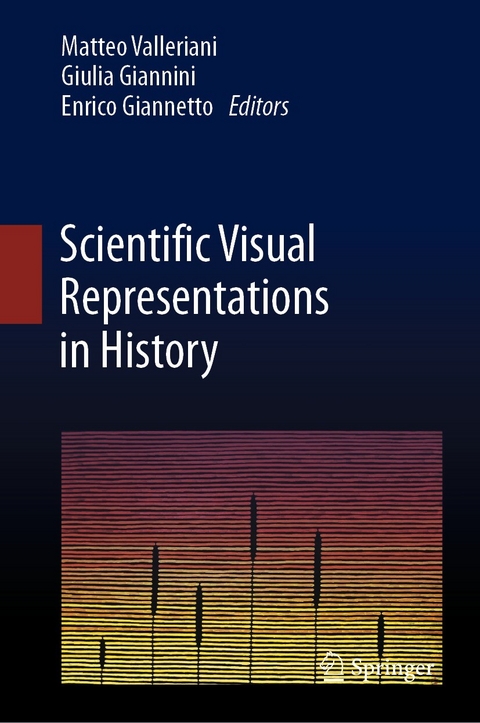
Scientific Visual Representations in History (eBook)
360 Seiten
Springer International Publishing (Verlag)
978-3-031-11317-8 (ISBN)
This book explores continuity and ruptures in the historical use of visual representations in science and related disciplines such as art history and anthropology. The book also considers more recent developments that attest to the unprecedented importance of scientific visualizations, such as video recordings, animations, simulations, graphs, and enhanced realities. The volume collects historical reflections concerned with the use of visual material, visualization, and vision in science from a historical perspective, ranging across multiple cultures from antiquity until present day.
The focus is on visual representations such as drawings, prints, tables, mathematical symbols, photos, data visualizations, mapping processes, and (on a meta-level) visualizations of data extracted from historical sources to visually support the historical research itself. Continuity and ruptures between the past and present use of visual material are presented against the backdrop of the epistemic functions of visual material in science. The function of visual material is defined according to three major epistemic categories: exploration, transformation, and transmission of knowledge.
Matteo Valleriani is a research group leader at the Department I at the Max Planck Institute for the History of Science in Berlin, honorary professor at the Technische Universita¨t of Berlin, and professor by Special Appointments at the University of Tel Aviv. He investigates the relation between diffusion processes of scientific, practical, and technological knowledge and their economic and political preconditions. His research focuses on the Hellenistic period, the late Middle Ages, and the Early Modern Period. Among his principal research endeavors, he leads the project 'The Sphere: Knowledge System Evolution and the Shared Scientific Identity of Europe,' which investigates the formation and evolution of a shared scientific identity in Europe between the thirteenth and seventeenth centuries. Among his publications, he has authored the book Galileo Engineer (Springer 2010), is editor of The Structures of Practical Knowledge (Springer Nature 2017), and published De sphaera of Johannes de Sacrobosco in the Early Modern Period. The Authors of the Commentaries (Springer Nature 2020)
Giulia Giannini is Associate Professor of History of Science at the University of Milan (Italy). She is the principal investigator of the ERC Consolidator research project 'TACITROOTS - The Accademia del Cimento in Florence: tracing the roots of the European scientific enterprise', which investigates the historical process of establishment of scientific societies in Europe, the emergence of a shared scientific discourse, and its normalization (Horizon 2020, GA 818098). She worked at the Center Koyré in Paris and at the Max Planck Institute for the History of Science in Berlin. Her research interests focus on the history of experimentation, and on cultural, political, and social studies of science in Early Modern Europe. Among recent project, she is the co-editor, with Mordechai Feingold, of The Institutionalization of Science in Early Modern Europe (Brill 2020).
Enrico Giannetto was a graduate at the University of Padova in elementary particle theoretical physics, and then he studied early universe cosmology at the ISAS of Trieste. He studied history of science at the Domus Galilaeana in Pisa and obtained his doctorate in theoretical physics of condensed matter at the University of Messina. He has been working as a researcher for ten years at the University of Pavia within the History of Science & Science Education Group. Here, he taught in particular General Physics. Since 2001, he is a full professor of History of Physics and History of Science, since 2002 at the University of Bergamo, Italy. Here, he has been teaching many disciplines from History of Scientific Thinking, to Theoretical Philosophy, Epistemology of Complexity, and Physics. His researches are focused on a perspective of a wide history of cultures where mythology, history of religions, anthropology, philosophy, human and natural science are entangled. In particular, he has done research works on the following disciplines among others: quantum chromodynamics, quantum electrodynamics, early universe quantum cosmology, phase transitions in cosmology and condensed matter, special and general relativity, foundations of quantum mechanics, quantum logic; history of quantum physics, of relativity, of chaos physics, of elementary particle physics, of medieval physics, of romantic natural philosophy, of the scientific revolution and of theoretical physics, history of psychology versus physics, science education, hermeneutics, philosophy of dialogue, anthropology of scientific thinking, and history of primeval Christianity. He has published more than 200 scientific papers and four major books: Saggi di Storie del Pensiero Scientifico, Bergamo University Press, Bergamo 2005; Il vangelo di Giuda-traduzione dal copto e commento, Medusa, Milano 2006; 'Un fisico delle origini. Heidegger, la scienza e la Natura, Donzelli, Roma 2010; Sguardi sul pensiero contemporaneo. Filosofia e scienze per cambiare il mondo, libreriauniversitaria.it, Limena (PD) 2018.
| Erscheint lt. Verlag | 1.1.2023 |
|---|---|
| Zusatzinfo | XV, 360 p. 112 illus., 106 illus. in color. |
| Sprache | englisch |
| Themenwelt | Kunst / Musik / Theater ► Malerei / Plastik |
| Geisteswissenschaften | |
| Naturwissenschaften | |
| Technik | |
| Schlagworte | Epistemic Functions • external representations • Image Transmission • numerical reconstruction • Visual Representation • visual thinking • woodcut illustrations |
| ISBN-10 | 3-031-11317-9 / 3031113179 |
| ISBN-13 | 978-3-031-11317-8 / 9783031113178 |
| Informationen gemäß Produktsicherheitsverordnung (GPSR) | |
| Haben Sie eine Frage zum Produkt? |
 PDF (Wasserzeichen)
DRM: Digitales Wasserzeichen
Dieses eBook enthält ein digitales Wasserzeichen und ist damit für Sie personalisiert. Bei einer missbräuchlichen Weitergabe des eBooks an Dritte ist eine Rückverfolgung an die Quelle möglich.
Dateiformat: PDF (Portable Document Format)
Mit einem festen Seitenlayout eignet sich die PDF besonders für Fachbücher mit Spalten, Tabellen und Abbildungen. Eine PDF kann auf fast allen Geräten angezeigt werden, ist aber für kleine Displays (Smartphone, eReader) nur eingeschränkt geeignet.
Systemvoraussetzungen:
PC/Mac: Mit einem PC oder Mac können Sie dieses eBook lesen. Sie benötigen dafür einen PDF-Viewer - z.B. den Adobe Reader oder Adobe Digital Editions.
eReader: Dieses eBook kann mit (fast) allen eBook-Readern gelesen werden. Mit dem amazon-Kindle ist es aber nicht kompatibel.
Smartphone/Tablet: Egal ob Apple oder Android, dieses eBook können Sie lesen. Sie benötigen dafür einen PDF-Viewer - z.B. die kostenlose Adobe Digital Editions-App.
Buying eBooks from abroad
For tax law reasons we can sell eBooks just within Germany and Switzerland. Regrettably we cannot fulfill eBook-orders from other countries.
aus dem Bereich


