Acting Is Believing
Rowman & Littlefield (Verlag)
978-1-5381-7176-9 (ISBN)
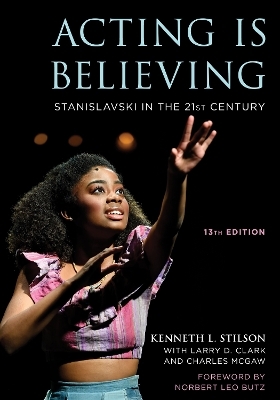
Acting Is Believing has trained generations of actors and remains one of the most popular and influential classic Stanislavski-based acting books over the past sixty years. Now in its thirteenth edition, ithas been reimagined for the art of acting in the twenty-first century.
Stanislavski expanded our understanding of the mysterious process that results in truthful acting, devising practical steps to pursue the most elusive element of the artform—inspiration. Acting Is Believing: Stanislavski in the 21st Century, 13th Edition,introduces students to all the major concepts of Stanislavski’s System of Acting, providing them with a logical process through which they can master this complex art. It breaks down even the most complex elements defining human behavior in ways that are easy to digest.
This new edition has been greatly updated, including:
Reworked chapters throughout to bring Stanislavski’s theories to life in a language that speaks to today’s actorsA new approach to entering Stanislavski’s Creative State, broken into an innovative five-part processUpdated discussions on anxiety, physical tension, social inhibitions, and intimacy onstageModified solo and group exercisesExpanded appendix on self-directed scene study Refined and updated glossary of acting, theatre, and film terminology
Acting Is Believing remains grounded in Stanislavski-based technique training, yet this latest text has evolved as a vital resource for twenty-first century artists pursing acting careers in theatre, film, and television. With a foreword by two-time Tony Award winning actor, Norbert Leo Butz, Acting Is Believing continues to set the gold standard in the art of acting for a new generation.
Kenneth L. Stilson is the author of the last five editions of Acting is Believing, along with the late Larry D. Clark and the late Charles McGaw. Stilson serves as the Executive Director of the Lanford Wilson New American Play Festival and Founding Chair of The Jeanine Larson Dobbins Conservatory of Theatre & Dance at Southeast Missouri State University. As a playwright/librettist, his works include An American Hero: A World War II Musical (OB, Acorn Theatre, NYMF, winner, Best of Festival), Stage Door Johnny: A Rock Musical (with Mike Appel), Where the Lilies Grow, and more. His screenplays include Fire Lily (Best of Festival, American Artist Film Festival) and Interviewing Monsters (with Tom Greene), and he is the author of Ezra Stone: A Theatre Biography. He has been an acting coach for 30 years, with former students having earned Tony and Obie Awards. He has directed more than 70 plays and musicals at numerous theatres. He currently serves on the Commission of Accreditation with the National Association of Schools of Theatre (NAST) in Arlington, VA.
Foreword by Norbert Leo Butz
Preface
Acknowledgments
Chapter 1A: Life in Art
Acting with Professional Competence
The Six Parts of Actor Training
The Business of Acting
Acting is Believing: Stanislavski in the 21st Century
External Resources
Chapter 2: The Creative State
Body Training
Breathing and Posture
Exercise 2.1 Breathing
Exercise 2.2 Posture
The Creative State
Exercise 2.3 Aerobic
Exercise 2.4 Stretching
Exercise 2.5 Moving
Exercise 2.6 Vocalizing
On Anxiety
Physical Tension
Social Inhibitions
Nudity and Intimacy
Chapter 3: The Choice of Actions
Exercise 3.1 Given Circumstances and Imagination
Commitment to Actions
Belief in Actions
Improvisational Technique
Exercise 3.2 Improvising Simple Tasks
Exercise 3.3 Recalling a Special Memory
Scoring Physical Actions
Tempo/Rhythm
Exercise 3.4 Scores from Scenarios
Chapter 4: Stanislavski’s Method of Physical Actions
Simple Objectives
Exercise 4.1 Refining Your Score
Action Verbs
Exercise 4.2 Actions from an Emotional State
Exercise 4.3 Everyday Actions
Physical and Psychological Obstacles
Strategy and Desire
Expectations and Adaptations
Nonverbal Group Improvisations
Exercise 4.4 Waiting
Exercise 4.5 Not on Speaking Terms
Verbal Group Improvisations
Exercise 4.6 Opposing Objectives
Exercise 4.7 Improvisation from Action Verbs
Exercise 4.8 Non-Content Scenes
Chapter 5: Observation
Exercise 5.1 Playing a Condition
Exercise 5.2 Three Objects
Exercise 5.3 Adjusting to Conditions
Observing People
Exercise 5.4 Observation Notebook
Exercise 5.5 Creating an Actor’s Image Collage
Adapting Your Observations
Exercise 5.6 Observing Visual Art
Abstraction
Exercise 5.7 Abstractions from Inanimate Objects
Exercise 5.8 Abstraction from Animals
Chapter 6: Circles of Attention
Exercise 6.1 Distractions
Exercise 6.2 Add-a-Word
Public Solitude
The Small Circle
Exercise 6.3 Objects in the Small Circle
Communion
Exercise 6.4 Mirrors
Exercise 6.5 Silent Argument
Communion with the Audience
Dramatic Action in Speech
Exercise 6.6 Key Line Improvisation
Chapter 7: Emotion Memory
Stanislavski and Emotion Memory
Retaining an Emotion Memory
Selecting the Emotion Memory
Using the Emotion Memory
Emotional Triggers
Exercise 7.1 Reconstructing a Personal Memory
Inner Images
Exercise 7.2 Verbalizing Images
Exercise 7.3 Image Improvisations
Inner Monologues
Exercise 7.4 Inner Monologues
Chapter 8: Creating a Character
Script Analysis
The World of the Play
Exercise 8.1 Historical Imagination
Character Autobiography
Exercise 8.2 Character Autobiography
Exercise 8.3 If It Were Up to Me…
Second Plan
Exercise 8.4 Second Plan
External Expression
Units of Action
Scoring
Exercise 8.5 Scoring a Role
The Motivating Force
Exercise 8.6 Motivating Force
The Super-Objective
Exercise 8.7 Super-Objective
Summary
Chapter 9: Subtext
Exercise 9.1 Improvising Subtext
Verbal Action
Exercise 9.2 Text, Subtext, and Verbal Action
Relating the Lines to the Motivating Force
Relating the Lines to the Super-Objective
Manners of Speaking
Dialects and Accents
Exercise 9.4 Speech Patterns
Longer Speeches
Exercise 9.5 Verbal Actions in Longer Speeches
Chapter 10: The Power of Words
Meaning, Operative Words, and Idioms
Sentence Structure
Progressions
Antithesis
Secondary Inner Images
Exercise 10.1 Longer Speeches
Chapter 11: Reincarnation
Tablework and Early Discoveries
Working Rehearsals
Exercise 11.1 Putting Spontaneity into Physical Choices
Run-throughs and Technical Rehearsals
Performances
Chapter 12: The Business of Acting
Understanding the Business
Business Plan
Exercise 12.1 The Actor’s Business Plan
Exercise 12.2 The Elevator Pitch
Headshots and Resumes
Exercise 12.3 Resume
Introductory and Follow-up Emails
Exercise 12.4 Introductory and Follow-up Emails
Preparing Your Audition
Exercise 12.5 Audition Preparation – Working Off a Partner
Auditioning
Exercise 12.6 Moment Before
Exercise 12.7 Laughing at the Top
Exercise 12.8 Portfolio
Appendix A: Self-Directed Scene Study
Appendix B: Glossary
Bibliography
Index
| Erscheinungsdatum | 31.05.2023 |
|---|---|
| Co-Autor | Larry D. Clark, Charles McGaw |
| Vorwort | Norbert Leo Butz |
| Zusatzinfo | 46 b/w photos; 5 tables |
| Sprache | englisch |
| Maße | 185 x 262 mm |
| Gewicht | 948 g |
| Themenwelt | Kunst / Musik / Theater ► Theater / Ballett |
| ISBN-10 | 1-5381-7176-7 / 1538171767 |
| ISBN-13 | 978-1-5381-7176-9 / 9781538171769 |
| Zustand | Neuware |
| Informationen gemäß Produktsicherheitsverordnung (GPSR) | |
| Haben Sie eine Frage zum Produkt? |
aus dem Bereich