


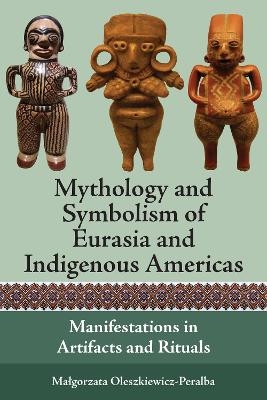
Mythology and Symbolism of Eurasia and Indigenous Americas
Manifestations in Artifacts and Rituals
Seiten
2022
Berghahn Books (Verlag)
978-1-80073-816-4 (ISBN)
Berghahn Books (Verlag)
978-1-80073-816-4 (ISBN)
There is a continuity of a cohesive system of symbols and patterns from the Paleolithic and the Neolithic that survives in present-day imagery. The understanding of commonalities underlying these seemingly distant cultures demonstrates that, despite appearances, there is more that unites us than that divides us.
A system of myths, symbols, and rituals, dating back to the Paleolithic and Neolithic, survives in present-day imagery. In exploring this system, special attention is drawn to the linkage between ancient and contemporary civilizations of Eurasia and Mesoamerica, as seen in their cosmology, and expressed in common mythological and iconographic themes. The author examines contemporary Middle American and eastern European textiles, especially women’s garments, that contain an elaborated sacred code of symbols, and include remnants of the four horizontal directions, and the three vertical worlds that portray the structure of the universe. The cosmology contained in patterns around the world denotes striking parallels that attest to internal connections between different cultures, beyond time and place.
A system of myths, symbols, and rituals, dating back to the Paleolithic and Neolithic, survives in present-day imagery. In exploring this system, special attention is drawn to the linkage between ancient and contemporary civilizations of Eurasia and Mesoamerica, as seen in their cosmology, and expressed in common mythological and iconographic themes. The author examines contemporary Middle American and eastern European textiles, especially women’s garments, that contain an elaborated sacred code of symbols, and include remnants of the four horizontal directions, and the three vertical worlds that portray the structure of the universe. The cosmology contained in patterns around the world denotes striking parallels that attest to internal connections between different cultures, beyond time and place.
Małgorzata Oleszkiewicz-Peralba is Professor of Hispanic Literary and Cultural Studies at the University of Texas at San Antonio. Her publications include Fierce Feminine Divinities of Eurasia and Latin America: Baba Yaga, Kali, Pombagira, and Santa Muerte (2015), The Black Madonna in Latin America and Europe: Tradition and Transformation (2007), and Teatro popular peruano: del precolombino al siglo XX (1995).
List of Illustrations
Foreword
Acknowledgments
Introduction: Worldview
Chapter 1. Cervids and Their Associations
Chapter 2. Goddess Civilizations and Their Symbols
Chapter 3. Image of the Universe
Chapter 4. Weaving and Embroidery: A Semblance of the Cosmos
Conclusion
Bibliography
Index
| Erscheinungsdatum | 18.11.2022 |
|---|---|
| Zusatzinfo | Bibliography; Index; 73 Illustrations |
| Verlagsort | Oxford |
| Sprache | englisch |
| Maße | 152 x 229 mm |
| Themenwelt | Kunst / Musik / Theater ► Kunstgeschichte / Kunststile |
| ISBN-10 | 1-80073-816-1 / 1800738161 |
| ISBN-13 | 978-1-80073-816-4 / 9781800738164 |
| Zustand | Neuware |
| Informationen gemäß Produktsicherheitsverordnung (GPSR) | |
| Haben Sie eine Frage zum Produkt? |
Mehr entdecken
aus dem Bereich

aus dem Bereich
kleine Kulturgeschichte einer brillanten Allianz
Buch | Softcover (2025)
Iudicium (Verlag)
CHF 33,90


