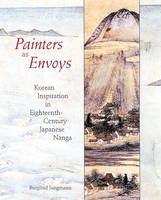
Painters as Envoys
Princeton University Press (Verlag)
978-0-691-11463-7 (ISBN)
- Titel ist leider vergriffen;
keine Neuauflage - Artikel merken
It is well known that Japanese literati painting of the eighteenth century was inspired by Chinese styles that found their way to Japan through trade relations. However, because Japanese and American art historians have focused on Japanese-Chinese ties, the fact that Japan also maintained important diplomatic--and aesthetic--relations with Korea during the same period has long been neglected. This richly illustrated, cogently argued book examines the role of Korean embassies in shaping the new Japanese literati style, known as Nanga in Japan. Burglind Jungmann describes the eighteenth-century Korean-Japanese diplomatic exchange and the circumstances under which Korean and Japanese painters met. Since diplomatic relations were conducted on both sides by scholars with a classical Chinese education, Korean envoys and their Japanese hosts shared a deep interest in Chinese philosophy, literature, calligraphy, and painting. Texts, such as Ike Taiga's letter to Kim Yusng and Gion Nankai's poem for Yi Hyn, and accounts by Korean and Japanese diplomats, give a vivid picture of the interaction between Korean and Japanese painters and envoys.
Further, the paintings done by Korean painters during their sojourns in Japan attest to the transmission of a distinctly Korean literati style, called Namjonghwa. By comparing Korean, Japanese, and Chinese paintings, the author shows how the Korean interpretation of Chinese styles influenced Japanese literati painters and helped inspire the creation of their new style.
Burglind Jungmann is Associate Professor of Korean Art History at the University of California, Los Angeles. Her previous book, on the Chinese influence on sixteenth-century Korean painting, was published in Germany in 1992.
Preface 7 Introduction 13 Part I: Historical Conditions and the Origin of the Style Chapter One: Korean Embassies to japan in the Eighteenth Century 25 Chapter Two: Southern School Painting in China, Korea, and Japan 47 Part II: The Nanga Pioneers and Their Relationahip with Korea Chapter Three: Gion Nankai and the Korean Embassy of 1741 75 Chapter Four: Sakaki Hyakusen, Yanagisawa Kien, and the An Kyon School Style 103 Part III: The Second Generation: Ike Taiga and the Impact of Korean Namjonghwa Chapter Five: Ike Taiga's Circle and the Korean Embassies 121 Chapter Six: Korean Influence on Ike Taiga's Painting Style 167 Chapter Seven: Korean True Scenery Painting and Its Spread to japan 187 Conclusion: Korean Contributions to the Creation of the Nanga Style 205 List of Characters 212 Appendix: Korean and Japanese Texts 219 Notes 223 Bibliography 253 Index 266 Photography Credits 272
| Erscheint lt. Verlag | 10.10.2004 |
|---|---|
| Zusatzinfo | 112 halftones. |
| Verlagsort | New Jersey |
| Sprache | englisch |
| Maße | 203 x 254 mm |
| Gewicht | 1332 g |
| Themenwelt | Kunst / Musik / Theater ► Kunstgeschichte / Kunststile |
| Kunst / Musik / Theater ► Malerei / Plastik | |
| ISBN-10 | 0-691-11463-3 / 0691114633 |
| ISBN-13 | 978-0-691-11463-7 / 9780691114637 |
| Zustand | Neuware |
| Informationen gemäß Produktsicherheitsverordnung (GPSR) | |
| Haben Sie eine Frage zum Produkt? |
aus dem Bereich