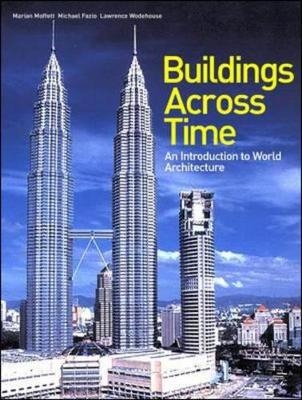
Buildings across Time
McGraw-Hill Publishing Co.
978-0-07-287864-6 (ISBN)
- Titel ist leider vergriffen;
keine Neuauflage - Artikel merken
The expanded second edition of this heavily illustrated survey provides students of both art history and architecture with a worldwide introduction to the history of architecture.
Marian Moffett earned a B.Arch. at North Carolina State University (1971) and the M.Arch. and PhD. at the Massachusetts Institute of Technology (1973 and 1975, respectively). Since 1975, she has taught architectural history at he University of Tennessee, where she has collaborated with Lawrence Wodehouse in producing exhibitions and catalogs on the architecture of the Tennessee Valley Authority and cantilever barns, as well as co-authoring A History of Western Architecture and East Tennessee Cantilever Barns. Her research includes work on wooden architecture in eastern Europe and town planning in Tennessee. She is active with the Southeast Chapter of the Society of Architectural Historians and has served as President of the UT Faculty Senate and as an academic administrator in the Office of the Provost. Michael Fazio is an architect and architectural historian. He holds a Bachelor of Architecture Degree from Auburn University, a Master of Architecture Degree from The Ohio State University, and a Ph.D. in the History of Architecture and Urban Development from Cornell University. He practices architecture in the southeast region, most often as a preservation consultant preparing historic structures reports. He teaches architectural design studios and architectural history in the School of Architecture at Mississippi State University. He is also an actively publishing scholar whose articles have appeared in the Society of Architectural Historians Journal, Arris (the journal of the Southeast Society of Architectural Historians), and the Journal of Architectural Education. His book (with co-author Patrick Snadon of the University of Cincinnati), Inventing the American House: the Domestic Architecture of Benjamin Henry Latrobe, will be published in 2003 by The Johns Hopkins University Press and will be accompanied by an exhibition at The Octagon and Decatur House in Washington, D.C. Lawrence Wodehouse, a native of Norwich, England, received a Diploma in Architecture from the University of Durham (1959), a diploma in Town Planning from London University (1962), an M.Arch degree from Cornell University (1963), and a Ph.D. in architectural history from the University of St. Andrews (1980). He taught architectural history at Texas Technological University, North Carolina State University, Pratt Institute, the University of Dundee, and the University of Tennessee until his retirement in 1993. Known for his research on nineteenth and twentieth American architecture, he is the author of many books, Including East Tennessee Cantilever Barns (1993), The Roots of International Style Architecture (1991), A History of Western Architecture (1989), White of McKim, Mead and White (1988), Ada Louise Huxtable: A Bibliography (1981), and British Architects, 1841-1976 (1980), and numerous scholarly articles. He is a registered architect in the United Kingdom and a founding member of the Southeast Chapter of the Society of Architectural Historians.
Introduction A Word about Drawings and Images Using the CD The Beginnings of Architecture Prehistoric Settlements and Megalith Constructions Ancient Mesopotamia Ancient Egypt The Early Dynastic Period and Old Kingdom (First through Eight Dynasties, CA. 2920-2134 BCE) The Middle Kingdom (Eleventh through Thirteenth Dynasties, CA. 2040-1640 BCE) The New Kingdom (Eighteenth through Twentieth Dynasties, CA. 1550-1070 BCE) The Greek World The Minoans The Mycenaeans Greece: The Archaic Period Greece: The Classical Period Greece: The Hellenistic Period Greek City Planning The Architecture of Ancient India and Southeast Asia Early Buddhist Shrines The Spread of Buddhist Influence Early Hindu Shrines Traditional Architecture of China and Japan Chinese Architectural Principles Principles of City Planning Houses and Gardens Japanese Temple Architecture Japanese Cities, Castles, and Houses Zen Buddhist Architecture The Roman World Roman Architecture Building Techniques and Materials City Planning Temples Public Buildings Residences Early Christian and Byzantine Architecture Early Christian Basilicas Martyria, Baptistries, and Mausolea Byzantine Basilicas and Domed Basilicas Centrally Planned Byzantine Churches Byzantine Churches in Russia Islamic Architecture Early Shrines and Palaces Development of the Mosque Regional Variations in Mosque Design Houses, Palaces, and Urban Patterns Early Medieval and Romanesque Architecture Carolingian Architecture Anglo-Saxon and Viking Architecture Early Romanesque Architecture Romanesque Architecture of the Holy Roman Empire Churches of the Pilgrimage Roads The Order of Cluny Romanesque Architecture of Aquitaine and Provence Cistercian Monasteries Norman Architecture Gothic Architecture Early Gothic High Gothic Gothic Architecture in England Italian and German Gothic Medieval Construction Medieval Housing and Castles Medieval Cities Indigenous Architecture in the Pre-Columbian Americas Tribes of the Great Plains and the Great Lakes Tribes of the Northeast Tribes of the Mississippi River Basin Arctic and Subarctic Tribes Tribes of the Northwest and Northern California Tribes of the Southwest The Olmecs of the Eastern Mexican Coast Teotihuacan in the Valley of Mexico The Zapotecs and Mixtecs at Monte Alban in Oaxaca Tikal and Oter Maya Sites in Guatemala and the Yucatan The Toltecs in the Valley of Mexico The Aztecs at Tenochlitlan The Incas in the Andes Renaissance Architecture Filippo Brunelleschi Leone Battista Alberti Other Renaissance City Plans The Spread of the Renaissance Leonardo da Vinci Donato Bramante The Late Renaissance or Mannerism Michelangelo Andrea Palladio Palladio's Venice Garden Design The Renaissance in France The Renaissance in England Baroque Architecture The Catholic reformation and Counter Reformation Pope Sixtus V and the Replanning of Rome The Completion of St. Peter's and the Work of Gianlorenzo Bernini The Small Roman Churches by Francesco Borromini Urban Open Spaces in Baroque Rome The Spread of Baroque Architecture to Northern Italy The Baroque in Central Europe The Baroque in France Christopher Wren and the Baroque in England Hawksmoor, VanBrugh, and Gibbs The Eighteenth Century The English Neo-Palladians The Return to Antiquity Robert Adam and William Chambers Aetienne-Louis Boullee and Claude-Nicholas Ledoux French Architects and the Aggrandizement of the State French Architectural Education and the Ecole de Beaux Arts The Challenge of the Industrial Revolution Romanticism and the Picturesque The Romantic Landscape Picturesque Buildings Nineteenth Century Developments Neo-Classicism The Gothic Revival The Ecole des Beaux-Arts Progress in Iron and Steel Fabrication Architectural Applications of Iron and Steel Construction Skeletal Construction in Concrete and Wood The Arts and Crafts Movement The Art Nouveau The Vienna Secession Henry Hobson Richardson and Louis Sullivan in America The Twentieth Century and Modernism The Idea of a Modern Architecture Adolf Loos The Modern Masters Frank Lloyd Wright Peter Behrens and the Deutscher Werkbund Futurism and Constructivism Dutch and German Expressionism The Art Deco De Stijl Architects and Engineers who Exploited the Potential of Concrete Tony Garnier and the Industrial City Le Corbusier Walter Gropius and the Bauhaus Ludwig Mies Van der Rohe The Weissenhof Siedlung and the International Style Later Work of Mies Van der Rohe Later Work of Frank Lloyd Wright Later Work of Le Corbusier Modernisms in the Mid- and Late-Twentieth Century Alvar Aalto Eero Saarinen Louis I. Kahn Robert Venturi's Radical Counter-Proposal to Modernism Intellectual Inspirations for Post-Modernism Philip Johnson Charles Moore Michael Graves Robert A.M. Stern Richard Meier The Exploitation of Technology by James Stirling and Others Deconstruction Peter Eisenman Frank Gehry Glenn Murcutt
| Erscheint lt. Verlag | 1.9.2003 |
|---|---|
| Verlagsort | London |
| Sprache | englisch; Multiple languages |
| Maße | 221 x 292 mm |
| Gewicht | 1814 g |
| Themenwelt | Kunst / Musik / Theater ► Kunstgeschichte / Kunststile |
| ISBN-10 | 0-07-287864-9 / 0072878649 |
| ISBN-13 | 978-0-07-287864-6 / 9780072878646 |
| Zustand | Neuware |
| Informationen gemäß Produktsicherheitsverordnung (GPSR) | |
| Haben Sie eine Frage zum Produkt? |
aus dem Bereich