


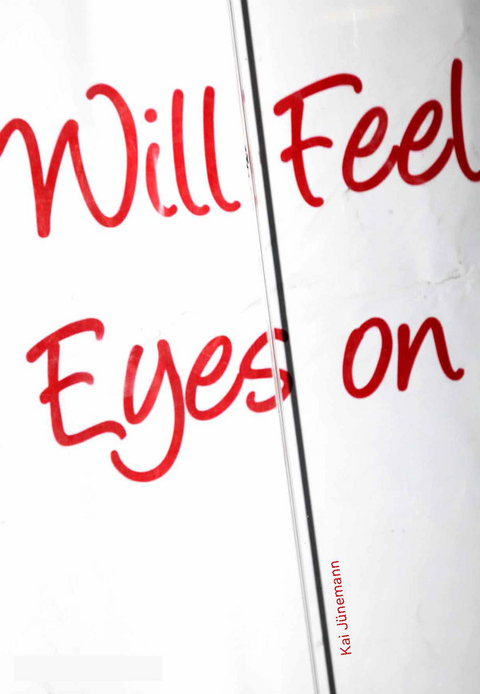
Will Feel Eyes on
Seiten
2019
Slanted Publishers (Verlag)
978-3-948440-03-9 (ISBN)
Slanted Publishers (Verlag)
978-3-948440-03-9 (ISBN)
- Titel leider nicht mehr lieferbar
- Artikel merken
Das Fotobuch »Will Feel Eyes on« des international renommierten Fotografen Kai Jünemann stellt ein buntes und spontanes, visuelles Tagebuch mit 113 Fotografien dar, die während seines ersten und intensiven Aufenthalts in Teheran im Iran entstanden sind.
Aus dem Vorwort von Dirk Gebhardt:
»Muster und Zeichen bilden einen eigentümlichen Raum non-verbaler Kommunikation im Straßenbild. Dem westlichen Blick erklären sie sich teilweise durch die Anlehnung an bekannte Bildmuster. Porzellanpferde, Raubkatzenstoffmuster und das letzte Abendmal sind direkt der soziologisch-symbolischen Bedeutung des Okzidents entlehnt. In Kombination mit der geschwungenen Schrift von Koran-Suren auf Kopfkissen, bedeckten Frauenköpfen und bunt bedruckten Stoffen entwickeln sie eine neue, unbekannte Bedeutung. Dem Iran unbeeinflusst der politischen Dimension, fotografisch entgegenzutreten ist eine Herausforderung.
Kai Jünemann umgeht jegliche Stellungnahme durch das verschlüsselte, spielerische Erkunden der visuellen Oberflächen. Details, Anschnitte und das harte Blitzlicht, schneiden mit der Präzision eines Skalpells, Objekte, Menschen und Situation aus der Wirklichkeit.
Jünemanns Welt wird reduziert auf Muster und Rhythmen dadurch steht sie metaphorisch für das Verschmelzen und das sich Beeinflussen von Kulturen. Ungewöhnliches wird so gewohnt, gewohntes verwundert den Betrachter. Es stellt sich ihm unmittelbar die Frage nach den eigenen Klischees und Seh-Gewohnheiten. Die Symbole von Status und Stolz, Eleganz und Banalität, Macht und Erotik prallen bunt durchmischt aufeinander und formen so einen Kosmos der Menschlichkeit – nachvollziehbar und emphatisch. Des Fremde wird Heimat, trotz oder gerade durch die Exotik vieler Bilder in Jünemanns visuellen, iranischen Tagebuch.« The photo book “Will Feel Eyes on” by Kai Jünemann, internationally renowned photographer, represents a colorful and spontaneous visual diary with 113 photographs taken during his first and intense stay in Teheran, Iran.
From the editorial by Dirk Gebhardt:
“On the street, patterns and signs shape a unique space of non-verbal communication. The Western gaze recognizes them in part by recalling familiar pictorial patterns. Porcelain horses, cheetah prints, and the last supper directly reference the sociological and symbolic significance of the Occident. In combination with the curved writing of Koran suras on pillows, covered hair, and colorful printed fabrics, they develop a new, unknown meaning. To confront Iran photographically, while remaining unaffected by its political dimension, is a challenge.
Kai Jünemann circumvents a personal statement through the coded, playful exploration of visual surfaces. The details, frames, and harsh exposures of his images, cut objects, people, and situations out of reality with the precision of a scalpel. Jünemann’s world is reduced to patterns and rhythms, thereby metaphorically representing the merging and cross-influencing of cultures.
The unusual is so mundane that the familiar astonishes the viewer, who is immediately confronted with the question of his own clichés and habits of seeing. Symbols of status and pride, elegance and banality, power and eroticism collide with each other in a colorful and mixed way, thus forming a cosmos of humanity—comprehensible and emphatic. What was once foreign ground is transformed into home territory, despite or maybe even because of the exoticism of many pictures in Jünemann’s visual Iranian diary.”
Aus dem Vorwort von Dirk Gebhardt:
»Muster und Zeichen bilden einen eigentümlichen Raum non-verbaler Kommunikation im Straßenbild. Dem westlichen Blick erklären sie sich teilweise durch die Anlehnung an bekannte Bildmuster. Porzellanpferde, Raubkatzenstoffmuster und das letzte Abendmal sind direkt der soziologisch-symbolischen Bedeutung des Okzidents entlehnt. In Kombination mit der geschwungenen Schrift von Koran-Suren auf Kopfkissen, bedeckten Frauenköpfen und bunt bedruckten Stoffen entwickeln sie eine neue, unbekannte Bedeutung. Dem Iran unbeeinflusst der politischen Dimension, fotografisch entgegenzutreten ist eine Herausforderung.
Kai Jünemann umgeht jegliche Stellungnahme durch das verschlüsselte, spielerische Erkunden der visuellen Oberflächen. Details, Anschnitte und das harte Blitzlicht, schneiden mit der Präzision eines Skalpells, Objekte, Menschen und Situation aus der Wirklichkeit.
Jünemanns Welt wird reduziert auf Muster und Rhythmen dadurch steht sie metaphorisch für das Verschmelzen und das sich Beeinflussen von Kulturen. Ungewöhnliches wird so gewohnt, gewohntes verwundert den Betrachter. Es stellt sich ihm unmittelbar die Frage nach den eigenen Klischees und Seh-Gewohnheiten. Die Symbole von Status und Stolz, Eleganz und Banalität, Macht und Erotik prallen bunt durchmischt aufeinander und formen so einen Kosmos der Menschlichkeit – nachvollziehbar und emphatisch. Des Fremde wird Heimat, trotz oder gerade durch die Exotik vieler Bilder in Jünemanns visuellen, iranischen Tagebuch.« The photo book “Will Feel Eyes on” by Kai Jünemann, internationally renowned photographer, represents a colorful and spontaneous visual diary with 113 photographs taken during his first and intense stay in Teheran, Iran.
From the editorial by Dirk Gebhardt:
“On the street, patterns and signs shape a unique space of non-verbal communication. The Western gaze recognizes them in part by recalling familiar pictorial patterns. Porcelain horses, cheetah prints, and the last supper directly reference the sociological and symbolic significance of the Occident. In combination with the curved writing of Koran suras on pillows, covered hair, and colorful printed fabrics, they develop a new, unknown meaning. To confront Iran photographically, while remaining unaffected by its political dimension, is a challenge.
Kai Jünemann circumvents a personal statement through the coded, playful exploration of visual surfaces. The details, frames, and harsh exposures of his images, cut objects, people, and situations out of reality with the precision of a scalpel. Jünemann’s world is reduced to patterns and rhythms, thereby metaphorically representing the merging and cross-influencing of cultures.
The unusual is so mundane that the familiar astonishes the viewer, who is immediately confronted with the question of his own clichés and habits of seeing. Symbols of status and pride, elegance and banality, power and eroticism collide with each other in a colorful and mixed way, thus forming a cosmos of humanity—comprehensible and emphatic. What was once foreign ground is transformed into home territory, despite or maybe even because of the exoticism of many pictures in Jünemann’s visual Iranian diary.”
| Erscheinungsdatum | 15.12.2021 |
|---|---|
| Mitarbeit |
Designer: Ulrike Brückner Sonstige Mitarbeit: Julia Kahl, Lars Harmsen |
| Verlagsort | Karlsruhe |
| Sprache | englisch |
| Maße | 185 x 265 mm |
| Gewicht | 450 g |
| Themenwelt | Kunst / Musik / Theater ► Design / Innenarchitektur / Mode |
| Kunst / Musik / Theater ► Fotokunst | |
| Schlagworte | Fotografie • Iran • Teheran |
| ISBN-10 | 3-948440-03-4 / 3948440034 |
| ISBN-13 | 978-3-948440-03-9 / 9783948440039 |
| Zustand | Neuware |
| Informationen gemäß Produktsicherheitsverordnung (GPSR) | |
| Haben Sie eine Frage zum Produkt? |
Mehr entdecken
aus dem Bereich


aus dem Bereich
die Geschichte des legendären Modehauses
Buch | Hardcover (2024)
ZS - ein Verlag der Edel Verlagsgruppe
CHF 20,95
zeitlose Kleidungstücke, ikonische Designs, kultige Styles : das …
Buch | Hardcover (2025)
Prestel (Verlag)
CHF 53,90


