


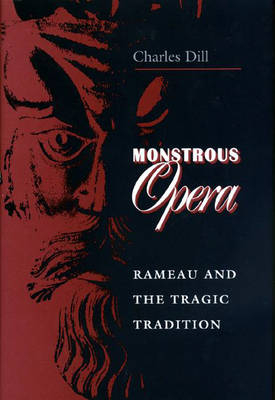
Monstrous Opera
Rameau and the Tragic Tradition
Seiten
1998
Princeton University Press (Verlag)
978-0-691-04443-9 (ISBN)
Princeton University Press (Verlag)
978-0-691-04443-9 (ISBN)
- Titel ist leider vergriffen;
keine Neuauflage - Artikel merken
One of the foremost composers of the French Baroque operatic tradition, Rameau is often cited for his struggle to steer lyric tragedy away from its strict Lullian form toward a more expressive musical style. This study of Rameau's compositional aesthetic depicts a much more complicated figure.
One of the foremost composers of the French Baroque operatic tradition, Rameau is often cited for his struggle to steer lyric tragedy away from its strict Lullian form, inspired by spoken tragedy, and toward a more expressive musical style. In this exploration of Rameau's compositional aesthetic, Charles Dill depicts a much more complicated figure: one obsessed with tradition, music theory, his own creative instincts, and the public's expectations of his music, Dill examines the ways Rameau mediated among these often competing values and how he interacted with his critics and with the public. The result is a rethinking of Rameau as a musical innovator. In his compositions, Rameau tried to highlight music's potential for dramatic meanings. But his listeners, who understood lyric tragedy to be a poetic rather than a musical genre, were generally frustrated by these attempts. In fact, some described Rameau's music as monstrous - using an image of deformity to represent the failure of reason and communication. Dill shows how Rameau answered his critics with rational, theoretical arguments about the role of music in lyric tragedy.
At the same time, however, the composer sought to placat
One of the foremost composers of the French Baroque operatic tradition, Rameau is often cited for his struggle to steer lyric tragedy away from its strict Lullian form, inspired by spoken tragedy, and toward a more expressive musical style. In this exploration of Rameau's compositional aesthetic, Charles Dill depicts a much more complicated figure: one obsessed with tradition, music theory, his own creative instincts, and the public's expectations of his music, Dill examines the ways Rameau mediated among these often competing values and how he interacted with his critics and with the public. The result is a rethinking of Rameau as a musical innovator. In his compositions, Rameau tried to highlight music's potential for dramatic meanings. But his listeners, who understood lyric tragedy to be a poetic rather than a musical genre, were generally frustrated by these attempts. In fact, some described Rameau's music as monstrous - using an image of deformity to represent the failure of reason and communication. Dill shows how Rameau answered his critics with rational, theoretical arguments about the role of music in lyric tragedy.
At the same time, however, the composer sought to placat
| Reihe/Serie | Princeton Legacy Library |
|---|---|
| Zusatzinfo | 22 music examples |
| Verlagsort | New Jersey |
| Sprache | englisch |
| Maße | 197 x 254 mm |
| Gewicht | 510 g |
| Themenwelt | Kunst / Musik / Theater ► Musik ► Klassik / Oper / Musical |
| ISBN-10 | 0-691-04443-0 / 0691044430 |
| ISBN-13 | 978-0-691-04443-9 / 9780691044439 |
| Zustand | Neuware |
| Informationen gemäß Produktsicherheitsverordnung (GPSR) | |
| Haben Sie eine Frage zum Produkt? |
Mehr entdecken
aus dem Bereich

aus dem Bereich
Essays und Gespräche
Buch | Hardcover (2025)
Wallstein Erfolgstitel (Verlag)
CHF 29,90


