


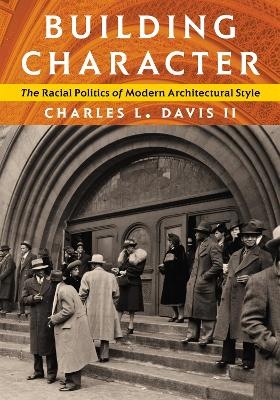
Building Character
The Racial Politics of Modern Architectural Style
Seiten
2021
University of Pittsburgh Press (Verlag)
978-0-8229-6682-1 (ISBN)
University of Pittsburgh Press (Verlag)
978-0-8229-6682-1 (ISBN)
Explores parallels between the development of racial and architectural thinking.
In the 19th-century paradigm of architectural organicism, the notion that buildings possessed character provided architects with a lens for relating the buildings they designed to the populations they served. Advances in scientific race theory enabled designers to think of 'race' and 'style' as manifestations of natural law: just as biological processes seemed to inherently regulate the racial characters that made humans a perfect fit for their geographical contexts, architectural characters became a rational product of design.
Parallels between racial and architectural characters provided a rationalist model of design that fashioned some of the most influential national building styles of the past, from the pioneering concepts of French structural rationalism and German tectonic theory to the nationalist associations of the Chicago Style, the Prairie Style, and the International Style. In Building Character, Charles Davis traces the racial charge of the architectural writings of five modern theorists
face=Calibri>– Eugene Emmanuel Viollet-le-Duc, Gottfried Semper, Louis Sullivan, Frank Lloyd Wright, and William Lescaze
face=Calibri>– to highlight the social, political, and historical significance of the spatial, structural, and ornamental elements of modern architectural styles.
In the 19th-century paradigm of architectural organicism, the notion that buildings possessed character provided architects with a lens for relating the buildings they designed to the populations they served. Advances in scientific race theory enabled designers to think of 'race' and 'style' as manifestations of natural law: just as biological processes seemed to inherently regulate the racial characters that made humans a perfect fit for their geographical contexts, architectural characters became a rational product of design.
Parallels between racial and architectural characters provided a rationalist model of design that fashioned some of the most influential national building styles of the past, from the pioneering concepts of French structural rationalism and German tectonic theory to the nationalist associations of the Chicago Style, the Prairie Style, and the International Style. In Building Character, Charles Davis traces the racial charge of the architectural writings of five modern theorists
face=Calibri>– Eugene Emmanuel Viollet-le-Duc, Gottfried Semper, Louis Sullivan, Frank Lloyd Wright, and William Lescaze
face=Calibri>– to highlight the social, political, and historical significance of the spatial, structural, and ornamental elements of modern architectural styles.
Charles L. Davis II is an assistant professor of architectural history and criticism at the University at Buffalo, SUNY.
| Erscheinungsdatum | 16.09.2021 |
|---|---|
| Reihe/Serie | Culture Politics & the Built Environment |
| Verlagsort | Pittsburgh PA |
| Sprache | englisch |
| Maße | 152 x 229 mm |
| Themenwelt | Kunst / Musik / Theater ► Kunstgeschichte / Kunststile |
| Technik ► Architektur | |
| ISBN-10 | 0-8229-6682-4 / 0822966824 |
| ISBN-13 | 978-0-8229-6682-1 / 9780822966821 |
| Zustand | Neuware |
| Informationen gemäß Produktsicherheitsverordnung (GPSR) | |
| Haben Sie eine Frage zum Produkt? |
Mehr entdecken
aus dem Bereich

aus dem Bereich
kleine Kulturgeschichte einer brillanten Allianz
Buch | Softcover (2025)
Iudicium (Verlag)
CHF 33,90


