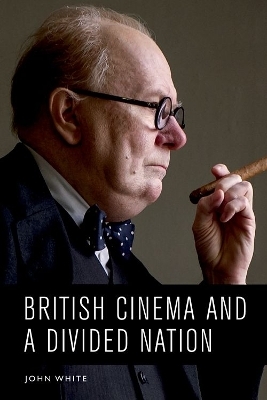
British Cinema and a Divided Nation
Edinburgh University Press (Verlag)
978-1-4744-8102-1 (ISBN)
British Cinema and a Divided Nation examines representations of the nation found within contemporary British cinema, against a backdrop of rising political tensions and deepening social divisions following the ‘Brexit’ referendum of June 2016. Exploring ways in which the contest of ideologies within media representations has played out post-2016, the book identifies divisions within society that have been given narrative shape and cultural form within recent British films. With case studies of major films such as Mary Queen of Scots, Peterloo, Darkest Hour, Sorry We Missed You and Downton Abbey, this book questions whether we are seeing the negotiation of a new relationship with the wider world, or simply a re-iteration of a long-standing British, or English, understanding of national identity.
John White teaches film studies at Anglia Ruskin University in Cambridge. He is co-editor of Fifty Key British Films (Routledge, 2008), Fifty Key American Films (Routledge, 2009) and The Routledge Encyclopedia of Films (Routledge, 2014). He recently contributed chapters to books on Budd Boetticher and Delmer Daves in the Edinburgh University Press ReFocus series, and is the author of Westerns (Routledge, 2011) and European Art Cinema (Routledge, 2017).
List of Figures
1. Introduction: popular culture and a shared national perspective
PART I: Reinterpreting pre-twentieth century British history
2. What chance sisterhood under patriarchy?: Mary Queen of Scots (Josie Rourke, 2018).
3. What would it be to ‘turn the world upside down’?: Fanny Lye Deliver'd (Thomas Clay, 2019).
4. Politics in ‘the corridors of power’ then (and now): The Favourite (Yorgos Lanthimos, 2018).
5. Class as the crucial division in UK society: Peterloo (Mike Leigh, 2018).
PART II: Rehearsing twentieth century British history.
6. One-nation Conservatism 1920s/2020s: Downton Abbey (Michael Engler, 2019).
7. Defending this ‘island nation’: Darkest Hour (Joe Wright, 2017) and Churchill (Jonathan Teplitzky, 2017).
8. Identity politics: Where Hands Touch (Amma Asante, 2018) and A United Kingdom (Asante, 2016).
9. Colonialism and the reshaping of history: Viceroy's House (Gurinder Chadha, 2017).
PART III: Re-presenting Britain in the twenty-first century.
10. Educated elites and plebeians: The Sense of an Ending (Ritesh Batra, 2017) and Daphne (Peter Mackie Burns, 2017).
11. Migration in an age of ideological confrontation: God's Own Country (Francis Lee, 2017).
12. Rural poverty: Dark River (Clio Barnard, 2017) and The Levelling (Hope Dickson Leach, 2016).
13. Urban poverty: Sorry We Missed You (Ken Loach, 2019).
14. Conclusion: liberal consensus politics, economics and class.
Bibliography Index
| Erscheinungsdatum | 03.12.2021 |
|---|---|
| Zusatzinfo | 22 black and white illustrations |
| Verlagsort | Edinburgh |
| Sprache | englisch |
| Maße | 156 x 234 mm |
| Themenwelt | Kunst / Musik / Theater ► Film / TV |
| ISBN-10 | 1-4744-8102-7 / 1474481027 |
| ISBN-13 | 978-1-4744-8102-1 / 9781474481021 |
| Zustand | Neuware |
| Informationen gemäß Produktsicherheitsverordnung (GPSR) | |
| Haben Sie eine Frage zum Produkt? |
aus dem Bereich