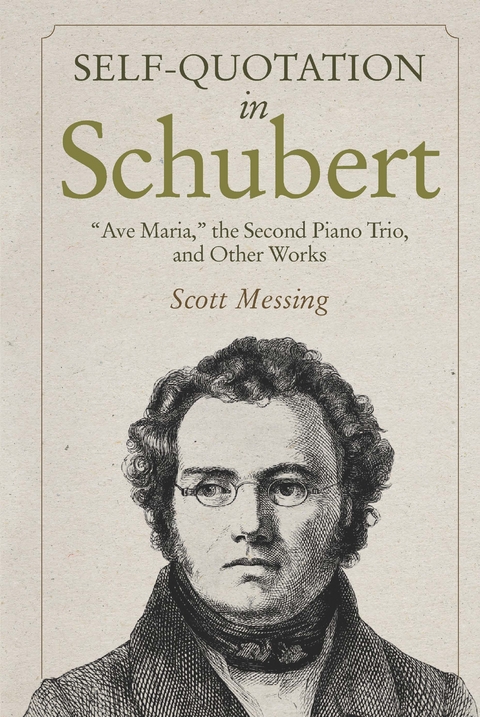
Self-Quotation in Schubert (eBook)
334 Seiten
Boydell & Brewer (Verlag)
978-1-78744-967-1 (ISBN)
Enthusiasts and experts have long relished Schubert's quotations of his own music. This study centers on a previously unidentified pairing: "e;Ave Maria,"e; one of his most beloved songs, and the Piano Trio no. 2, a masterpiece that holds a unique position in his career. Messing's Self-Quotation in Schubert interrogates the concept of self-quotation from the standpoints of terminology and authorial intent, and it demonstrates, for the first time, how Schubert's practice of self-quotation relates to prevailing practices in the late eighteenth and early nineteenth centuries. Messing goes on to analyze in detail the musical relationships between the two works and to investigate thecircumstances that led Schubert to compose each of them. "e;Ave Maria"e; is one of the few Schubert songs for which we have documentation of some early private performances, and the trio stood at the heart of Schubert's only public concert devoted to his works. Messing establishes that Schubert sought to convey an associative meaning with this self-quotation, trusting in his contemporaries' familiarity with the original melody and with Walter Scott's poem, a text that carried profound resonances in Catholic Vienna. Scrutinizing this evidence yields the symbolic purpose behind Schubert's allusion to "e;Ave Maria"e; in the piano trio: honoring the recently deceased Beethoven andvalidating Schubert as his legatee. SCOTT MESSING is Charles A. Dana Professor of Music Emeritus at Alma College.
Introduction
Commencements and Contexts
On the Reception of Schubert's Self-Quotations
Two Scores and Their Musical Relationships
Parents and Children: On the Background to "Ave Maria"
From "Ave Maria" to Trio
"Dedicated to nobody, save those who find pleasure in it."
Contexts and Conclusions
| Erscheint lt. Verlag | 1.5.2020 |
|---|---|
| Reihe/Serie | Eastman Studies in Music | Eastman Studies in Music |
| Zusatzinfo | 16 line. |
| Verlagsort | Rochester |
| Sprache | englisch |
| Maße | 160 x 160 mm |
| Themenwelt | Kunst / Musik / Theater ► Musik ► Klassik / Oper / Musical |
| Kunst / Musik / Theater ► Musik ► Musikgeschichte | |
| Kunst / Musik / Theater ► Musik ► Musiktheorie / Musiklehre | |
| Schlagworte | Austrian history • Beethoven • Composer • Dedication • Intertextuality • Lieder • Music History • nineteenth-century music • Reuse • Schumann |
| ISBN-10 | 1-78744-967-X / 178744967X |
| ISBN-13 | 978-1-78744-967-1 / 9781787449671 |
| Informationen gemäß Produktsicherheitsverordnung (GPSR) | |
| Haben Sie eine Frage zum Produkt? |
 EPUB (Adobe DRM)
Kopierschutz: Adobe-DRM
Adobe-DRM ist ein Kopierschutz, der das eBook vor Mißbrauch schützen soll. Dabei wird das eBook bereits beim Download auf Ihre persönliche Adobe-ID autorisiert. Lesen können Sie das eBook dann nur auf den Geräten, welche ebenfalls auf Ihre Adobe-ID registriert sind.
Details zum Adobe-DRM
Dateiformat: EPUB (Electronic Publication)
EPUB ist ein offener Standard für eBooks und eignet sich besonders zur Darstellung von Belletristik und Sachbüchern. Der Fließtext wird dynamisch an die Display- und Schriftgröße angepasst. Auch für mobile Lesegeräte ist EPUB daher gut geeignet.
Systemvoraussetzungen:
PC/Mac: Mit einem PC oder Mac können Sie dieses eBook lesen. Sie benötigen eine
eReader: Dieses eBook kann mit (fast) allen eBook-Readern gelesen werden. Mit dem amazon-Kindle ist es aber nicht kompatibel.
Smartphone/Tablet: Egal ob Apple oder Android, dieses eBook können Sie lesen. Sie benötigen eine
Geräteliste und zusätzliche Hinweise
Buying eBooks from abroad
For tax law reasons we can sell eBooks just within Germany and Switzerland. Regrettably we cannot fulfill eBook-orders from other countries.
aus dem Bereich