


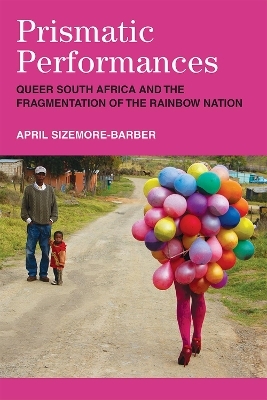
Prismatic Performances
Queer South Africa and the Fragmentation of the Rainbow Nation
Seiten
2021
The University of Michigan Press (Verlag)
978-0-472-03879-4 (ISBN)
The University of Michigan Press (Verlag)
978-0-472-03879-4 (ISBN)
Exploring the contradictions of post-Apartheid South Africa through performance
At his 1994 inauguration, South African president Nelson Mandela announced the “Rainbow Nation, at peace with itself and the world.” This national rainbow notably extended beyond the bounds of racial coexistence and reconciliation to include “sexual orientation” as a protected category in the Bill of Rights. Yet despite the promise of equality and dignity, the new government’s alliance with neoliberal interests and the devastation of the AIDS epidemic left South Africa an increasingly unequal society.
Prismatic Performances focuses on the queer embodiments that both reveal and animate the gaps between South Africa’s self-image and its lived realities. It argues that performance has become a key location where contradictions inherent to South Africa’s post-apartheid identity are negotiated. The book spans 30 years of cultural production and numerous social locations and includes: a team of black lesbian soccer players who reveal and redefine the gendered and sexed limitations of racialized “Africanness;” white gay performers who use drag and gender subversion to work through questions of racial and societal transformation; black artists across the arts who have developed aesthetics that place on display their audiences’ complicity in the problem of sexual violence; and a primarily heterosexual panAfrican online soap opera fandom community who, by combining new virtual spaces with old melodramatic tropes allow for extended deliberation and new paradigms through which African same-sex relationships are acceptable.
Prismatic Performances contends that when explicitly queer bodies emerge onto public stages, audiences are made intimately aware of their own bodies’ identifications and desires. As the sheen of the New South Africa began to fade, these performances revealed the inadequacy and, indeed, the violence, of the Rainbow Nation as an aspirational metaphor. Simultaneously they created space for imagining new radical configurations of belonging.
At his 1994 inauguration, South African president Nelson Mandela announced the “Rainbow Nation, at peace with itself and the world.” This national rainbow notably extended beyond the bounds of racial coexistence and reconciliation to include “sexual orientation” as a protected category in the Bill of Rights. Yet despite the promise of equality and dignity, the new government’s alliance with neoliberal interests and the devastation of the AIDS epidemic left South Africa an increasingly unequal society.
Prismatic Performances focuses on the queer embodiments that both reveal and animate the gaps between South Africa’s self-image and its lived realities. It argues that performance has become a key location where contradictions inherent to South Africa’s post-apartheid identity are negotiated. The book spans 30 years of cultural production and numerous social locations and includes: a team of black lesbian soccer players who reveal and redefine the gendered and sexed limitations of racialized “Africanness;” white gay performers who use drag and gender subversion to work through questions of racial and societal transformation; black artists across the arts who have developed aesthetics that place on display their audiences’ complicity in the problem of sexual violence; and a primarily heterosexual panAfrican online soap opera fandom community who, by combining new virtual spaces with old melodramatic tropes allow for extended deliberation and new paradigms through which African same-sex relationships are acceptable.
Prismatic Performances contends that when explicitly queer bodies emerge onto public stages, audiences are made intimately aware of their own bodies’ identifications and desires. As the sheen of the New South Africa began to fade, these performances revealed the inadequacy and, indeed, the violence, of the Rainbow Nation as an aspirational metaphor. Simultaneously they created space for imagining new radical configurations of belonging.
April Sizemore-Barber is Assistant Professor of the Practice in Women’s and Gender Studies at Georgetown University.
| Erscheinungsdatum | 15.09.2021 |
|---|---|
| Reihe/Serie | Triangulations: Lesbian/Gay/Queer Theater/Drama/Performance |
| Zusatzinfo | 12 illustrations |
| Verlagsort | Ann Arbor |
| Sprache | englisch |
| Maße | 152 x 229 mm |
| Themenwelt | Kunst / Musik / Theater ► Theater / Ballett |
| Sozialwissenschaften ► Ethnologie | |
| Sozialwissenschaften ► Soziologie | |
| ISBN-10 | 0-472-03879-6 / 0472038796 |
| ISBN-13 | 978-0-472-03879-4 / 9780472038794 |
| Zustand | Neuware |
| Informationen gemäß Produktsicherheitsverordnung (GPSR) | |
| Haben Sie eine Frage zum Produkt? |
Mehr entdecken
aus dem Bereich

aus dem Bereich
ein Handbuch für die Aus- und Weiterbildung
Buch | Softcover (2024)
Henschel Verlag in E. A. Seemann Henschel GmbH & Co. KG
CHF 38,90
im Weltgarten des Spiels 1928–1965
Buch | Hardcover (2025)
Hollitzer Wissenschaftsverlag
CHF 52,90


