


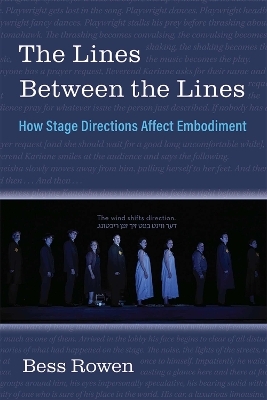
The Lines Between the Lines
How Stage Directions Affect Embodiment
Seiten
2021
The University of Michigan Press (Verlag)
978-0-472-07436-5 (ISBN)
The University of Michigan Press (Verlag)
978-0-472-07436-5 (ISBN)
How stage directions convey not what a given moment looks like—but how it feels
What is the purpose of a stage direction? These italicized lines written in between the lines of spoken dialogue tell us a great deal of information about a play's genre, mood, tone, visual setting, cast of characters, and more. Yet generations of actors have been taught to cross these words out as records of previous performances or signs of overly controlling playwrights, while scholars have either treated them as problems to be solved or as silent lines of dialogue. Stage directions can be all of these things, and yet there are examples from over one-hundred years of American playwriting that show that stage directions can also be so much more. The Lines Between the Lines focuses on how playwrights have written stage directions that engage readers, production team members, and scholars in a process of embodied creation in order to determine meaning. Author Bess Rowen calls the products of this method “affective stage directions” because they reach out from the page and affect the bodies of those who encounter them. Affective stage directions do not tell a reader or production team what a given moment looks like, but rather how a moment feels. In this way, these stage directions provide playgrounds for individual readers or production teams to make sense of a given moment in a play based on their own individual cultural experience, geographic location, and identity-markers. Affective stage directions enable us to check our assumptions about what kinds of bodies are represented on stage, allowing for a greater multitude of voices and kinds of embodied identity to make their own interpretations of a play while still following the text exactly. The tools provided in this book are as useful for the theater scholar as they are for the theater audience member, casting director, and actor. Each chapter covers a different function of stage directions (spoken, affective, choreographic, multivalent, impossible) and looks at it through a different practical lens (focusing on actors, directors, designers, dramaturgs, and readers). Every embodied person will have a slightly different understanding of affective stage directions, and it is precisely this diversity that makes these stage directions crucial to understanding theater in our time.
What is the purpose of a stage direction? These italicized lines written in between the lines of spoken dialogue tell us a great deal of information about a play's genre, mood, tone, visual setting, cast of characters, and more. Yet generations of actors have been taught to cross these words out as records of previous performances or signs of overly controlling playwrights, while scholars have either treated them as problems to be solved or as silent lines of dialogue. Stage directions can be all of these things, and yet there are examples from over one-hundred years of American playwriting that show that stage directions can also be so much more. The Lines Between the Lines focuses on how playwrights have written stage directions that engage readers, production team members, and scholars in a process of embodied creation in order to determine meaning. Author Bess Rowen calls the products of this method “affective stage directions” because they reach out from the page and affect the bodies of those who encounter them. Affective stage directions do not tell a reader or production team what a given moment looks like, but rather how a moment feels. In this way, these stage directions provide playgrounds for individual readers or production teams to make sense of a given moment in a play based on their own individual cultural experience, geographic location, and identity-markers. Affective stage directions enable us to check our assumptions about what kinds of bodies are represented on stage, allowing for a greater multitude of voices and kinds of embodied identity to make their own interpretations of a play while still following the text exactly. The tools provided in this book are as useful for the theater scholar as they are for the theater audience member, casting director, and actor. Each chapter covers a different function of stage directions (spoken, affective, choreographic, multivalent, impossible) and looks at it through a different practical lens (focusing on actors, directors, designers, dramaturgs, and readers). Every embodied person will have a slightly different understanding of affective stage directions, and it is precisely this diversity that makes these stage directions crucial to understanding theater in our time.
Bess Rowen is Assistant Professor of Theatre at Villanova University.
Contents
Acknowledgments
Introduction
Chapter 1: “Ogun Goes Back Under the Car”: Spoken Stage Directions
Chapter 2: “The Bird I Hope to Catch in the Net of This Play”: Affective Stage Directions
Chapter 3: “They Dance. Except It’s Not Really Like Gandhi”: Choreographic Stage Directions
Chapter 4: “And, Perhaps, the Hairy Ape at Last Belongs”: Multivalent Stage Directions
Chapter 5: “A Man Named Newburn Comes Out of the Faucet Which Has Been Left Running”: Impossible Stage Directions
Conclusion
Works Cited and Selected Bibliography
| Erscheinungsdatum | 16.09.2021 |
|---|---|
| Zusatzinfo | 1 illustration |
| Verlagsort | Ann Arbor |
| Sprache | englisch |
| Maße | 152 x 229 mm |
| Themenwelt | Kunst / Musik / Theater ► Theater / Ballett |
| ISBN-10 | 0-472-07436-9 / 0472074369 |
| ISBN-13 | 978-0-472-07436-5 / 9780472074365 |
| Zustand | Neuware |
| Informationen gemäß Produktsicherheitsverordnung (GPSR) | |
| Haben Sie eine Frage zum Produkt? |
Mehr entdecken
aus dem Bereich


aus dem Bereich
ein Handbuch für die Aus- und Weiterbildung
Buch | Softcover (2024)
Henschel Verlag in E. A. Seemann Henschel GmbH & Co. KG
CHF 38,90
Buch | Hardcover (2024)
Karl-May-Verlag
CHF 81,90
Perspektiven der Szenografie und performance design studies
Buch (2025)
Theater der Zeit (Verlag)
CHF 41,90


