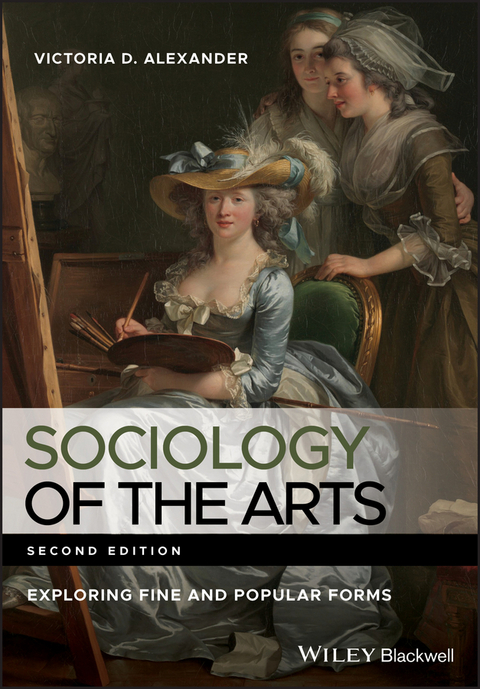
Sociology of the Arts (eBook)
John Wiley & Sons (Verlag)
978-1-118-32346-5 (ISBN)
Explains the key concepts, theories, and studies in the sociology of the arts-the fully updated new edition of the classic textbook
Sociology of the Arts is a comprehensive yet accessible review of sociological approaches to studying the fine, popular, and folk arts. Integrating scholarly literature, theoretical models, and empirical studies, this authoritative textbook provides balanced coverage of a broad range of essential topics-enabling a deeper understanding of the field as a whole. Throughout the text, numerous real-world case studies reinforce key concepts, stimulate classroom discussion, and encourage students to contemplate abstract theoretical issues central to the relationship between art and society.
Now in its second edition, this bestselling volume features fully revised content that reflects the most recent literature and research in the field. New discussion on the production and the consumption of culture are complemented by fresh perspectives on changes in the social world such as the rise of the internet and digital media. Updated chapters offer insights into social boundaries and embodiment in the arts, emplacement, materiality, the social construction of art and aesthetics, and more. Exploring how art is created, distributed, received, and consumed, this textbook:
- Explores both classic work and new approaches in the sociology of the arts
- Features case studies and discussion questions on art forms including popular music, film, romance novels, visual arts, and classical music
- Discusses the meaning of artistic objects and why interpretations of art vary
- Examines the ways art intersects with race, gender, sexuality, and class
- Includes photographs, tables and figures, and a comprehensive reference list
Written by a leading scholar in the field, Sociology of the Arts: Exploring Fine and Popular Forms, Second Edition is an ideal textbook for advanced undergraduate and graduate courses on sociology of art and culture, media studies, anthropology of art, arts management, and the social history of art, and is a useful reference for established scholars studying any aspect of sociology of the arts.
VICTORIA D. ALEXANDER is Professor of Sociology and Arts Management at the Institute for Creative and Cultural Entrepreneurship, Goldsmiths, University of London, UK. She is author of Museums and Money: The Impact of Funding on Exhibitions, Scholarship, and Management (1996), co-author of Art and the State: The Visual Arts in Comparative Perspective (2005), and co-editor of the multi-volume Art and the Challenge of Markets (2018).
Explains the key concepts, theories, and studies in the sociology of the arts the fully updated new edition of the classic textbook Sociology of the Arts is a comprehensive yet accessible review of sociological approaches to studying the fine, popular, and folk arts. Integrating scholarly literature, theoretical models, and empirical studies, this authoritative textbook provides balanced coverage of a broad range of essential topics enabling a deeper understanding of the field as a whole. Throughout the text, numerous real-world case studies reinforce key concepts, stimulate classroom discussion, and encourage students to contemplate abstract theoretical issues central to the relationship between art and society. Now in its second edition, this bestselling volume features fully revised content that reflects the most recent literature and research in the field. New discussion on the production and the consumption of culture are complemented by fresh perspectives on changes in the social world such as the rise of the internet and digital media. Updated chapters offer insights into social boundaries and embodiment in the arts, emplacement, materiality, the social construction of art and aesthetics, and more. Exploring how art is created, distributed, received, and consumed, this textbook: Explores both classic work and new approaches in the sociology of the arts Features case studies and discussion questions on art forms including popular music, film, romance novels, visual arts, and classical music Discusses the meaning of artistic objects and why interpretations of art vary Examines the ways art intersects with race, gender, sexuality, and class Includes photographs, tables and figures, and a comprehensive reference list Written by a leading scholar in the field, Sociology of the Arts: Exploring Fine and Popular Forms, Second Edition is an ideal textbook for advanced undergraduate and graduate courses on sociology of art and culture, media studies, anthropology of art, arts management, and the social history of art, and is a useful reference for established scholars studying any aspect of sociology of the arts.
VICTORIA D. ALEXANDER is Professor of Sociology and Arts Management at the Institute for Creative and Cultural Entrepreneurship, Goldsmiths, University of London, UK. She is author of Museums and Money: The Impact of Funding on Exhibitions, Scholarship, and Management (1996), co-author of Art and the State: The Visual Arts in Comparative Perspective (2005), and co-editor of the multi-volume Art and the Challenge of Markets (2018).
List of Illustrations vii
List of Tables ix
List of Figures xi
List of Boxes xiii
Preface and Acknowledgements xv
1 Introduction: What is Art? 1
Part I The Relationship between Art and Society 11
2 Reflection Approaches 13
Case Study 2.1 The Reflection of Race in Children's Books 25
3 Shaping Approaches 29
Case Study 3.1 Violence in Popular Arts 43
4 A Mediated View: The Cultural Diamond 49
Part IIA The Cultural Diamond: The Production of Culture 53
5 Art Worlds and Artistic Fields 55
Case Study 5.1 From Academy to Public Sale 69
6 Businesses and Industries 75
Case Study 6.1 Innovation in Commercial Musical Theatre 89
7 Nonprofits and Networks 95
Case Study 7.1 Piccolos on the Picket Line: A Strike in the Symphony 108
8 Artists 113
Case Study 8.1 Nothing Succeeds Like Success: Careers in the Film Industry 129
Part IIB The Cultural Diamond: The Consumption of Culture 133
9 Consumption Approaches 135
Case Study 9.1 Romance Novels as Combat and Compensation 150
10 Sites and Experiences 155
Case Study 10.1 The Experience of Music 172
11 Identities 177
Case Study 11.1 Acropolis Now: National Identity and the Return of the Parthenon Marbles? 191
12 Distinction 199
Case Study 12.1 New Forms of Cultural Capital? Debates about Distinction 215
Part III Art in Society 221
13 The Art Itself 223
Case Study 13.1 The Renaissance Way of Seeing 241
14 The Constitution of Art in Society 245
Case Study 14.1 A Strange Sensation: Controversies in Art 263
Part IV Conclusion 269
15 Studying Art Sociologically 271
References 275
Index 299
Preface and Acknowledgements
Since the first edition of Sociology of the Arts, the literature in the field has grown vibrantly, as more sociologists recognize the value of studying the fine and popular arts. As an arts sociologist, I am delighted. This has provided a challenge in updating this book, however. There is simply more literature out there and more wonderful studies than can be addressed here.
As with the first edition, my goal with this version is to provide an overview of the field, and as such, I present studies with an eye to their contribution to the literature. Overall, I aim for a synthesis across approaches and rarely provide detailed critical analysis of individual studies, as this would make the book impossibly long. I describe many individual studies with enough detail that readers can understand the main ideas without consulting the original (although further reading is always encouraged!); consequently, I do not provide long lists of bracketed citations, even though, as always, there is more good material that could be cited.
Changes in the social world, as well as changes in the field, have necessitated changes in the structure of the book. I have retained the main structure, using the cultural diamond as the main framing device. A key change in the world has been the rise of the Internet, especially the interactive web 2.0. When the book was first published in 2003, YouTube (for instance) had not been invented. It would not be launched until 2005, but now has had profound impact on both the production and consumption of the arts. The Internet changes everything (though sometimes not as much as people think), and this is reflected in new research covered throughout this edition. Globalization was treated in a separate chapter in the first edition, but this aspect of art worlds, like the digital revolution, is now addressed, inter alia, in multiple chapters in this second edition. This makes room for an extra chapter in the consumption of culture. In this way, the second edition has four chapters each in the production and the consumption of culture.
The reweighting of the chapters reflects developments in the field. The (American) Production of Culture school, while still important, has waned, with declining major citations after 2004. Becker’s notion of art worlds remains enormously influential, as does Bourdieu’s idea of artistic fields. This revised edition addresses Bourdieu much earlier (in Chapter 5) than in the previous edition, to reflect his place as one of the two dominant sociologists of art worldwide. All chapters have been updated, though the structure of chapters covering reflection, shaping, and the production of culture (broadly stated) remains the same as in the first edition (see the book outline in Chapter 1). The chapters covering the consumption of culture have been significantly reorganized, to include chapters on sites and experiences, and identities. There has been an explosion of sociological work on distinction and the omnivore model, meaning that the chapter on social boundaries in art has been updated to focus on these developments and debates. The final section of the book, on Art in Society, retains the same chapter titles, but the content of these two chapters has shifted significantly, as developments in studies of materiality, emplacement, and embodiment in the arts, along with new sociological research on the work of art itself are addressed.
The book continues to define “art” inclusively to encompass fine, popular, and folk forms, from Rembrandt to Rap as it were. The book also recognizes that sociologists do not all approach the sociology of the arts with the same types of questions, and that what constitutes an answer varies from scholar to scholar. My belief is that examining the range of questions and answers allows one to develop a richer understanding of the field as a whole. In mapping out the currents of thought in the field, I have attempted to balance the requirements of a comprehensive overview (as in a review article of particular interest to scholars) with the need for enough detail on individual studies to make the book useful to readers new to the field. At the same time, I have worked within my publisher’s parameters on the length of the book. (I have removed epigraphs from the chapters at their request, as well, to fit with a revised house style.) I hope that I have struck a balance that will make this edition of use and interest to both students and scholars. Inevitably, however, scholars will spot omissions, only some of which will have been intentional on my part.
Victoria D. Alexander
London, 10 December 2019
Acknowledgements (Second Edition)
I have completed this second edition in my new role as Professor of Sociology and Arts Management at Goldsmiths, University of London. I am grateful to my colleagues in the Institute for Creative and Cultural Entrepreneurship (ICCE) and the pleasant and stimulating environment it provides, as well as to my arts management students, who have read my chapter drafts and discussed them in class. I particularly thank my co‐author (on other work), Anne E. Bowler, for ongoing conversations about the sociology of art. Jim Benson once again read every word. In these acknowledgements, I wish to remember the late Richard A. (Pete) Peterson and the late Vera L. Zolberg. Their passing marks a loss to the field and those of us working in it will miss them greatly.
I remain grateful to all whom I mentioned in the acknowledgments for the first edition. I would like to thank the editorial and production teams at Wiley, including Justin Vaughan, Richard Samson, Merryl Le Roux, and Rajalakshmi Nadarajan, as well as Jacky Mucklow for their support on the second edition.
Preface to the First Edition
I have taught courses on the Sociology of the Arts for quite some time now. Every year, students ask me to recommend a single text that will provide an overview of the materials I cover. I have been unable to accommodate them, despite the existence of a number of excellent books on sociological aspects of the arts, on popular culture, and on culture more broadly speaking. Their constant requests for a single source which draws across different intellectual approaches to the subject while focusing specifically on the fine and popular arts inspired me to write this book.
In setting out the intellectual topography of the field of study, I have drawn on a large body of theory and research. Scholarship is a search for truth, and it also constructs an arena in which combatants from different perspectives battle over each other’s claims. My description the sociology of the arts, then, considers its various theories and empirical studies which cluster around central debates that colleagues will find familiar. Nevertheless, this work (inevitably) contains my personal vision of the field. I hope that my presentation is close enough to my colleagues’ own understandings of the field to allow them to teach from the book, should they wish, but that it also provides an original argument they will find stimulating. The goal I set for myself in writing the book was to produce a work that would be helpful to undergraduates new to the field, useful to graduate students wishing to launch their research in it, and interesting to colleagues well established in it. How successfully this one modest book has met such a broad goal will be decided by you, its reader.
I have also taught courses on the Sociology of Organizations. One pedagogic lesson I have learned from that field concerns the crucial role that concrete case studies can play in getting students to think about the more abstract theoretical issues. Case studies are almost indispensable in the teaching of work, occupations, and organizational behavior, but are used less often in other subfields in sociology. Convinced of their utility in organizations classes, I subsequently tried them in arts classes, where they worked quite well. Accordingly, I have written a case study for each substantive chapter in the book. They are intended to spark classroom discussion, and also to exemplify some of the most interesting empirical work within the sociology of the arts.
Acknowledgments (First Edition)
Although the idea of writing this book came to me fairly recently [writing in 2002], the resulting work is, fundamentally, the product of eighteen years of studying and teaching. As a consequence, thanks are due to many more people than I can adequately acknowledge. I owe a great intellectual debt to Ann Swidler. Her ideas have influenced my work since I met her in 1984. I took her seminar on the Sociology of Culture that academic year, a course which provided a strong foundation for my subsequent thinking. Ann has been enormously helpful over the years and it has been my privilege to know her. Also in 1984–85, I took a seminar on Sociology of Literature with Wendy Griswold, whose idea of the cultural diamond frames the presentation of scholarship in this book. My students over the years at Stanford, Harvard, and Surrey, where I have taught courses on the sociology of art and culture, have asked innumerable questions and raised many interesting points. Through them, I have clarified my thinking. I deeply appreciate their input, and the book is better for it.
I met Howard Becker as a student in a photography seminar in Rochester, New York in the late 1970s. I learned a lot, but I had no idea that he was at that very moment researching a book which would so deeply influence my future career. People I have seen regularly at conferences over the years,...
| Erscheint lt. Verlag | 17.9.2020 |
|---|---|
| Sprache | englisch |
| Themenwelt | Kunst / Musik / Theater ► Kunstgeschichte / Kunststile |
| Sozialwissenschaften ► Soziologie | |
| Schlagworte | art in culture • art in society • arts consumption arts • culture consumption • Kunstsoziologie • Production of Culture • Sociology • sociology art research • sociology arts • sociology arts overview • sociology arts textbook • sociology fine arts • sociology folk arts • Sociology of Art • sociology pop arts • Soziologie |
| ISBN-10 | 1-118-32346-7 / 1118323467 |
| ISBN-13 | 978-1-118-32346-5 / 9781118323465 |
| Informationen gemäß Produktsicherheitsverordnung (GPSR) | |
| Haben Sie eine Frage zum Produkt? |
 EPUB (Adobe DRM)
Kopierschutz: Adobe-DRM
Adobe-DRM ist ein Kopierschutz, der das eBook vor Mißbrauch schützen soll. Dabei wird das eBook bereits beim Download auf Ihre persönliche Adobe-ID autorisiert. Lesen können Sie das eBook dann nur auf den Geräten, welche ebenfalls auf Ihre Adobe-ID registriert sind.
Details zum Adobe-DRM
Dateiformat: EPUB (Electronic Publication)
EPUB ist ein offener Standard für eBooks und eignet sich besonders zur Darstellung von Belletristik und Sachbüchern. Der Fließtext wird dynamisch an die Display- und Schriftgröße angepasst. Auch für mobile Lesegeräte ist EPUB daher gut geeignet.
Systemvoraussetzungen:
PC/Mac: Mit einem PC oder Mac können Sie dieses eBook lesen. Sie benötigen eine
eReader: Dieses eBook kann mit (fast) allen eBook-Readern gelesen werden. Mit dem amazon-Kindle ist es aber nicht kompatibel.
Smartphone/Tablet: Egal ob Apple oder Android, dieses eBook können Sie lesen. Sie benötigen eine
Geräteliste und zusätzliche Hinweise
Buying eBooks from abroad
For tax law reasons we can sell eBooks just within Germany and Switzerland. Regrettably we cannot fulfill eBook-orders from other countries.
aus dem Bereich