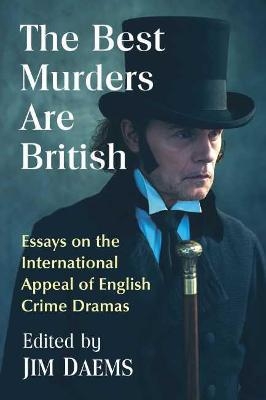
The Best Murders Are British
McFarland & Co Inc (Verlag)
978-1-4766-7939-6 (ISBN)
A staple of television since the early years of the BBC, British crime drama first crossed the Atlantic on public broadcasting stations and specialty cable channels, and later through streaming services. Often engaging with domestic anxieties about the government's power (or lack thereof), and with larger issues of social justice like gender equality, racism, and homophobia, it has constantly evolved to reflect social and cultural changes while adapting U.S. and Nordic noir influences in a way that retains its characteristically British elements.
This collection examines the continuing appeal of British crime drama from The Sweeney through Sherlock, Marcella, and Happy Valley. Individual essays focus on male melodrama, nostalgia, definitions of community, gender and LGBTQ representation, and neoliberalism. The persistence of the English murder, as each chapter of this collection reveals, points to the complexity of British crime drama's engagement with social, political, and cultural issues. It is precisely the mix of British stereotypes, coupled with a willingness to engage with broader global social and political issues, that makes British crime drama such a successful cultural export.
Jim Daems’ work focuses primarily on 16th and 17th century English representations of Ireland and on queer theory. He has published books and articles on Canadian multi-media artist and poet Bill Bissett, Harry Potter, Hank Williams, and Chuck Berry.
Table of Contents
Introduction: The Persistence of the English Murder (Jim Daems)
“Queen’s Pawn”: Changing Male Melodrama, Class Discord and Gender Divides in The Sweeney (Sue Matheson)
“Trust the Gene Genie”: Nostalgia and Ideology in Life on Mars (George S. Larke-Walsh)
The “Bloody ’ell” of Broadchurch: Heterotopia in British
Television Crime Series (Debnita Chakravarti)
A Tale of Two Sidneys: The Aesthetics of Jazz and the Church
of England in Grantchester (Phillip E. Mitchell)
“Not so much Happy Valley as brutal, violent, drug-ridden,
death valley”: Exploring the Big Society in Sally Wainwright’s Crime Drama (Gill Jamieson)
Stumbling Around: The Art of Detection in the British Crime
Series Endeavour (Michelle D. Miranda)
Women in British Crime Procedurals (Katrina L. Hinson and Ruth M.E. Oldman)
Speaking in Code: Feminist Narratives in The Bletchley Circle (Meghan Purvis)
No Lipstick Required: Vera and the Potential for an Examination
of Post-Feminist Representation in British TV Crime Drama (James Shelton)
From “Freak” to “Good Man”: Homosocial Triangulation
in BBC’s Sherlock (Rachel Van Hofwegen Willis)
“Crossing the Moor in Those Dark Hours”: Modernizing
the Gothic in the BBC Sherlock Adaptation of The Hound
of the Baskervilles (L.N. Rosales)
From Out of the Flames: Queer Revenge Plots in Lewis
and Waking the Dead (Jim Daems)
Neo-Liberal Violence: Marcella and Britain’s Monstrous
Work Culture (Robert A. Saunders)
About the Contributors
Index
| Erscheinungsdatum | 21.09.2020 |
|---|---|
| Zusatzinfo | notes, bibliographies, index |
| Verlagsort | Jefferson, NC |
| Sprache | englisch |
| Maße | 152 x 229 mm |
| Gewicht | 272 g |
| Themenwelt | Kunst / Musik / Theater ► Film / TV |
| ISBN-10 | 1-4766-7939-8 / 1476679398 |
| ISBN-13 | 978-1-4766-7939-6 / 9781476679396 |
| Zustand | Neuware |
| Informationen gemäß Produktsicherheitsverordnung (GPSR) | |
| Haben Sie eine Frage zum Produkt? |
aus dem Bereich