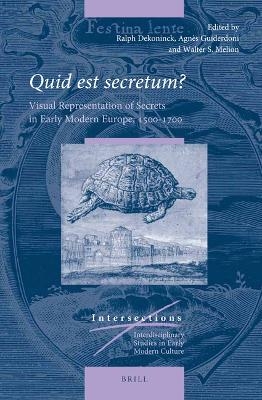
Quid est secretum?
Brill (Verlag)
978-90-04-43225-3 (ISBN)
Quid est secretum? Visual Representation of Secrets in Early Modern Europe, 1500–1700 is the companion volume to Intersections 65.1, Quid est sacramentum? Visual Representation of Sacred Mysteries in Early Modern Europe, 1400–1700. Whereas the latter volume focused on sacramental mysteries, the current one examines a wider range of secret subjects. The book examines how secret knowledge was represented visually in ways that both revealed and concealed the true nature of that knowledge, giving and yet impeding access to it. In the early modern period, the discursive and symbolical sites for the representation of secrets were closely related to epistemic changes that transformed conceptions of the transmissibility of knowledge.
Contributors: Monika Biel, Alicja Bielak, C. Jean Campbell, Tom Conley, Ralph Dekoninck, Peter G.F. Eversmann, Ingrid Falque, Agnès Guiderdoni, Koenraad Jonckheere, Suzanne Karr Schmidt, Stephanie Leitch, Carme López Calderón, Mark A. Meadow, Walter S. Melion, Eelco Nagelsmit, Lars Cyril Nørgaard, Alexandra Onuf, Bret L. Rothstein, Xavier Vert, Madeleine C. Viljoen, Mara R. Wade, Lee Palmer Wandel, and Caecilie Weissert.
Ralph Dekoninck is Professor of Early Modern Art History at the Université catholique de Louvain, co-director of the Centre for Early Modern Cultural Analysis (GEMCA) and member of the Royal Academy of Belgium. His research focuses on early modern image theories and practices, specifically in their relation to spirituality, on Baroque festival culture, on the relationships between art and liturgy, and on the iconography of martyrdom. He is the author of numerous articles and books, including Ad Imaginem. Statuts, fonctions et usages de l’image dans la littérature spirituelle jésuite du XVIIe siècle (Geneva: 2005) and La vision incarnante et l’image incarnée. Santi di Tito et Caravage (Paris: 2016). Agnès Guiderdoni is a Senior Research Associate of the Fonds National de la Recherche Scientifique (Belgium) and a Professor of Early Modern Literature at the Université catholique de Louvain, where she is the co-director of the Centre for Early Modern Cultural Analysis (GEMCA). Originally a specialist of seventeenth century French literature, she more particularly studies emblematic literature and the field of figurative representations (imago figurate). She has published many articles on these topics, as well as on theoretical aspects of text-image relationships. Among her publications: in 2017, a co-edited special issue of the journal La Part de l’Œil on Force de figures. Le travail de la figurabilité entre texte et image, and a volume on Maximilianus Sandaeus, un jésuite entre mystique et symbolique in 2019, also co-edited. Walter S. Melion, Ph.D. (1988, Emory University), is Asa Griggs Candler Professor of Art History and Director of the Fox Center for Humanistic Inquiry. He is the author of numerous articles and books on Northern art and art theory, including The Meditative Art: Studies on the Northern Devotional Print, 1500-1625 (Saint Joseph’s University Press, 2010).
Contents
Acknowledgements
Notes on the Editors
Notes on the Contributors
List of Illustrations
Introduction: What’s in a Secret?
Ralph Dekoninck, Agnès Guiderdoni, and Walter S. Melion
part 1: The Spiritual locus of Secret
1 In the Secrecy of the Cell: Late Medieval Carthusian Devotional Imagery and Meditative Practices in the Low Countries
Ingrid Falque
2 Jesus, Mary, and Joseph as Artisans of the Heart and Soul in Manuscript MPM R 35 Vita S. Ioseph beatissimae Virginis sponsi of ca. 1600
Walter S. Melion
3 Symbols and (Un)concealed Marian Mysteries in the First Litany of Loreto Illustrated with Emblems: Peter Stoergler’s Asma Poeticum (Linz, 1636)
Carme López Calderón
4 ‘Teach Me, Reveal the Secret to My Heart’: the Role of a Spiritual Guide in the Meditative Works of Marcin Hińcza
Alicja Bielak
part 2: Science and Secrecy
5 Of Grids and Divine Mystery: Gerard Mercator’s Revelation
Lee Palmer Wandel
6 What Did They See?: Science and Religion in the Anatomical Theatres of the Sixteenth and Seventeenth Centuries
Peter G.F. Eversmann
part 3: The Secret in Matter
7 The Sienese Goldsmith and the Secrets of Florentine Disegno
C. Jean Campbell
8 An Open and Shut Case: On the Dialectic of Secrecy and Access in the Early-Modern Kunstkammer
Mark A. Meadow
9 Mysterious Noises: Orphic Strings, Rough Music, and the Sounds of Early Modern Ornament Prints
Madeleine C. Viljoen
10 ‘Insettinghe’ and ‘yegelijcx conversatie’: Understanding of the Image on the Eve of Baroque
Koenraad Jonckheere
11 Roger de Piles and the Secret of Grace
Caecilie Weissert
part 4: Secrecy and Sanctity: Negotiating Secular and Sacred Registers of the Secret
12 In Abscondito: Visuality and Testimony in Raphael’s Transfiguration
Xavier Vert
13 Secrets of the Dark: Rembrandt’s Entombment (c. 1654)
Alexandra Onuf
14 Poussin and Richeome: Mystery and Figurability
Ralph Dekoninck
15 Portrait or Parable?: Pierre Mignard and the Mystery of Madame de Maintenon
Eelco Nagelsmit & Lars Cyril Nørgaard
part 5: Secrets of the Ars symbolica: Emblems and Enigmas
16 Secret est à louer: Secrets and Secrecy in French Baroque Cartography, 1580–1640
Tom Conley
17 Hidden in Plain Sight: Melchior Lorck’s Emblematized Adages
Mara R. Wade
18 To Hide is to Reveal: the Paradox of Representing Secrets
Agnès Guiderdoni
part 6: Challenges of the Secret: Publicity, Performance, and Play
19 Getting to How-To: Chiromancy, Physiognomy, Metoscopy and Prints in Secrets’ Service
Stephanie Leitch
20 The Answer Lies in the Eye of the Beholder: the Emblematic Ceiling Program in the Town Hall of Gdańsk
Monika Biel
21 Convents, Condottieri, and Compulsive Gamblers: Hands-On Secrets of Lorenzo Spirito’s Libro
Suzanne Karr Schmidt
22 Secrecy and the Understanding of Small Things in Early Modern Italy
Bret L. Rothstein
Index Nominum
| Erscheinungsdatum | 11.09.2020 |
|---|---|
| Reihe/Serie | Intersections ; 65/2 |
| Verlagsort | Leiden |
| Sprache | englisch |
| Maße | 155 x 235 mm |
| Gewicht | 1558 g |
| Themenwelt | Kunst / Musik / Theater ► Kunstgeschichte / Kunststile |
| ISBN-10 | 90-04-43225-6 / 9004432256 |
| ISBN-13 | 978-90-04-43225-3 / 9789004432253 |
| Zustand | Neuware |
| Informationen gemäß Produktsicherheitsverordnung (GPSR) | |
| Haben Sie eine Frage zum Produkt? |
aus dem Bereich