


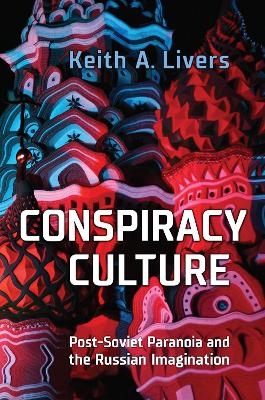
Conspiracy Culture
Post-Soviet Paranoia and the Russian Imagination
Seiten
2020
University of Toronto Press (Verlag)
978-1-4875-0737-4 (ISBN)
University of Toronto Press (Verlag)
978-1-4875-0737-4 (ISBN)
This book examines the uses of conspiracy tropes in post-Soviet culture, providing the first systematic, in-depth analysis of Russia’s most "paranoid" contemporary authors.
Contemporary Russia stands apart as one of the most prolific generators of conspiracy theories and paranoid rhetoric. Conspiracy Culture traces the roots of the phenomenon within the sphere of culture and history, examining the long arc of Russian paranoia from the present moment back to earlier nineteenth-century sources, such as Dostoevsky’s anti-nihilist novel Demons.
Conspiracy Culture examines the use of conspiracy tropes by contemporary Russian authors and filmmakers including the postmodernist writer Viktor Pelevin, the conservative author and pundit Aleksandr Prokhanov, and the popular director Timur Bekmambetov. It also explores paranoia as an instrument within contemporary Russian political rhetoric, as well as in pseudo-historical works. What stands out is the manner in which popular paranoia is utilized to express broadly shared fears not only of a long-standing anti-Russian conspiracy undertaken by the West, but also about the destruction of the country’s cultural and spiritual capital within this imagined "Russophobic" plot.
Contemporary Russia stands apart as one of the most prolific generators of conspiracy theories and paranoid rhetoric. Conspiracy Culture traces the roots of the phenomenon within the sphere of culture and history, examining the long arc of Russian paranoia from the present moment back to earlier nineteenth-century sources, such as Dostoevsky’s anti-nihilist novel Demons.
Conspiracy Culture examines the use of conspiracy tropes by contemporary Russian authors and filmmakers including the postmodernist writer Viktor Pelevin, the conservative author and pundit Aleksandr Prokhanov, and the popular director Timur Bekmambetov. It also explores paranoia as an instrument within contemporary Russian political rhetoric, as well as in pseudo-historical works. What stands out is the manner in which popular paranoia is utilized to express broadly shared fears not only of a long-standing anti-Russian conspiracy undertaken by the West, but also about the destruction of the country’s cultural and spiritual capital within this imagined "Russophobic" plot.
Keith A. Livers is an associate professor in the Department of Slavic and Eurasian Studies at the University of Texas at Austin.
Acknowledgments
Introduction: The Anti-Russian Conspiracy
1. From Vampire Capitalism to Enlightened Selfhood: Viktor Pelevin’s (Anti)-Conspiracy Novels
2. The Great Anti-Russian Plot: Aleksandr Prokhanov’s Conspiracy Novels of the 2000s
3. Timur Bekmambetov’s Night and Day Watch: Russia’s Secret Others
4. From the "Dulles Plan" to Pussy Riot: Conspiracy Theories in Today’s Russia
Conclusion: Mr. Putin and Comrade Trump
Bibliography
| Erscheinungsdatum | 06.12.2021 |
|---|---|
| Verlagsort | Toronto |
| Sprache | englisch |
| Maße | 150 x 231 mm |
| Gewicht | 620 g |
| Themenwelt | Kunst / Musik / Theater ► Film / TV |
| Geschichte ► Allgemeine Geschichte ► Neuzeit (bis 1918) | |
| Geisteswissenschaften ► Geschichte ► Regional- / Ländergeschichte | |
| Geschichte ► Teilgebiete der Geschichte ► Kulturgeschichte | |
| Geschichte ► Teilgebiete der Geschichte ► Militärgeschichte | |
| ISBN-10 | 1-4875-0737-2 / 1487507372 |
| ISBN-13 | 978-1-4875-0737-4 / 9781487507374 |
| Zustand | Neuware |
| Informationen gemäß Produktsicherheitsverordnung (GPSR) | |
| Haben Sie eine Frage zum Produkt? |
Mehr entdecken
aus dem Bereich


aus dem Bereich
Geschichte einer wilden Handlung
Buch | Hardcover (2024)
C.H.Beck (Verlag)
CHF 47,60


