


James Ensor
The Entry of Christ into Brussels in 1889
Seiten
2020
BAI NV (Verlag)
978-90-5325-466-0 (ISBN)
BAI NV (Verlag)
978-90-5325-466-0 (ISBN)
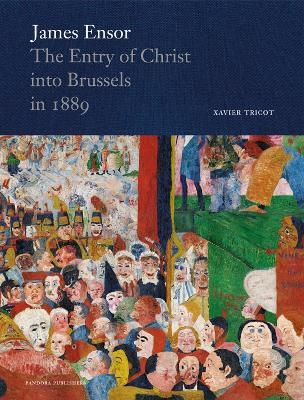
A monograph on James Ensor's The Entry of Christ into Brussels in 1889, a forerunner of 20th Century Expressionism
During 1889, Belgian artist James Ensor (1860-1949) painted a monumental canvas that would be his magnum opus: The Entry of Christ into Brussels in 1889.
The work is one of the most complex paintings ever painted. It was only
40 years after its completion that the monumental canvas was first
publicly exhibited at the James Ensor retrospective at the Brussels
Palais des Beaux-Arts in 1929. Needless to say, therefore, that the
exhibiting of Ensor's work in 1929 was for many a revelation. Until then
it had been seen and was known only to a limited group of visitors and
insiders.
Between 1889 and 1929, a veritable revolution had taken
place in the visual arts. Before and during World War I, Fauvism,
Cubism, Futurism, Expressionism, and Dadaism all came into being. Few
explanations can accommodate the full daring and frenzy of such a
painting which chaotic composition and barbaric style seem
revolutionary, and look far beyond the early 20th century. Since the
purchase of the work in 1987 by the J. Paul Getty Museum (Los Angeles), The Entry has acquired cult status. No other work depicts the notion of belgitude so aptly as The Entry of Christ into Brussels in 1889,
and yet the painting can in the first place be regarded as a somewhat
quirky but striking representation of Ensor's vision of humanity.
During 1889, Belgian artist James Ensor (1860-1949) painted a monumental canvas that would be his magnum opus: The Entry of Christ into Brussels in 1889.
The work is one of the most complex paintings ever painted. It was only
40 years after its completion that the monumental canvas was first
publicly exhibited at the James Ensor retrospective at the Brussels
Palais des Beaux-Arts in 1929. Needless to say, therefore, that the
exhibiting of Ensor's work in 1929 was for many a revelation. Until then
it had been seen and was known only to a limited group of visitors and
insiders.
Between 1889 and 1929, a veritable revolution had taken
place in the visual arts. Before and during World War I, Fauvism,
Cubism, Futurism, Expressionism, and Dadaism all came into being. Few
explanations can accommodate the full daring and frenzy of such a
painting which chaotic composition and barbaric style seem
revolutionary, and look far beyond the early 20th century. Since the
purchase of the work in 1987 by the J. Paul Getty Museum (Los Angeles), The Entry has acquired cult status. No other work depicts the notion of belgitude so aptly as The Entry of Christ into Brussels in 1889,
and yet the painting can in the first place be regarded as a somewhat
quirky but striking representation of Ensor's vision of humanity.
| Erscheinungsdatum | 14.02.2022 |
|---|---|
| Mitarbeit |
Designer: Thomas Soete |
| Verlagsort | Schoten |
| Sprache | englisch |
| Maße | 245 x 325 mm |
| Gewicht | 2230 g |
| Themenwelt | Kunst / Musik / Theater ► Kunstgeschichte / Kunststile |
| Kunst / Musik / Theater ► Malerei / Plastik | |
| ISBN-10 | 90-5325-466-8 / 9053254668 |
| ISBN-13 | 978-90-5325-466-0 / 9789053254660 |
| Zustand | Neuware |
| Informationen gemäß Produktsicherheitsverordnung (GPSR) | |
| Haben Sie eine Frage zum Produkt? |
Mehr entdecken
aus dem Bereich

aus dem Bereich
kleine Kulturgeschichte einer brillanten Allianz
Buch | Softcover (2025)
Iudicium (Verlag)
CHF 33,90


