


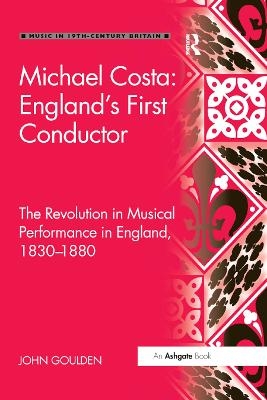
Michael Costa: England's First Conductor
The Revolution in Musical Performance in England, 1830-1880
Seiten
2019
Routledge (Verlag)
978-0-367-87939-6 (ISBN)
Routledge (Verlag)
978-0-367-87939-6 (ISBN)
Among the major changes that swept through the music industry during the mid-nineteenth century was how musical performances were managed and directed. From a loose control shared between the violin-leader, musical director and maestro al cembalo to a system of tight and unified control under a professional conductor-manager. This process brought w
Among the major changes that swept through the music industry during the mid-nineteenth century, one that has received little attention is how musical performances were managed and directed. Yet this was arguably the most radical change of all: from a loose control shared between the violin-leader, musical director and maestro al cembalo to a system of tight and unified control under a professional conductor-manager. This process brought with it not only baton conducting in its modern form, but also higher standards of training and discipline, a new orchestral lay-out and a more focused rehearsal regime. The resulting rise in standards of performance was arguably the greatest achievement of English music in the otherwise rather barren mid-Victorian period. The key figure in this process was Michael Costa, who built for himself unprecedented contractual powers and used his awesome personal authority to impose reform on the three main institutions of mid-Victorian music: the opera houses, the Philharmonic and the Sacred Harmonic Society. He was a central figure in the battles between the two rival opera houses, between the Philharmonic and the New Philharmonic, and between the venerable Ancient Concerts and the mass festival events of the Sacred Harmonic Society. Costa’s uniquely powerful position in the operatic, symphonic and choral world and the rapidity with which he was forgotten after his death provide a fascinating insight into the politics and changing aesthetics of the Victorian musical world.
Among the major changes that swept through the music industry during the mid-nineteenth century, one that has received little attention is how musical performances were managed and directed. Yet this was arguably the most radical change of all: from a loose control shared between the violin-leader, musical director and maestro al cembalo to a system of tight and unified control under a professional conductor-manager. This process brought with it not only baton conducting in its modern form, but also higher standards of training and discipline, a new orchestral lay-out and a more focused rehearsal regime. The resulting rise in standards of performance was arguably the greatest achievement of English music in the otherwise rather barren mid-Victorian period. The key figure in this process was Michael Costa, who built for himself unprecedented contractual powers and used his awesome personal authority to impose reform on the three main institutions of mid-Victorian music: the opera houses, the Philharmonic and the Sacred Harmonic Society. He was a central figure in the battles between the two rival opera houses, between the Philharmonic and the New Philharmonic, and between the venerable Ancient Concerts and the mass festival events of the Sacred Harmonic Society. Costa’s uniquely powerful position in the operatic, symphonic and choral world and the rapidity with which he was forgotten after his death provide a fascinating insight into the politics and changing aesthetics of the Victorian musical world.
Sir John Goulden retired in 2000 from a distinguished career in the British Diplomatic Service, during which he served as Ambassador to Turkey and Permanent Representative to Nato (1995-2000). On retirement he began to pursue his interest in the revolution in musical performance during the early nineteenth century and the role in this of the conductor and composer Michael Costa. He was awarded a PhD in musicology in 2012.
Costa's background and personality. Conducting prior to 1830. Costa's system. Costa as a conductor. Opera. Concerts, oratorios and festivals. Costa's reputation and legacy. Reassessment.
| Erscheinungsdatum | 16.12.2019 |
|---|---|
| Reihe/Serie | Music in Nineteenth-Century Britain |
| Verlagsort | London |
| Sprache | englisch |
| Maße | 156 x 234 mm |
| Gewicht | 453 g |
| Themenwelt | Kunst / Musik / Theater ► Musik ► Klassik / Oper / Musical |
| ISBN-10 | 0-367-87939-5 / 0367879395 |
| ISBN-13 | 978-0-367-87939-6 / 9780367879396 |
| Zustand | Neuware |
| Informationen gemäß Produktsicherheitsverordnung (GPSR) | |
| Haben Sie eine Frage zum Produkt? |
Mehr entdecken
aus dem Bereich


aus dem Bereich
Essays und Gespräche
Buch | Hardcover (2025)
Wallstein Erfolgstitel (Verlag)
CHF 29,90


