


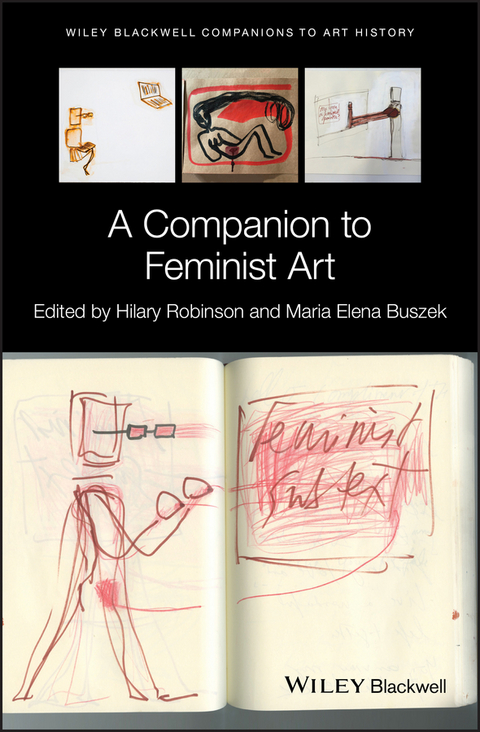
Companion to Feminist Art (eBook)
1127 Seiten
Wiley (Verlag)
978-1-118-92919-3 (ISBN)
Original essays offering fresh ideas and global perspectives on contemporary feminist art
The term 'feminist art' is often misused when viewed as a codification within the discipline of Art History-a codification that includes restrictive definitions of geography, chronology, style, materials, influence, and other definitions inherent to Art Historical and museological classifications. Employing a different approach, A Companion to Feminist Art defines 'art' as a dynamic set of material and theoretical practices in the realm of culture, and 'feminism' as an equally dynamic set of activist and theoretical practices in the realm of politics. Feminist art, therefore, is not a simple classification of a type of art, but rather the space where feminist politics and the domain of art-making intersect. The Companion provides readers with an overview of the developments, concepts, trends, influences, and activities within the space of contemporary feminist art-in different locations, ways of making, and ways of thinking.
Newly-commissioned essays focus on the recent history of and current discussions within feminist art. Diverse in scope and style, these contributions range from essays on the questions and challenges of large sectors of artists, such as configurations of feminism and gender in post-Cold War Europe, to more focused conversations with women artists on Afropean decoloniality. Ranging from discussions of essentialism and feminist aesthetics to examinations of political activism and curatorial practice, the Companion informs and questions readers, introduces new concepts and fresh perspectives, and illustrates just how much more there is to discover within the realm of feminist art.
- Addresses the intersection between feminist thinking and major theories that have influenced art theory
- Incorporates diverse voices from around the world to offer viewpoints on global feminisms from scholars who live and work in the regions about which they write
- Examines how feminist art intersects with considerations of collectivity, war, maternal relationships, desire, men, and relational aesthetics
- Explores the myriad ways in which the experience of inhabiting and perceiving aged, raced, and gendered bodies relates to feminist politics in the art world
- Discusses a range practices in feminism such as activism, language, education, and different ways of making art
The intersection of feminist art-making and feminist politics are not merely components of a unified whole, they sometimes diverge and divide. A Companion to Feminist Art is an indispensable resource for artists, critics, scholars, curators, and anyone seeking greater strength on the subject through informed critique and debate.
Hilary Robinson is Professor of Feminism, Art, and Theory at Loughborough University, UK. She is former Dean of the College of Fine Arts, Carnegie Mellon University, USA, and earlier, was Head of the School of Art and Design at the University of Ulster, Belfast, UK. Her publications include Visibly Female: Women and Art Today (1987), Reading Art, Reading Irigaray: The Politics of Art by Women (2006), and Feminism-Art-Theory 1968-2014 (2015).
Maria Elena Buszek is Associate Professor of Art History at the University of Colorado Denver. She is author of Pin???Up Grrrls: Feminism, Sexuality, Popular Culture (2006) and Extra/Ordinary: Craft and Contemporary Art (2011). A prolific independent curator as well as a scholar, she has also served as a curatorial assistant at the Los Angeles County Museum of Art and the Museum of Modern Art in New York City.
Original essays offering fresh ideas and global perspectives on contemporary feminist art The term feminist art is often misused when viewed as a codification within the discipline of Art History a codification that includes restrictive definitions of geography, chronology, style, materials, influence, and other definitions inherent to Art Historical and museological classifications. Employing a different approach, A Companion to Feminist Art defines art as a dynamic set of material and theoretical practices in the realm of culture, and feminism as an equally dynamic set of activist and theoretical practices in the realm of politics. Feminist art, therefore, is not a simple classification of a type of art, but rather the space where feminist politics and the domain of art-making intersect. The Companion provides readers with an overview of the developments, concepts, trends, influences, and activities within the space of contemporary feminist art in different locations, ways of making, and ways of thinking. Newly-commissioned essays focus on the recent history of and current discussions within feminist art. Diverse in scope and style, these contributions range from essays on the questions and challenges of large sectors of artists, such as configurations of feminism and gender in post-Cold War Europe, to more focused conversations with women artists on Afropean decoloniality. Ranging from discussions of essentialism and feminist aesthetics to examinations of political activism and curatorial practice, the Companion informs and questions readers, introduces new concepts and fresh perspectives, and illustrates just how much more there is to discover within the realm of feminist art. Addresses the intersection between feminist thinking and major theories that have influenced art theory Incorporates diverse voices from around the world to offer viewpoints on global feminisms from scholars who live and work in the regions about which they write Examines how feminist art intersects with considerations of collectivity, war, maternal relationships, desire, men, and relational aesthetics Explores the myriad ways in which the experience of inhabiting and perceiving aged, raced, and gendered bodies relates to feminist politics in the art world Discusses a range practices in feminism such as activism, language, education, and different ways of making art The intersection of feminist art-making and feminist politics are not merely components of a unified whole, they sometimes diverge and divide. A Companion to Feminist Art is an indispensable resource for artists, critics, scholars, curators, and anyone seeking greater strength on the subject through informed critique and debate.
Hilary Robinson is Professor of Feminism, Art, and Theory at Loughborough University, UK. She is former Dean of the College of Fine Arts, Carnegie Mellon University, USA, and earlier, was Head of the School of Art and Design at the University of Ulster, Belfast, UK. Her publications include Visibly Female: Women and Art Today (1987), Reading Art, Reading Irigaray: The Politics of Art by Women (2006), and Feminism-Art-Theory 1968-2014 (2015). Maria Elena Buszek is Associate Professor of Art History at the University of Colorado Denver. She is author of Pin???Up Grrrls: Feminism, Sexuality, Popular Culture (2006) and Extra/Ordinary: Craft and Contemporary Art (2011). A prolific independent curator as well as a scholar, she has also served as a curatorial assistant at the Los Angeles County Museum of Art and the Museum of Modern Art in New York City.
Series Editor Preface xi
About the Editors xiii
Notes on Contributors xv
Introduction 1
Part I Geographies 15
1 Recurring Questions, Cyclical Energies: A History of Feminist Art Practices in Australia 17
Julie Ewington
2 Debunking the Patriarchy: Feminist Collectives in Argentina, Bolivia, Chile, and Peru 37
María Laura Rosa (Translated by Maria Elena Buszek)
3 Women Artists: Making a Subject Space in India 53
Gayatri Sinha
4 Feminism as Activism in Contemporary South African Art 69
Karen von Veh
5 Moving Towards Paratactical Curating: A Critical Overview of Feminist Curating in Istanbul in the Twenty-First Century 91
Ebru Yetiskin
6 From Within, From Without: Configurations of Feminism, Gender and Art in Post-Wall Europe 111
Martina Pachmanová
7 Crossing Borders and Other Dividers in Western Europe and the British Isles 127
Alexandra Kokoli
8 Wheels and Waves in the USA 141
Mira Schor
Part II Being 155
9 Essentialism, Feminism, and Art: Spaces Where Woman "Oozes Away" 157
Amelia Jones
10 Feminist Ageing: Representations of Age in Feminist Art 181
Michelle Meagher
11 Letters to Susan 199
Lubaina Himid
12 Feminist Art Re-Covered 215
Richard Meyer
13 Collecting Creative Transcestors: Trans* Portraiture Hirstory, from Snapshots to Sculpture 225
Eliza Steinbock
Part III Doing 243
14 Witness It: Activism, Art, and the Feminist Performative Subject 245
Hilary Robinson
15 Feminism and Language 261
Griselda Pollock
16 Busy Hands, Light Work: Toward a Feminist Historiography of Hand-Made Photography in the Era of the 'New Materiality' 283
Harriet Riches
17 Reading Posthumanism in Feminist New Media Art 299
Maria Fernandez
18 Finding Ourselves Feminists: Curating and Exhibitions 315
Lucy Day and Eliza Gluckman
19 Erasure, Transformation and the Politics of Pedagogy as Feminist Artistic/Curatorial Practice 331
Felicity Allen
Part IV Thinking 351
20 Art Matters: Feminist Corporeal-Materialist Aesthetics 353
Marsha Meskimmon
21 The Hidden Abode Beneath/Behind/Beyond the Factory Floor, Gendered Labor, and the Human Strike: Claire Fontaine's Italian Marxist Feminism 369
Jaleh Mansoor
22 Dear World: Arts and Theories of Queer Feminism 389
Tirza Latimer
23 From Representation to Affect: Beyond Postmodern Identity Politics in Feminist Art 405
Susan Best
24 Call and Response: Conversations with Three Women Artists on Afropean Decoloniality 419
Alanna Lockward
Part V Relating 437
25 On Feminism, Art and Collaboration 439
Amy Tobin
26 Opening the Patriarchive: Photography, Feminism, and State Violence 459
Siona Wilson
27 Maternal Mattering: The Performance and Politics of the Maternal in Contemporary Art 475
Natalie Loveless
28 Ars Eroticas of Their Own Making: Explicit Sexual Imagery in American Feminist Art 493
Tanya Augsburg
29 Masculinity, Art, and Value Extraction: An Intersectional Reading in the Advance of Capital as Post-Democracy 513
Angela Dimitrakaki
30 New Subjects and Subjectivities 533
Jill Bennett
Index 545
"The strength of the book is in its articulation of theoretical frameworks for understanding art and feminism in a global context." - T. Nygard, Ripon College for CHOICE Connect, February 2020 Vol. 57 No. 6
Notes on Contributors
Felicity Allen is an artist, writer, and educator. Her career’s work is a model of The Disoeuvre, the neologism she coined to describe the contingent and adaptable practices that she has developed (like many other artists), in contrast to a conventional ‘oeuvre’. In the last decade she has made five series of Dialogic Portraits projects, producing paintings, films, and artists books (included in Tate’s and Getty’s artists’ books collections). She has written numerous articles on gallery education, published poetry, and sustained a long‐term project with a Syrian artist based in Damascus.
Tanya Augsburg is a humanities‐trained, interdisciplinary feminist performance scholar, critic, and curator who can be occasionally persuaded to perform. She teaches at San Francisco State University, where she is Professor of Humanities. Her current projects include completing a book‐length manuscript on the interdisciplinary arts and a book‐length manuscript on what she is calling “feminist ars erotica.”
Jill Bennett is an Australian Research Council Laureate Fellow and Professor of Experimental Arts at the University of New South Wales. She leads a transdisciplinary research team investigating the experience of ageing and neurological/mental health, and producing 3D immersive visualization of subjective experience. She is Founding Director of The Big Anxiety: Festival of Arts + Science + People. Her books include Empathic Vision: Affect, Trauma and Contemporary Art and Practical Aesthetics, as well as monographs on media arts and curating.
Susan Best is Professor of Art History and Theory and Deputy Director (research and postgraduate) at Queensland College of Art, Griffith University. She is the author of Visualizing Feeling: Affect and the Feminine Avant‐Garde (2011) and Reparative Aesthetics: Witnessing in Contemporary Art Photography (2016).
Lucy Day is a lecturer, writer, and Fellow of the Royal Society of Arts. Alongside her 30‐year curating career, Day has supported artists and arts organizers through mentoring, workshops, and organizational change. For over 10 years as part of the independent curatorial partnership Day + Gluckman, she has collaborated with a variety of organizations, and in 2015 founded A Woman’s Place Project CIC, which takes equality as its starting point, exploring it creatively through contemporary‐art exhibitions, projects, and events.
Angela Dimitrakaki is Senior Lecturer in Contemporary Art History and Theory, University of Edinburgh. She has co‐edited Economy: Art, Production and the Subject in the 21st Century (2015, with Kirsten Lloyd) and Politics in a Glass Case: Feminism, Exhibition Cultures, and Curatorial Transgressions (2013, with Lara Perry), and special issues on social reproduction for the journals Historical Materialism (2016) and Third Text (2017), and on antifascist art theory for Third Text (2019). She has authored Gender, ArtWork and the Global Imperative (2013), and Art and Globalisation: From the Postmodern Sign to the Biopolitical Arena (2013, in Greek). Her forthcoming book is Feminism, Art, Capitalism. She has received an Academy of Athens award for fiction writing (2017).
Julie Ewington is a writer and curator based in Sydney, Australia. Between 2001 and 2014 she was Head of Australian Art at Queensland Art Gallery|Gallery of Modern Art, Brisbane. She has written numerous catalogue essays and reviews for journals, including The Monthly, Art Monthly Australasia, and Artforum. Major publications include monographs on Fiona Hall (2005) and Del Kathryn Barton (2014). In 2016 Ewington curated The Sculpture of Bronwyn Oliver for TarraWarra Museum of Art, and in 2017 was a curatorium member for Unfinished Business: Perspectives on Art and Feminism, at ACCA, Melbourne.
Maria Fernandez teaches at Cornell University. She works on the history and theory of digital art, postcolonial and gender studies, Latin American art and architecture, and the intersections of these fields. She is the author of Cosmopolitanism in Mexican Visual Culture (2014) for which she was awarded the Arvey Prize by the Association for Latin American Art in 2015. She edited Latin American Modernisms and Technology (2018) and with Faith Wilding and Michelle Wright coedited Domain Errors: Cyberfeminist Practices (2002).
Eliza Gluckman was Curator of the New Hall Art Collection, Murray Edwards College, University of Cambridge, the largest collection of works by women in Europe, from 2015 to 2018, and is currently Senior Curator and Deputy Director of the Government Art Collection (UK). For over 10 years as part of the independent curatorial partnership Day + Gluckman, she has collaborated with a variety of organizations, and in 2015 founded A Woman’s Place Project CIC, which takes equality as its starting point, exploring it creatively through contemporary‐art exhibitions, projects, and events.
Lubaina Himid is an artist, curator, and Professor of Contemporary Art at the University of Central Lancaster. She was awarded the Turner Prize (2017), and an MBE for services to Black women’s art (2010). Recent exhibitions include Invisible Strategies, Modern Art Oxford, 2017, and Navigation Charts, Spike Island, 2017. Other exhibitions include the Studio Museum, New York, 1997, Tate Britain, 2011, and the Badischer Kunstverein, 2017. She represented Britain at the Gwangju Biennial, 2014 and the Berlin Biennial, 2018. She curated Five Black Women, Africa Centre, London 1983, The Thin Black Line, ICA London, 1985, and Thin Black Line(s), Tate Britain 2011.
Amelia Jones is Robert A. Day Professor, Roski School of Art & Design, USC, and is a curator and scholar of contemporary art, performance, and feminist/sexuality studies. Recent publications include Seeing Differently: A History and Theory of Identification and the Visual Arts (2012), co‐edited with Erin Silver, Otherwise: Imagining Queer Feminist Art Histories (2016), and the edited special issue “On Trans/Performance” of Performance Research (2016). Jones is currently working on a retrospective of the work of Ron Athey and a book tentatively entitled In Between Subjects: A Critical Genealogy of Queer Performance.
Alexandra Kokoli is Senior Lecturer in Visual Culture, Middlesex University, London, and Research Associate at VIAD, University of Johannesburg. A writer and curator, she has published widely on feminism, art, and visual culture in journals including Art Journal, Women and Performance, n.paradoxa, Performance Research, Oxford Art Journal, and Hypatia. Her books include The Feminist Uncanny in Theory and Art Practice (2016, paperback 2017), and (as editor) Feminism Reframed: Reflections on Art and Difference (2008), and The Provisional Texture of Reality: Selected Talks and Texts by Susan Hiller, 1977–2007 (2008).
Tirza Latimer earned her PhD in Art History at Stanford University. Professor in Visual Studies at California College of the Arts, Oakland/San Francisco, her teaching, publications, and curatorial projects reflect on visual culture and visual politics from queer feminist perspectives. Her latest book, Eccentric Modernisms: Making Differences in the History of American Art, was released by University of California Press in 2016.
Alanna Lockward was a Dominican‐German writer, journalist, filmmaker and founding director of Art Labour Archives. Lockward conceptualized and curated the groundbreaking transdisciplinary meeting BE.BOP. BLACK EUROPE BODY POLITICS (2012–2018). She was the author of several books, including Apremio: apuntes sobre el pensamiento y la creación contemporánea desde el Caribe (2006) and Un Haití Dominicano: Tatuajes fantasmas y narrativas bilaterales (2014), and editor of BE.BOP 2012–2014. El cuerpo en el continente de la conciencia Negra (2016). She was research professor at the Center of Caribbean Studies, Pontificia Universidad Católica Madre y Maestra. Dr Lockward passed away in January 2019.
Natalie Loveless is an associate professor in the Department of Art and Design (History of Art, Design, and Visual Culture) at the University of Alberta, Canada, where she also directs the Research‐Creation and Social Justice CoLABoratory. Recent projects include New Maternalisms and Immune Nations. Current work includes a forthcoming book, Art at the End of the World: A Manifesto for Research‐Creation, and a collaborative project on art and ecology called Speculative Energy Futures.
Jaleh Mansoor is Associate Professor of Art History at the University of British Columbia. She coedited the anthology Communities of Sense: Rethinking Aesthetics and Politics (2010), and her monograph Marshall Plan Modernism: Italian Postwar Abstraction and the Beginnings of Autonomia was published in September 2016. She has contributed to October, Texte Zur Kunst, and Artforum. Mansoor’s current project traces the historical and structural entwinement of aesthetic and real (or concrete) abstraction, the latter understood as the extraction of surplus labor valorized on and by the market.
Michelle Meagher is Associate Professor of...
| Erscheint lt. Verlag | 27.6.2019 |
|---|---|
| Reihe/Serie | Blackwell Companions to Art History |
| Blackwell Companions to Art History | Blackwell Companions to Art History |
| Sprache | englisch |
| Themenwelt | Kunst / Musik / Theater ► Allgemeines / Lexika |
| Kunst / Musik / Theater ► Kunstgeschichte / Kunststile | |
| Kunst / Musik / Theater ► Malerei / Plastik | |
| Schlagworte | Art & Applied Arts • art feminism • Art History & Theory • Cultural Studies • Feminist Art • feminist art articles • feminist art curation • feminist art discourse • feminist art essays • feminist art history • feminist art scholarship • Feminist Art Theory • feminist media • feminist media</p> • Frauenforschung • global feminist art • international feminist art • Kulturwissenschaften • Kunstgeschichte u. -theorie • Kunst u. Angewandte Kunst • <p>feminist art • women's studies |
| ISBN-10 | 1-118-92919-5 / 1118929195 |
| ISBN-13 | 978-1-118-92919-3 / 9781118929193 |
| Informationen gemäß Produktsicherheitsverordnung (GPSR) | |
| Haben Sie eine Frage zum Produkt? |
 EPUB (Adobe DRM)
Kopierschutz: Adobe-DRM
Adobe-DRM ist ein Kopierschutz, der das eBook vor Mißbrauch schützen soll. Dabei wird das eBook bereits beim Download auf Ihre persönliche Adobe-ID autorisiert. Lesen können Sie das eBook dann nur auf den Geräten, welche ebenfalls auf Ihre Adobe-ID registriert sind.
Details zum Adobe-DRM
Dateiformat: EPUB (Electronic Publication)
EPUB ist ein offener Standard für eBooks und eignet sich besonders zur Darstellung von Belletristik und Sachbüchern. Der Fließtext wird dynamisch an die Display- und Schriftgröße angepasst. Auch für mobile Lesegeräte ist EPUB daher gut geeignet.
Systemvoraussetzungen:
PC/Mac: Mit einem PC oder Mac können Sie dieses eBook lesen. Sie benötigen eine
eReader: Dieses eBook kann mit (fast) allen eBook-Readern gelesen werden. Mit dem amazon-Kindle ist es aber nicht kompatibel.
Smartphone/Tablet: Egal ob Apple oder Android, dieses eBook können Sie lesen. Sie benötigen eine
Geräteliste und zusätzliche Hinweise
Buying eBooks from abroad
For tax law reasons we can sell eBooks just within Germany and Switzerland. Regrettably we cannot fulfill eBook-orders from other countries.
aus dem Bereich


