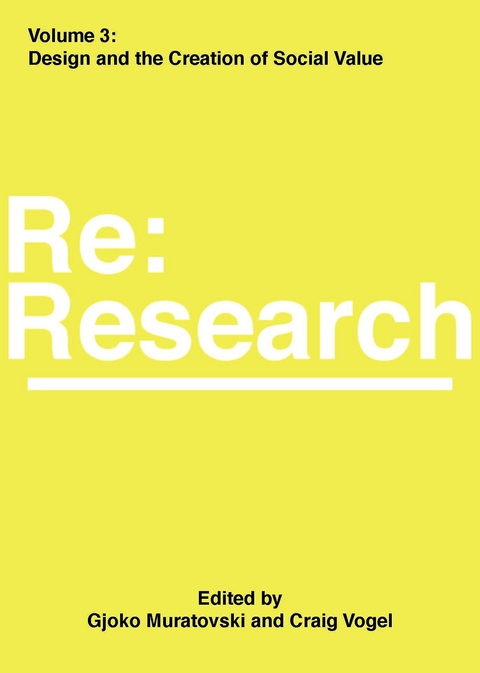
This collection showcases diverse perspectives in design and design research, with topics ranging from the introduction of design in the primary education sector to designing information for artificial intelligence systems. Divided into seven thematic volumes, the Re:Research series maps out where the field of design research is now.
Just as the term design has been going through change, growth and expansion of meaning, and interpretation in practice and education - the same can be said for design research. The traditional boundaries of design are dissolving and connections are being established with other fields at an exponential rate. Based on the proceedings from the IASDR 2017 Conference, Re:Research is an edited collection that showcases a curated selection of 83 papers - just over half of the works presented at the conference. With topics ranging from the introduction of design in the primary education sector to designing information for Artificial Intelligence systems, this book collection demonstrates the diverse perspectives of design and design research. Divided into seven thematic volumes, this collection maps out where the field of design research is now. Understanding Everyday Design Soyoung Kim, Kwangmin Cho, Chajoong Kim The more society gets complicated and developed, the more demand for various products. As a result, we are living in a flood of various products. However, considering how people consume and use products in their daily life, it is not difficult to find people transforming, changing the original purpose or adding value to existing products instead of buying new ones. This phenomenon has been defined as everyday design. In a sense that everyday design provides a better understanding of actual uses in real context, it deserves to be studied. Therefore, this paper attempts to figure out an underlying mechanism of everyday design. For this, a conceptual framework was developed, whose focus was on what triggers everyday design, what goals are set and how a product is transformed. The conceptual framework was validated with a photographic inventory of users everyday design in our daily life. The conceptual framework could provide a better understanding of everyday design in a systematic way. If it is considered in the product development process, it could contribute to an increase of use satisfaction as well as sustainable design. The limitations and a further study are discussed at the end of the paper. Social Value Creation through Multidisciplinary Design Education Steven Kyffin, Mersha Aftab, Nicholas Spencer The paper proposes that design with a multidisciplinary student cohort as active partners can play the role of bringing the four different stakeholder groupings, namely, government, industry, society and academia together within the creative consortia, and create innovation for the greater good of the society. By studying a selection of social innovation projects undertaken by multidisciplinary student teams as connector-integrators, which engaged with companies, government bodies and community groups, we have examined a combination of four different activities across different economic and cultural (human experience) contexts to assess their different degrees of appropriateness in creating future value. We apply these methods to establish creative consortia, which has enabled us to reframe the context of the problem space. We believe that the creative consortia has the potential to create more relevance in the solution space, greater engagement in realizing the proposition into the future and a higher opportunity for integration of such future principles into emerging government policy, and national innovation agendas. Taking Aim at wicked problems : A Practical Philosophy for Educating Designers in the Making of Wise Decisions Paul Emmerson, Robert Young Today s design pedagogies lack the characteristics for redressing the nature of the wicked problems they attempt to solve, such as sustainability. We argue it is not fair for future generations to suffer the systemic effects of our unsustainable consumer culture, partly resulting from today s design professionals decisions, which ensue because design is an amoral discipline lacking a systemic perspective. To rectify design s characteristic failings, as part of a PhD study, we report a new pedagogical architecture founded as the synthesis of the practices of design and civics, forming the relationship design-as-civics (DaC): a practical philosophy. We position DaC as a reflexive, systemic radical political praxis for every citizen, possessing the explicit teleological goal to achieve the good life for all. DaC takes a transdisciplinary approach. It integrates the discoveries of cognitive science and linguistics to expose how we construct our understanding of the world interpreting metaphors and frames, which we utilize to aim DaC. Alongside shared social practice theory (SSP) and insights from developmental psychology that reveal the distinctly human capacity of shared intentionality engendering humankind s willingness for cooperation and empathy for fairness. That living in a fairer society is desired by people from rival political perspectives, with egalitarian societies reporting lower environmental impact lifestyles and more willingness for transitioning toward sustainment. Thus, it is humankind s cooperative behavior and aligning values that provides the foundational rationale of DaC s SSP goal to achieve the good life through the ongoing critical examination of its aim of resolving fairness between citizens. Developing a Matrix for Designerly Way of Creating Shared Value (DCSV): Four Examples of CSV via Perspectives of Design Kyulee Kim Today, while profit maximization is still the bedrock of the capitalist model, people have embraced the idea of social contribution as a useful strategy in businesses. In this recent movement, Creating Shared Value (CSV) strives for a win-win solution that creates both social and business value. While in its early stage, CSV is showing promise and potential; society is witnessing a paradigm shift from practices of corporate social responsibilities (CSR) to CSV which is more sustainable and effective approach. Since Porter and Kramer originally introduced the concept in 2011, CSV s application has expanded to many areas of business management, but it has not been discussed comprehensively in design research as of yet. The title of this paper, Designerly Way of Creating Shared Value (DCSV) is inspired by Nigel Cross s famous book, Designerly way of knowing (2006). Designerly is an adjective describing how designers think and behave that is different from professionals in scientific disciplines. The aim of this paper is to propose a new matrix illustrating the link between creating shared value and design, and to systemically describe the existing examples of DCSV. The paper will begin with an introduction to the concept of CSV followed by a brief literature review on CSV in design research. The second part will focus on demonstrating the new DCSV matrix by illustrating the four examples that exemplify it. Design for Social Innovation Digital Technologies and Local Communities Teresa Franqueira, Goncalo Gomes AbstractThe use and democratization of new digital technologies have given visibility to groups of people and grassroots organizations that can be considered agents of change in the transition to a more sustainable world. Design plays an important role in the definition of strategies and in the development of innovative solutions to tackle some of the contemporary problems society faces. This paper aims to show several projects developed over the last 5 years in the subject Design for Social Innovation at the Master in Design and the Master in Engineering and Product Design at the University of Aveiro, and its relation to the new social media and technologies. By using Service Design tools to improve Social Innovations and the integration of new digital technologies, we design new and improved solutions to foster sustainable development. The creation of a DESIS Lab has also allowed to develop innovative design solutions within local communities. The methodology used is based on Learning-by-Doing with an important and relevant initial phase using ethnographic methods. The results are showed as academic projects that can be applied and replicated in different contexts. The Extent of Transformation: Measuring the Impact of Design in VCS Organizations Laura E. Warwick, Robert A. Young A Design for Service (DfS) approach has been linked with impacts that significantly alter touchpoints, services and organizational culture. However, there is no model with which to assess the extent to which these impacts can be considered transformational. In the absence of such a model, the authors have reviewed literature on subjects including the transformational potential of design; characteristics of transformational design; transformational change; and organizational change. From this review, six indicators of transformational change in design projects have been identified: evidence of nontraditional transformative design objects; evidence of a new perspective; evidence of a community of advocates; evidence of design capability; evidence of new power dynamics; and evidence of new organizational standards. These indicators, along with an assessment scale, have been used to successfully review the findings from a doctoral study exploring the impact of the DfS approach in Voluntary Community Sector (VCS) organizations. This paper presents this model as a first-step to establishing a method to helpfully gauge the extent of transformational impact in design projects. Applying Design Thinking for Business Model Innovation for a Nonprofit Organization Case Study: Art a la Carte Alison Miyauchi, Scott Cressman The challenges facing many small nonprofit organizations are increasing at a greater rate than the internal capacities of many within this sector are able to address effectively. This situation has small nonprofits questioning their sustainability and ability to deliver their services in the long term. Often these small nonprofit organizations are working within a business model and communications paradigm that has remained unchanged for decades and one which is proving no longer effective in attracting awareness, engagement and support. Many of these organizations are facing a critical failure requiring significant business model innovation to achieve both their short-, mid- and long-term goals. Design thinking is an avenue for nonprofits to achieve business model innovation by developing new, unique concepts supporting an organization s viability and the processes for bringing those concepts to fruition. This case study outlines the design thinking process applied to business model innovation for a small, 22-year-old, nonprofit approaching critical business failure. Generative Design Research for Sustainability: Exemplary Cases for the Adaptation of the EC Guide Tool and the ERM Method Mert Kulaksiz, Itir Gungor Boncukcu, Dilruba Ogur, Ismail Yavuz Paksoy, Senem Turhan, Cagla Dogan This paper presents the main process of a graduate course entitled Generative Design Research for Sustainability offered in the Department of Industrial Design at Middle East Technical University in the spring semester of 2015/2016 through exemplary design research cases conducted by the graduate students at the doctoral level. These cases focus on the adaptation of the generative tool and the method, namely Experience Chart (EC) Guide tool and Experience Reflection Modelling (ERM) method, in line with the graduate students particular research topics. First, the paper provides the course objectives, outcomes and process, then, it explains the EC Guide tool and the ERM method to be adapted and implemented within the context of the course. Then, these generative tool and method, and their adaptations are demonstrated through the exemplary cases (i.e. efficient use of working environment in design studios, lighting practices in kitchen environment, and interactive prototyping practice) selected from the submitted assignments considering their quality, originality and comprehensiveness. The main emphasis of this paper is on the adaptation and implementation of the EC Guide tool and the ERM method through providing the experiences, insights and suggestions of the graduate students who are also the co-authors of the paper. Based on that review, major conclusions and findings are presented through comparing and contrasting these cases for the future development of the course. Beyond Greener Things: Sustainability within Communication Design Practice Niki Wallace, Robert Crocker This paper reviews contemporary communication design practice in Australia through a series of interviews with practitioners, conducted to better understand the place of sustainability in contemporary practice. It is especially concerned with the expectations and experience of designers, and their attitudes toward sustainability in practice, and the contrast between designing greener things and establishing more sustainable outcomes for their clients through deeper collaboration. The paper is part of a larger PhD project attempting to establish ways of expanding the understanding of sustainability for communication designers. Craft and Design for Sustainability: Leverage for Change Xiaofang Zhan, Stuart Walker Traditional craft has been relegated to the margins in modern culture, being perceived as out step with technological, economic and societal progress. However, emergent research is rediscovering the nature of craft and its potential for contributing to design practice in conjunction with developments in science and technology. Through the analyses of craft and sustainability, strong connections are revealed as well as some incompatibilities. The contribution of this paper is to (a) map a systemic view of craft and (b) establish a theoretical understanding of the relationship between craft and a holistic understanding of sustainability. Drawing on recent research that proposes three areas of leverage for sustainability, we argue that craft, as a system of making, knowing and being, has significant potential to contribute actively and tangibly to the transitional conditions, thereby serving as an agency for sustainable transformation. Nature-Inspired Organizational Design Framework for Open Collaboration Platform Development Sojung Kim, Joon Sang Baek Over the last two decades, for-profit and not-for-profit organizations have increasingly adopted open collaboration, such as open innovation and crowdsourcing, as a strategy for innovation. Information and communication technology (ICT) has played a major role in forming open collaboration communities, but organizational design also needs to be considered to encourage the active participation and collaboration of actors. Nonetheless, organizational design aspect has seldom been addressed in developing open collaboration platforms. In this research, an organizational design framework for open collaboration was developed through a nature-inspired design approach. This framework suggests that the self-organization mechanism of social insects provides inspirations for the design of the platform, especially in terms of setting simple rules to induce behaviors of the actors and facilitating interactions among them. Since the open collaboration strategy depends on external actors who are not in employment relationship, an organization cannot force their contribution. Accordingly, the organization s capability to induce the spontaneous participation of actors is essential, and it implies the potential role of designers in platform design based on a thorough understanding of actors. We thus claim that designers can bring a new perspective to organizational design. Open collaboration platforms serve as an exemplar in which designers contribute to the design of an organizational environment that fosters collaboration.
lt;p>Gjoko Muratovski is the founding editor of the Journal of Design, Business & Society and director of the Myron E. Ullman Jr. School of Design at the University of Cincinnati’s College of Design, Architecture, Art, and Planning (DAAP). He is the editor of Consumer Culture: Selected Essays and three volumes of Design for Business, and co-editor of Global Fashion Brands: Style, Luxury and History, all also published by Intellect Books.
Craig Vogel is associate dean for graduate studies and research at the University of Cincinnati’s College of Design, Architecture, Art, and Planning (DAAP) and professor at the Myron E. Ullman Jr. School of Design.
| Erscheint lt. Verlag | 22.5.2019 |
|---|---|
| Reihe/Serie | Re:Research |
| Re:Research | Re:Research |
| Verlagsort | Bristol |
| Sprache | englisch |
| Maße | 170 x 170 mm |
| Themenwelt | Kunst / Musik / Theater ► Design / Innenarchitektur / Mode |
| Sachbuch/Ratgeber ► Freizeit / Hobby ► Kreatives Gestalten | |
| Schlagworte | Artificial Intelligence • Boundaries • Consumerism • Creative Consortia • Design education • Design Pedagogies • Design research • Development • Developmental Psychology • educating designers • Everyday Design • government policy • Local Communities • Multi-Disciplinary • National Innovation • non-profit design • Shared Social Practice Theory • Social Innovation • Sustainable design • Tradition |
| ISBN-13 | 9781789381467 / 9781789381467 |
| Informationen gemäß Produktsicherheitsverordnung (GPSR) | |
| Haben Sie eine Frage zum Produkt? |
 PDF (Adobe DRM)
Kopierschutz: Adobe-DRM
Adobe-DRM ist ein Kopierschutz, der das eBook vor Mißbrauch schützen soll. Dabei wird das eBook bereits beim Download auf Ihre persönliche Adobe-ID autorisiert. Lesen können Sie das eBook dann nur auf den Geräten, welche ebenfalls auf Ihre Adobe-ID registriert sind.
Details zum Adobe-DRM
Dateiformat: PDF (Portable Document Format)
Mit einem festen Seitenlayout eignet sich die PDF besonders für Fachbücher mit Spalten, Tabellen und Abbildungen. Eine PDF kann auf fast allen Geräten angezeigt werden, ist aber für kleine Displays (Smartphone, eReader) nur eingeschränkt geeignet.
Systemvoraussetzungen:
PC/Mac: Mit einem PC oder Mac können Sie dieses eBook lesen. Sie benötigen eine
eReader: Dieses eBook kann mit (fast) allen eBook-Readern gelesen werden. Mit dem amazon-Kindle ist es aber nicht kompatibel.
Smartphone/Tablet: Egal ob Apple oder Android, dieses eBook können Sie lesen. Sie benötigen eine
Geräteliste und zusätzliche Hinweise
Buying eBooks from abroad
For tax law reasons we can sell eBooks just within Germany and Switzerland. Regrettably we cannot fulfill eBook-orders from other countries.
aus dem Bereich