


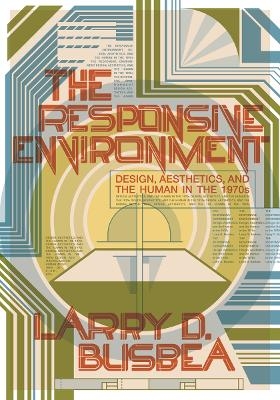
The Responsive Environment
Design, Aesthetics, and the Human in the 1970s
Seiten
2020
|
1
University of Minnesota Press (Verlag)
978-1-5179-0709-9 (ISBN)
University of Minnesota Press (Verlag)
978-1-5179-0709-9 (ISBN)
How new conceptions of human–environment interaction became central to design theories and practices in the 1970s
At the end of the 1960s, new models of responsiveness between humans and their environments had a profound impact on theories and practices in architecture, design, art, technology, media, and the sciences. The resulting initiatives-design philosophies, art installations, architectural projects, exhibitions, publications, and symposia-sought to bring together insights from biology, systems theory, psychology, and anthropology with modernist legacies of total design.
In The Responsive Environment, Larry D. Busbea takes up this concept of environment as an object and method of design at the height of its aesthetic, technical, and discursive elaboration. Exploring emerging paradigms of environmental perception, patterning, and control as developed by Gregory Bateson, Edward T. Hall, Wolf Hilbertz, GyÖrgy Kepes, Marshall McLuhan, Nicholas Negroponte, Paolo Soleri, and others, he shows how living space itself was reimagined as a domain capable of modification through input from its newly sensitized inhabitants.
The Responsive Environment intercuts the development of new ideas about environmental awareness with case studies of specific architecture and design projects for responsive environments. Throughout, Busbea connects these theories and practices to the contemporary obsession with “smart” things: responsive technologies, intelligent environments, biomimetic materials, and digital atmospherics.
At the end of the 1960s, new models of responsiveness between humans and their environments had a profound impact on theories and practices in architecture, design, art, technology, media, and the sciences. The resulting initiatives-design philosophies, art installations, architectural projects, exhibitions, publications, and symposia-sought to bring together insights from biology, systems theory, psychology, and anthropology with modernist legacies of total design.
In The Responsive Environment, Larry D. Busbea takes up this concept of environment as an object and method of design at the height of its aesthetic, technical, and discursive elaboration. Exploring emerging paradigms of environmental perception, patterning, and control as developed by Gregory Bateson, Edward T. Hall, Wolf Hilbertz, GyÖrgy Kepes, Marshall McLuhan, Nicholas Negroponte, Paolo Soleri, and others, he shows how living space itself was reimagined as a domain capable of modification through input from its newly sensitized inhabitants.
The Responsive Environment intercuts the development of new ideas about environmental awareness with case studies of specific architecture and design projects for responsive environments. Throughout, Busbea connects these theories and practices to the contemporary obsession with “smart” things: responsive technologies, intelligent environments, biomimetic materials, and digital atmospherics.
Larry D. Busbea is associate professor of art history at the University of Arizona. He is author of Topologies: The Urban Utopia in France, 1960–1970.
| Erscheinungsdatum | 18.06.2019 |
|---|---|
| Zusatzinfo | 126 |
| Verlagsort | Minnesota |
| Sprache | englisch |
| Maße | 178 x 254 mm |
| Themenwelt | Kunst / Musik / Theater ► Design / Innenarchitektur / Mode |
| Kunst / Musik / Theater ► Kunstgeschichte / Kunststile | |
| Technik ► Architektur | |
| ISBN-10 | 1-5179-0709-8 / 1517907098 |
| ISBN-13 | 978-1-5179-0709-9 / 9781517907099 |
| Zustand | Neuware |
| Informationen gemäß Produktsicherheitsverordnung (GPSR) | |
| Haben Sie eine Frage zum Produkt? |
Mehr entdecken
aus dem Bereich


aus dem Bereich
ein Designer und sein kreatives Vermächtnis
Buch | Hardcover (2023)
Verlag Zabert Sandmann
CHF 24,90
zeitlose Kleidungstücke, ikonische Designs, kultige Styles : das …
Buch | Hardcover (2025)
Prestel (Verlag)
CHF 53,90


