


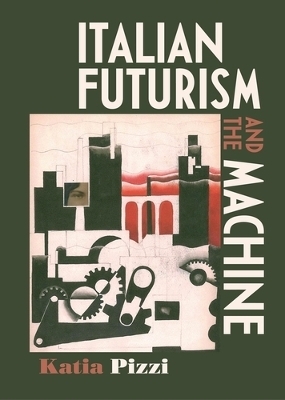
Italian Futurism and the Machine
Seiten
2019
Manchester University Press (Verlag)
978-0-7190-9709-6 (ISBN)
Manchester University Press (Verlag)
978-0-7190-9709-6 (ISBN)
The machine was a primary concern for the Italian futurists. A tool in the factory, it was also a social and political agent, an aesthetic emblem and a symbol of past technologies. This groundbreaking book explores the culture of machines in Italian futurism after the First World War, taking in literature, art, photography, music and film. -- .
This is the first interdisciplinary exploration of machine culture in Italian futurism after the First World War. The machine was a primary concern for the futuristi. As well as being a material tool in the factory it was a social and political agent, an aesthetic emblem, a metonymy of modernity and international circulation and a living symbol of past crafts and technologies. Exploring literature, the visual and performing arts, photography, music and film, the book uses the lens of European machine culture to elucidate the work of a broad set of artists and practitioners, including Censi, Depero, Marinetti, Munari and Prampolini. The machine emerges here as an archaeology of technology in modernity: the time machine of futurism. -- .
This is the first interdisciplinary exploration of machine culture in Italian futurism after the First World War. The machine was a primary concern for the futuristi. As well as being a material tool in the factory it was a social and political agent, an aesthetic emblem, a metonymy of modernity and international circulation and a living symbol of past crafts and technologies. Exploring literature, the visual and performing arts, photography, music and film, the book uses the lens of European machine culture to elucidate the work of a broad set of artists and practitioners, including Censi, Depero, Marinetti, Munari and Prampolini. The machine emerges here as an archaeology of technology in modernity: the time machine of futurism. -- .
Katia Pizzi is Senior Lecturer in Italian Studies at the Institute of Modern Languages Research, School of Advanced Study, University of London. -- .
Introduction: the rape of Europa
1 Futurismo and the machine
2 Mechanic machi(ni)smo: Filippo Tommaso Marinetti
3 Style of steel: Fortunato Depero in ‘dynamoland’
4 At the frontier of futurismo
5 Between technodialogism and cosmic idealism
6 From aerodancing technobodies to dysfunctional machines
Conclusion: ex machina
Index -- .
| Erscheinungsdatum | 07.07.2019 |
|---|---|
| Zusatzinfo | 2 colour illustrations, 9 black & white illustrations |
| Verlagsort | Manchester |
| Sprache | englisch |
| Maße | 170 x 240 mm |
| Gewicht | 712 g |
| Themenwelt | Kunst / Musik / Theater ► Kunstgeschichte / Kunststile |
| Geschichte ► Teilgebiete der Geschichte ► Kulturgeschichte | |
| ISBN-10 | 0-7190-9709-6 / 0719097096 |
| ISBN-13 | 978-0-7190-9709-6 / 9780719097096 |
| Zustand | Neuware |
| Informationen gemäß Produktsicherheitsverordnung (GPSR) | |
| Haben Sie eine Frage zum Produkt? |
Mehr entdecken
aus dem Bereich



aus dem Bereich
Die Revolution des Gemeinen Mannes
Buch | Softcover (2024)
C.H.Beck (Verlag)
CHF 16,80
vom Mittelalter bis zur Gegenwart
Buch | Softcover (2024)
C.H.Beck (Verlag)
CHF 16,80
Eine Geschichte des Geschmacks
Buch | Hardcover (2025)
C.H.Beck (Verlag)
CHF 49,95


