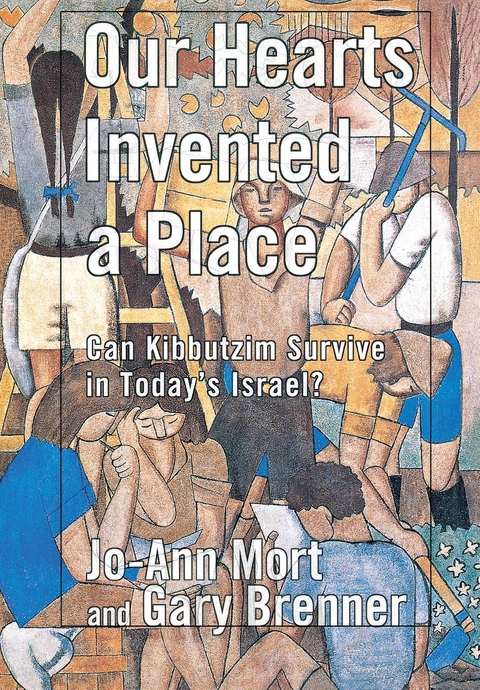
Our Hearts Invented a Place (eBook)
232 Seiten
Cornell University Press (Verlag)
978-1-5017-2900-3 (ISBN)
"We thought we were living in a society of the future, showing how people can live together in a way that the human being is not a product of society where you have to put somebody down so that you are up.... Suddenly we [find] that people want to...
"We thought we were living in a society of the future, showing how people can live together in a way that the human being is not a product of society where you have to put somebody down so that you are up.... Suddenly we [find] that people want to be more like outside, and we are disappointed."
"When people say to me, 'We're so sorry to see what's going on in the kibbutzim because we are losing the most important thing that happened to the State of Israel,' I say to them, 'Listen....' The government lost interest in the kibbutz movement, and we had to find another way. The State of Israel slowly but surely became a normal state, and the pioneers finished their job. We are living in a new era. We have to make the adjustment."—from Our Hearts Invented a Place
One of the grand social experiments of modern time, the Israeli kibbutz is today in a state of flux. Created initially to advance Zionism, support national security, and forge a new socialist, communal model, the kibbutzim no longer serve a clear purpose and are struggling financially. In Our Hearts Invented a Place, Jo-Ann Mort and Gary Brenner describe how life on the kibbutz is changing as members seek to adapt to contemporary realities and prepare themselves for the future. Throughout, the authors allow the members' often-impassioned voices—some disillusioned, some optimistic, some pragmatic—to be heard.
"The founders [of the kibbutz] had a dream," an Israeli told the authors in one of many interviews they conducted between 2000 and 2002, "[which] they fulfilled... a hundred times." The current generation, he explains, must alter that dream in order for it to survive. After tracing the formidable challenges facing the kibbutzim today, Mort and Brenner compare three distinct models of change as exemplified by three different communities. The first, Gesher Haziv, decided to pursue privatization. The second, Hatzor, is diversifying its economy while creating an extensive social safety net and a system of private wages with progressive taxation. In the third instance, Gan Shmuel is attempting to hold on to the traditional kibbutz model.
In closing, the authors address the new-style urban kibbutz. Their book will provide readers with a deeper understanding of the kibbutz—and of Israel itself—during an era of dramatic social, economic, and political change.
Jo-Ann Mort's articles about Israel and Jewish issues have appeared in a range of publications including the Chicago Tribune, the Los Angeles Times, the LA Weekly, the Forward, the Jerusalem Report, and Dissent Magazine, where she is a member of the editorial board. She is the editor of Not Your Father's Union Movement: Inside the AFLC/O. She lives and works in New York City. Gary Brenner, a member of Kibbutz Hatzor, is Chairperson of the Board of Directors of the Givat Haviva Institute and Marketing Director of Solbar Hatzor Ltd.
| Erscheint lt. Verlag | 5.9.2018 |
|---|---|
| Verlagsort | Ithaca |
| Sprache | englisch |
| Maße | 150 x 150 mm |
| Themenwelt | Kunst / Musik / Theater ► Musik ► Klassik / Oper / Musical |
| Geisteswissenschaften ► Geschichte ► Regional- / Ländergeschichte | |
| Geschichte ► Teilgebiete der Geschichte ► Kulturgeschichte | |
| Geisteswissenschaften ► Religion / Theologie ► Judentum | |
| ISBN-10 | 1-5017-2900-4 / 1501729004 |
| ISBN-13 | 978-1-5017-2900-3 / 9781501729003 |
| Informationen gemäß Produktsicherheitsverordnung (GPSR) | |
| Haben Sie eine Frage zum Produkt? |
 PDF (Adobe DRM)
Kopierschutz: Adobe-DRM
Adobe-DRM ist ein Kopierschutz, der das eBook vor Mißbrauch schützen soll. Dabei wird das eBook bereits beim Download auf Ihre persönliche Adobe-ID autorisiert. Lesen können Sie das eBook dann nur auf den Geräten, welche ebenfalls auf Ihre Adobe-ID registriert sind.
Details zum Adobe-DRM
Dateiformat: PDF (Portable Document Format)
Mit einem festen Seitenlayout eignet sich die PDF besonders für Fachbücher mit Spalten, Tabellen und Abbildungen. Eine PDF kann auf fast allen Geräten angezeigt werden, ist aber für kleine Displays (Smartphone, eReader) nur eingeschränkt geeignet.
Systemvoraussetzungen:
PC/Mac: Mit einem PC oder Mac können Sie dieses eBook lesen. Sie benötigen eine
eReader: Dieses eBook kann mit (fast) allen eBook-Readern gelesen werden. Mit dem amazon-Kindle ist es aber nicht kompatibel.
Smartphone/Tablet: Egal ob Apple oder Android, dieses eBook können Sie lesen. Sie benötigen eine
Geräteliste und zusätzliche Hinweise
Buying eBooks from abroad
For tax law reasons we can sell eBooks just within Germany and Switzerland. Regrettably we cannot fulfill eBook-orders from other countries.
aus dem Bereich