


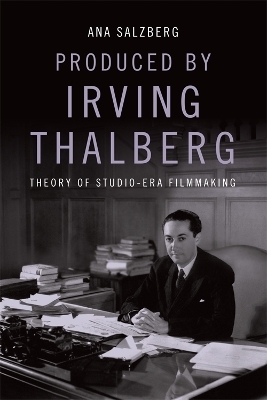
Produced by Irving Thalberg
Theory of Studio-Era Filmmaking
Seiten
2020
Edinburgh University Press (Verlag)
978-1-4744-5104-8 (ISBN)
Edinburgh University Press (Verlag)
978-1-4744-5104-8 (ISBN)
Explores Irving Thalberg's importance as not only a producer, but also a theorist of studio-era filmmaking
Offers a critical reappraisal of Thalberg’s legacyProvides in-depth analyses of Thalberg’s productions at MGM from 1924 through 1936Examines Thalberg’s impact on film-historical turning points, including the transition to sound cinema and the development of the Production CodeIrving Thalberg was not just a critically important producer during Hollywood’s Golden Age, but also an innovative theorist of studio-era filmmaking. Drawing on archival sources, this is the first book to explore Thalberg’s insights into casting, editing, story composition and the importance of the mass audience from a theoretical perspective. It examines Thalberg’s impact on film-historical turning points, such as the transition to sound cinema and the development of the Production Code, and features in-depth analyses of Thalberg’s productions at MGM from 1924 to 1936, including films like The Big Parade (1925), The Broadway Melody of 1929 (1929) and Romeo and Juliet (1936). The book argues that Thalberg’s views represent a unified conceptual understanding of filmmaking – one that is still significant in the modern day.
Offers a critical reappraisal of Thalberg’s legacyProvides in-depth analyses of Thalberg’s productions at MGM from 1924 through 1936Examines Thalberg’s impact on film-historical turning points, including the transition to sound cinema and the development of the Production CodeIrving Thalberg was not just a critically important producer during Hollywood’s Golden Age, but also an innovative theorist of studio-era filmmaking. Drawing on archival sources, this is the first book to explore Thalberg’s insights into casting, editing, story composition and the importance of the mass audience from a theoretical perspective. It examines Thalberg’s impact on film-historical turning points, such as the transition to sound cinema and the development of the Production Code, and features in-depth analyses of Thalberg’s productions at MGM from 1924 to 1936, including films like The Big Parade (1925), The Broadway Melody of 1929 (1929) and Romeo and Juliet (1936). The book argues that Thalberg’s views represent a unified conceptual understanding of filmmaking – one that is still significant in the modern day.
Dr Ana Salzberg is is Senior Lecturer in Film Studies at the University of Edinburgh. She is the author of Produced by Irving Thalberg: Theory of Studio-Era Filmmaking (Edinburgh University Press, 2020) and Beyond the Looking Glass: Narcissism and Female Stardom in Studio-Era Hollywood (Berghahn Books, 2014).
Acknowledgements…3
Chapter I: Opening Credits…4
Chapter II: Oblique Casting and Early MGM…38
Chapter III: "One Great Scene"…68
Chapter IV: Entertainment Value and Sound Cinema…96
Chapter V: Love Stories and General Principles…127
Chapter VI: The Intelligent Producer and the Restructuring of MGM…159
Chapter VII: "What Can We Do to Make the Picture Better?"…195
Chapter VIII: "Once a star, always a star"…236
Works Cited …260
| Erscheinungsdatum | 21.08.2020 |
|---|---|
| Zusatzinfo | 19 black and white illustrations |
| Verlagsort | Edinburgh |
| Sprache | englisch |
| Maße | 156 x 234 mm |
| Gewicht | 470 g |
| Themenwelt | Kunst / Musik / Theater ► Film / TV |
| Kunst / Musik / Theater ► Theater / Ballett | |
| ISBN-10 | 1-4744-5104-7 / 1474451047 |
| ISBN-13 | 978-1-4744-5104-8 / 9781474451048 |
| Zustand | Neuware |
| Informationen gemäß Produktsicherheitsverordnung (GPSR) | |
| Haben Sie eine Frage zum Produkt? |
Mehr entdecken
aus dem Bereich


aus dem Bereich
Buch | Hardcover (2025)
MACK and Important Flowers (Verlag)
CHF 43,60


