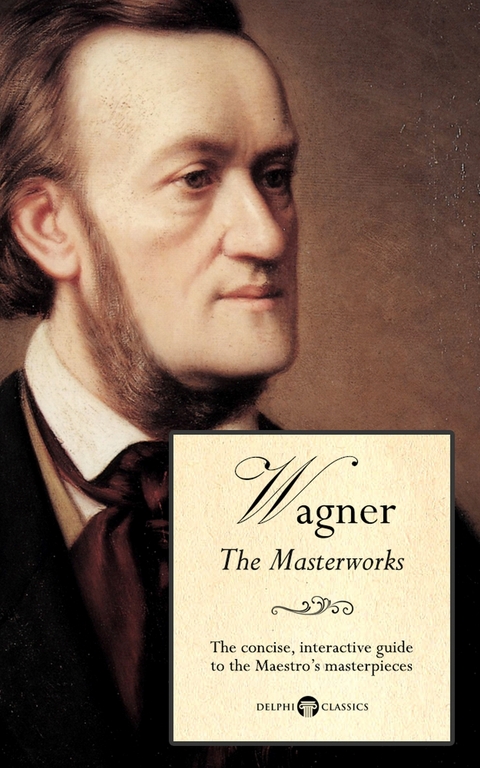
Delphi Masterworks of Richard Wagner (Illustrated) (eBook)
3953 Seiten
Delphi Classics Ltd (Verlag)
9781786564023 (ISBN)
The operas of the German composer Richard Wagner had a revolutionary influence on the course of Western music. Unlike most opera composers, Wagner wrote both the libretto and the music for each of his works. He went on to revolutionise the music form through his concept of the Gesamtkunstwerk (total work of art), by which he sought to synthesise the poetic, visual, musical and dramatic arts, with music subsidiary to drama. He achieved these ideas most fully in his epic cycle of operas 'Der Ring des Nibelungen', notable for complex textures, rich harmonies and the elaborate use of leitmotifs. Delphi's Great Composers Series offers concise illustrated guides to the life and works of our greatest composers. Analysing the masterworks of each composer, these interactive eBooks include links to popular streaming services, allowing you to listen to the pieces of music you are reading about. Evaluating the masterworks of each composer, you will explore the development of their works, tracing how they changed the course of music history. Whether a classical novice or a cultivated connoisseur, this series offers an intriguing overview of the world's most famous and iconic compositions. This volume presents Wagner's masterworks in succinct detail, with informative introductions, accompanying illustrations and the usual Delphi bonus features. (Version 1)
* Concise and informative overview of Wagner's masterworks
* Learn about the operas that made Wagner a celebrated composer
* Links to popular streaming services (free and paid), allowing you to listen to the masterpieces you're reading about
* Features a special 'Complete Compositions' section, with an index of Wagner's complete works and links to streaming services
* English translations of the librettos for the major operas, including works appearing for the first time in digital print
* A wide selection of the composer's prose works, including fiction, pioneering essays and Wagner's celebrated autobiography
* Includes Wagner's letters to Franz Liszt - explore the composer's personal correspondence
* Features six biographies on the great composer - explore Wagner's intriguing musical and personal life
Please visit www.delphiclassics.com to browse through our range of exciting eBooks
CONTENTS:
The Masterworks
Symphony in C Major
Das Liebesverbot
Faust Overture
Rienzi
Der fliegende Holländer
Tannhäuser
Lohengrin
Das Rhinegold
Die Walküre
Tristan und Isolde
Wesendonck Lieder
Die Meistersinger von Nürnberg
Siegfried
Siegfried Idyll
Götterdämmerung
Parsifal
Complete Compositions
Index of Wagner's Compositions
Selected Librettos
Der fliegende Holländer
Lohengrin
Das Rhinegold
Die Walküre
Tristan und Isolde
Siegfried
Götterdämmerung
Parsifal
Selected Prose
Autobiographic Sketch
On German Opera
Art and Revolution
The Art-Work of the Future
Judaism in Music
A Communication to My Friends
Opera and Drama
Beethoven
What is German?
An End in Paris
On Conducting
Religion and Art
The Letters
Correspondence of Wagner and Liszt
The Autobiography
My Life
The Biographies
Richard Wagner: His Life and His Dramas by W. J. Henderson
Life of Wagner by Ludwig Nohl
Richard Wagner, Composer of Operas by John F. Runciman
Wagner by Paul Rosenfeld
Wagner as I Knew Him by Ferdinand Praeger
Richard Wagner by Rupert Hughes
Please visit www.delphiclassics.com to learn more about our wide range of exciting titles
The operas of the German composer Richard Wagner had a revolutionary influence on the course of Western music. Unlike most opera composers, Wagner wrote both the libretto and the music for each of his works. He went on to revolutionise the music form through his concept of the Gesamtkunstwerk (total work of art), by which he sought to synthesise the poetic, visual, musical and dramatic arts, with music subsidiary to drama. He achieved these ideas most fully in his epic cycle of operas 'Der Ring des Nibelungen', notable for complex textures, rich harmonies and the elaborate use of leitmotifs. Delphi's Great Composers Series offers concise illustrated guides to the life and works of our greatest composers. Analysing the masterworks of each composer, these interactive eBooks include links to popular streaming services, allowing you to listen to the pieces of music you are reading about. Evaluating the masterworks of each composer, you will explore the development of their works, tracing how they changed the course of music history. Whether a classical novice or a cultivated connoisseur, this series offers an intriguing overview of the world's most famous and iconic compositions. This volume presents Wagner's masterworks in succinct detail, with informative introductions, accompanying illustrations and the usual Delphi bonus features. (Version 1)* Concise and informative overview of Wagner s masterworks* Learn about the operas that made Wagner a celebrated composer* Links to popular streaming services (free and paid), allowing you to listen to the masterpieces you re reading about* Features a special Complete Compositions section, with an index of Wagner s complete works and links to streaming services* English translations of the librettos for the major operas, including works appearing for the first time in digital print* A wide selection of the composer s prose works, including fiction, pioneering essays and Wagner s celebrated autobiography* Includes Wagner s letters to Franz Liszt explore the composer s personal correspondence* Features six biographies on the great composer explore Wagner's intriguing musical and personal lifePlease visit www.delphiclassics.com to browse through our range of exciting eBooksCONTENTS:The MasterworksSymphony in C MajorDas LiebesverbotFaust OvertureRienziDer fliegende HollanderTannhauserLohengrinDas RhinegoldDie WalkureTristan und IsoldeWesendonck LiederDie Meistersinger von NurnbergSiegfriedSiegfried IdyllGotterdammerungParsifalComplete CompositionsIndex of Wagner s CompositionsSelected LibrettosDer fliegende HollanderLohengrinDas RhinegoldDie WalkureTristan und IsoldeSiegfriedGotterdammerungParsifalSelected ProseAutobiographic SketchOn German OperaArt and RevolutionThe Art-Work of the FutureJudaism in MusicA Communication to My FriendsOpera and DramaBeethovenWhat is German?An End in ParisOn ConductingReligion and ArtThe LettersCorrespondence of Wagner and LisztThe AutobiographyMy LifeThe BiographiesRichard Wagner: His Life and His Dramas by W. J. HendersonLife of Wagner by Ludwig NohlRichard Wagner, Composer of Operas by John F. RuncimanWagner by Paul RosenfeldWagner as I Knew Him by Ferdinand PraegerRichard Wagner by Rupert HughesPlease visit www.delphiclassics.com to learn more about our wide range of exciting titles
Parsifal
AMAZON APPLE GOOGLE MUSOPEN SPOTIFY YOUTUBE SCORES
Loosely based on Parzival by Wolfram von Eschenbach, a thirteenth century epic poem of the Arthurian knight Percival and his quest for the Holy Grail, Wagner’s last opera was in fact conceived as early as April 1857. However, it would take him twenty-five years until he had finished the entire score. Wagner had read von Eschenbach’s poem while taking the waters at Marienbad in 1845. After encountering Arthur Schopenhauer’s writings in 1854, he had become interested in oriental philosophies, especially Buddhism, which offered such themes as self-renouncing, reincarnation, compassion and even exclusive social groups (castes). According to his autobiography, Wagner first hit upon the idea for Parsifal on Good Friday morning, April 1857, in the small cottage on Otto Wesendonck’s estate in Enge:
“On Good Friday I awoke to find the sun shining brightly for the first time in this house: the little garden was radiant with green, the birds sang, and at last I could sit on the roof and enjoy the long-yearned-for peace with its message of promise. Full of this sentiment, I suddenly remembered that the day was Good Friday, and I called to mind the significance this omen had already once assumed for me when I was reading Wolfram’s Parzival. Since the sojourn in Marienbad where I had conceived Die Meistersinger and Lohengrin, I had never occupied myself again with that poem; now its noble possibilities struck me with overwhelming force, and out of my thoughts about Good Friday I rapidly conceived a whole drama, of which I made a rough sketch with a few dashes of the pen, dividing the whole into three acts.”
It would not be till the passing of eight years that Wagner would work in earnest on Parsifal, however. In August 1865, he took it up again and made a prose draft, containing a fairly brief outline of the plot, adding a considerable amount of detailed commentary on the characters and themes of the drama. But once again the work was dropped and set aside; this time for eleven and a half years, when the composer’s time and creative energy was devoted to The Ring. After its first full performance at Bayreuth in August 1876, Wagner found time again to work on Parsifal. By 23 February 1877 he had completed a second and more extensive prose draft of the work, and by 19 April of the same year he had adapted it into a verse libretto.
Wagner composed the opera one act at a time, scored between August 1879 and 13 January 1882. On 12 November 1880, he had conducted a private performance of the prelude for his patron Ludwig II of Bavaria at the Court Theatre in Munich. The premiere of the entire work was given in the Festspielhaus at Bayreuth on 26 July 1882, conducted by Hermann Levi. Stage designs were by Max Brückner and Paul von Joukowsky, under the guidance of Wagner himself. The Grail Hall was based on the interior of Siena Cathedral that Wagner had visited in 1880, while Klingsor’s magic garden was modelled on the gardens at the Palazzo Rufolo in Ravello. In July and August 1882 sixteen performances of the work were given in Bayreuth conducted by Levi and Franz Fischer. The production boasted an orchestra of 107, a chorus of 135 and 23 soloists (with the main parts being double cast). At the last of these performances, Wagner took the baton from Levi and conducted the final scene of Act III, from the orchestral interlude to the opera’s end.
For the first twenty years, the only staged performances of Parsifal took place in the Bayreuth Festspielhaus, as Wagner wished to keep the opera exclusively for the Bayreuth stage. He was determined to prevent it from degenerating into ‘mere amusement’ for an opera-going public. Only at Bayreuth did he feel that his last work would be presented in the way envisaged by him — a tradition maintained by his wife, Cosima, long after his death. He also hoped that by giving Bayreuth the monopoly on its performance, the opera would provide an income for his family long after his death.
Up until 1903, an embargo was maintained on stage performances outside Bayreuth. However, on 24 December 1903, after receiving a court ruling that performances in the United States could not be prevented by Bayreuth, the New York Metropolitan Opera staged the complete opera, employing many Bayreuth-trained singers. Incensed with their actions, Cosima barred anyone involved in the New York production from working at Bayreuth in future performances. However, this did not deter other unauthorised performances. Bayreuth finally lifted its monopoly on Parsifal on 1 January 1914 in the Teatro Comunale di Bologna in Bologna with Giuseppe Borgatti taking the lead.
Interestingly, performances of Parsifal at Bayreuth have become associated with an unusual tradition of audiences not applauding at the end of the first Act. This is the result of a misunderstanding arising from Wagner’s desire at the premiere to maintain the serious mood of the opera. After a thundering applause following the first and second Acts, Wagner spoke to the audience and said that the cast would take no curtain calls until the end of the performance. This caused much confusion, as the audience remained silent at the end, until Wagner addressed them again, saying that he did not mean that they could not applaud. After the performance Wagner complained, “Now I don’t know. Did the audience like it or not?” At subsequent performances some believed that Wagner had wanted no applause until the very end, and there was silence after the first two acts. In time, it became a Bayreuth tradition that no applause would be heard after the first act, though this was certainly not Wagner’s original idea.
Largely due to its overtly Christian symbolism, Wagner considered Parsifal to be a sacred work for the stage and not an opera; the music is unusually solemn and slow. It opens near the sanctuary of the Holy Grail, as the old knight Gurnemanz and two sentries awaken and perform their morning prayers. Several other knights prepare a bath for the injured ruler Amfortas, who suffers from an incurable wound. Suddenly, a mysterious, ageless woman (Kundry) appears as the Grail’s messenger, explaining she has brought medicine for Amfortas. The knights carry in the king, while he reflects on a prophecy that tells of his cure by a “pure fool, enlightened by compassion”. When the knights ask about Klingsor, a sorcerer that is trying to destroy the knights of the Grail, Gurnemanz tells the story of Amfortas’ wound: The Holy Grail and the Holy Spear were given into the care of Titurel, Amfortas’ father, who assembled a company of knights to guard the relics.
Wishing to join the brotherhood, an unhappy man called Klingsor had tried to overcome his sinful thoughts by castrating himself, but the brotherhood rejected him. Seeking vengeance, he built a castle across the mountains with a magic garden full of alluring women to entrap the knights. When Amfortas set out to defeat Klingsor, he was himself seduced by a mesmirisingly beautiful woman. Klingsor stole the Holy Spear from Amfortas, using it to stab him, giving a wound that can only be healed by the innocent youth of which the prophecy told…
The score contrasts the sacred with the sensual, from the magnificence of the music for the procession to the Grail Hall in Act I to the richly orchestrated scene in which Kundry tries to seduce Parsifal in Act II. The Act I Prologue is notable for its ethereal beauty of expression, while other highlights include the Good Friday music in Act III and the opera’s closing scene, in which Parsifal reveals the Grail to the knights.
Parsifal makes liberal use of leitmotifs. Although Wagner did not specifically identify or name leitmotifs in the score, the esteemed Wagner follower Hans von Wolzogen, whose guide to Parsifal was published in 1882, identified and analysed many of them and they were later highlighted in piano arrangements of the score. The opening prelude introduces two important leitmotifs, generally referred to as the Communion theme and the theme of the Grail. Along with Parsifal’s own motif, these are repeated throughout the course of the opera. Wagner himself reacted to the naming of motifs with disgust: “In the end people believe that such nonsense happens by my suggestion.”
A number of orchestral excerpts from the opera were arranged by Wagner himself and remain in the concert repertory. The prelude to Act I is frequently performed either alone or in conjunction with an arrangement of the “Good Friday” music that accompanies the second half of Act III Scene 1.
Wagner spent the rest of his life principally at Villa Wahnfried, only making a visit to London in 1877 to give a successful series of concerts and then making several other journeys to Italy. During these years he dictated to his wife his autobiography, Mein Leben, which he had commenced work on in 1865. In the winter of 1882 he journeyed to Venice, where he remained for several months. He died of a heart attack at the age of 69 on 13 February 1883 at Ca’ Vendramin Calergi, a sixteenth century palazzo...
| Erscheint lt. Verlag | 15.8.2018 |
|---|---|
| Reihe/Serie | Delphi Great Composers | Delphi Great Composers |
| Sprache | englisch |
| Themenwelt | Kunst / Musik / Theater ► Musik ► Klassik / Oper / Musical |
| Schlagworte | Beethoven • Flying • Librettos • Lohengrin • Parsifal • Ring • Tristan |
| ISBN-13 | 9781786564023 / 9781786564023 |
| Informationen gemäß Produktsicherheitsverordnung (GPSR) | |
| Haben Sie eine Frage zum Produkt? |
 EPUB (Adobe DRM)
Größe: 47,0 MB
Kopierschutz: Adobe-DRM
Adobe-DRM ist ein Kopierschutz, der das eBook vor Mißbrauch schützen soll. Dabei wird das eBook bereits beim Download auf Ihre persönliche Adobe-ID autorisiert. Lesen können Sie das eBook dann nur auf den Geräten, welche ebenfalls auf Ihre Adobe-ID registriert sind.
Details zum Adobe-DRM
Dateiformat: EPUB (Electronic Publication)
EPUB ist ein offener Standard für eBooks und eignet sich besonders zur Darstellung von Belletristik und Sachbüchern. Der Fließtext wird dynamisch an die Display- und Schriftgröße angepasst. Auch für mobile Lesegeräte ist EPUB daher gut geeignet.
Systemvoraussetzungen:
PC/Mac: Mit einem PC oder Mac können Sie dieses eBook lesen. Sie benötigen eine
eReader: Dieses eBook kann mit (fast) allen eBook-Readern gelesen werden. Mit dem amazon-Kindle ist es aber nicht kompatibel.
Smartphone/Tablet: Egal ob Apple oder Android, dieses eBook können Sie lesen. Sie benötigen eine
Geräteliste und zusätzliche Hinweise
Buying eBooks from abroad
For tax law reasons we can sell eBooks just within Germany and Switzerland. Regrettably we cannot fulfill eBook-orders from other countries.
EPUB (Ohne DRM)Digital Rights Management: ohne DRM
Dieses eBook enthält kein DRM oder Kopierschutz. Eine Weitergabe an Dritte ist jedoch rechtlich nicht zulässig, weil Sie beim Kauf nur die Rechte an der persönlichen Nutzung erwerben.
Dateiformat: EPUB (Electronic Publication)
EPUB ist ein offener Standard für eBooks und eignet sich besonders zur Darstellung von Belletristik und Sachbüchern. Der Fließtext wird dynamisch an die Display- und Schriftgröße angepasst. Auch für mobile Lesegeräte ist EPUB daher gut geeignet.
Systemvoraussetzungen:
PC/Mac: Mit einem PC oder Mac können Sie dieses eBook lesen. Sie benötigen dafür die kostenlose Software Adobe Digital Editions.
eReader: Dieses eBook kann mit (fast) allen eBook-Readern gelesen werden. Mit dem amazon-Kindle ist es aber nicht kompatibel.
Smartphone/Tablet: Egal ob Apple oder Android, dieses eBook können Sie lesen. Sie benötigen dafür eine kostenlose App.
Geräteliste und zusätzliche Hinweise
Buying eBooks from abroad
For tax law reasons we can sell eBooks just within Germany and Switzerland. Regrettably we cannot fulfill eBook-orders from other countries.
aus dem Bereich