Wagnerian Romances (eBook)
441 Seiten
Seltzer Books (Verlag)
978-1-4553-4337-9 (ISBN)
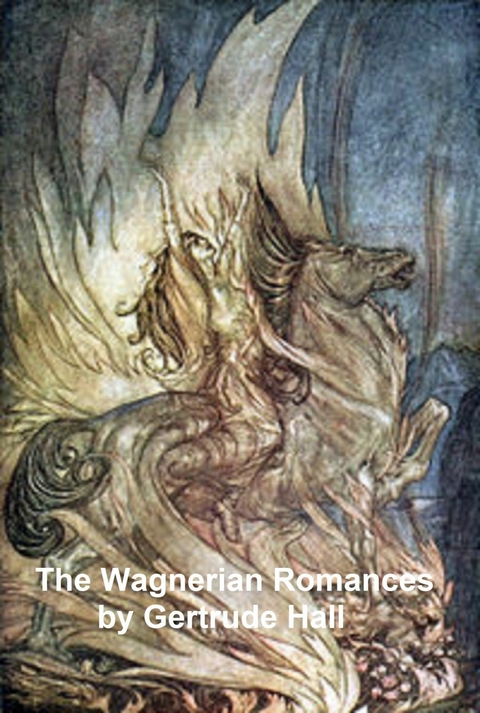
Chapters cover: PARSIFAL, THE RHINE-GOLD, THE VALKYRIE (DIE WALKÜRE), SIEGFRIED, THE TWILIGHT OF THE GODS (DIE GÖTTERDÄMMERUNG), THE MASTER-SINGERS OF NUREMBERG, TRISTAN AND ISOLDE, LOHENGRIN, TANNHÄUSER, and THE FLYING DUTCHMAN. According to Wikipedia: 'Wilhelm Richard Wagner (22 May 1813, Leipzig, Germany - 13 February 1883, Venice, Italy) was a German composer, conductor, theatre director and essayist, primarily known for his operas (or 'music dramas', as they were later called). Unlike most other great opera composers, Wagner wrote both the scenario and libretto for his works.'
Chapters cover: PARSIFAL, THE RHINE-GOLD, THE VALKYRIE (DIE WALKURE), SIEGFRIED, THE TWILIGHT OF THE GODS (DIE GOTTERDAMMERUNG), THE MASTER-SINGERS OF NUREMBERG, TRISTAN AND ISOLDE, LOHENGRIN, TANNHAUSER, and THE FLYING DUTCHMAN. According to Wikipedia: "e;Wilhelm Richard Wagner (22 May 1813, Leipzig, Germany - 13 February 1883, Venice, Italy) was a German composer, conductor, theatre director and essayist, primarily known for his operas (or "e;music dramas"e;, as they were later called). Unlike most other great opera composers, Wagner wrote both the scenario and libretto for his works."e;
SIEGFRIED
I
Fafner, when he had become possessor of the Nibelungen treasure, conveyed it, as we have seen, to a cave in a lonesome forest, and there in the shape of a dragon mounted guard over it. Mime, the dwarf, in order to keep the same treasure under some sort of oversight, took up his abode in the forest, at a respectful distance from the flame-breathing monster. Alberich haunted the immediate neighbourhood of the cave.
Thus it happened that Sieglinde, directed by the Valkyries to that region, where she should be safest from Wotan's anger, was overheard by Mime, out in the lonesome wood, moaning in her trouble. He assisted her into his cave. There Siegfried was born, and there Sieglinde died. Mime reared the "Waelsungen-shoot" with solicitous care, in the ulterior view that this scion of a strong race when grown to man's size should kill Fafner for him and get him the Ring.
At the rise of the curtain we see Mime at his anvil, struggling with a heavy difficulty. He is fashioning a sword for Siegfried,--still another sword, after ever so many,--realising even as he works that no sword he can forge but will break in the lad's strong hands. "The best sword I ever forged, which in the hands of a giant would stand stiff, the insignificant stripling for whom it was shaped he whacks and snaps it in two, as if I had made him a child's plaything!" It is sober fact to Mime that he cannot use Siegfried for his purposes until he have equipped him with a sword. "A sword there is," he continues his meditation, "which he could not break. The fragments of Nothung he never could shatter, could I weld the strong pieces together, which all my art cannot compass! Nothung alone could be of use,... and I cannot weld it, Nothung, the sword!"
Half-heartedly he has resumed his toil, when a joyous shout is heard from the forest, of which a sun-shot patch glimmers through the cave's mouth, and there storms in, driving before him a tethered bear, a magnificent youth, clad in skins, a silver horn at his side. The splendour of Siegfried's appearance is constantly referred to, the qualifications applied to him suggesting most frequently an effect he shed of light. This child of the unhappy Waelsungen seems to have been indelibly stamped with the joy of their one golden hour. Of Siegmund's tragic consciousness of frustration, of Sieglinde's sufferings, there is no trace in their vigorous offspring; but the superabundant vitality of joy which lifted them to the lovers' seventh heaven for one triumphant hour is all in his young blood. He is big, strong, sane, comely, fearless, simple, ignorant of all mean passions and interests; pensive for moments, gay for hours-nearly boisterous; frank and outspoken to the point of brutality; unmannerly at times to the point of ruffianism; but the dice are loaded to secure our cherishing him right through his bright course, by that irresistible, ingrain joyousness of his, born of strength, balance, fearlessness.
Laughing immoderately, he urges the bear against Mime, who flees hither and thither to elude the fearful pair. "I am come in double force, the better to corner you.... Brownie, ask for the sword!" When assured by the trembling Mime that the sword is in readiness, he releases and sends home his shaggy ally. But when Mime hands him the newly finished sword, and he strikes it on the anvil, it flies to bits. The angry boy expresses his wish that he had smashed the sword on the disgraceful bungler's skull. "Shall such a braggart go on bragging? He prates me of giants and lusty fighting; of gallant deeds and solid armour; he will forge weapons for me, provide me with swords; he vaunts his art as if he could do something of account; but let me take hold of the thing he has hammered, with a single grip I crush flat the idle rubbish! If the creature were not so utterly mean, I would drop him into the forge-fire with all the stuff of his forging, the old imbecile hobgoblin! There might be an end then to vexation!" He casts himself fuming on a stone seat and turns his face toward the wall. The dwarf, who has kept his distance from the storming youth, tries to quiet him, reminds him of his benefits, of his teachings on the subject of gratitude. Ingratiatingly he brings him food. Siegfried without turning dashes spit and pipkin from his hands. The little man affects a deeply hurt sensibility. He rehearses at length all Siegfried has to thank him for, material necessities, education,--"With clever counsel I made you clever, with subtle wisdom I taught you wit...." This tale of benefactions has been gone over so often that the dwarf has reached a fine glibness in it; the smooth air on which he enumerates the instances of his kindness has a peculiar cast of hypocrisy. He is so touched by the contemplation finally of his own goodness and Siegfried's hardness of heart that he falls to weeping. "And for all I have borne this is now the reward, that the hot-tempered boy torments and hates me!"
Siegfried has been calmly gazing into Mime's eyes; trying through these to get at the truth of him. Mime expresses surprise that after so many unquestionable services the boy should hate him; and the boy is not himself without a touch of wonder at the invincible antipathy with which this creature inspires him, to whom yet he is actually indebted for many good offices. "Much you have taught me, Mime, and many a thing have I learned of you; but that which you have most cared to teach me, never have I succeeded in learning: how I could bear the sight of you! If you bring me food and drink, disgust takes the place of dinner; if you spread an easy couch for me, sleep on it becomes difficult; if you endeavour to teach me wise conversation, I prefer to be dumb and dull. Whenever I set eyes on you, I recognise as ill-done everything you do; whether I watch you stand, or waggle and walk, ducking, nidnodding, blinking with your eyes, my impulse is to catch the nidnodder by the scruff of the neck, to hurl out of the way for good and all the odious blinker! That is my manner, Mime, of being fond of you. Now, if you are wise, help me to know a thing which I have vainly reflected upon: I run into the woods to be rid of you; how does it happen that I come back? All animals are dearer to me than you, trees and birds, the fish in the stream, I am fonder of them all than I am of you; then how does it happen that I still come back? If you are wise, make clear to me this thing!" "My child," replies Mime, "you are informed by that circumstance how near I lie to your heart!" "I tell you I cannot bear you! Forget it not so soon!" Mime argues that such a thing is impossible, is out of nature; that what to the young bird is the old bird, which feeds it in the nest until it is fledged, that is to Siegfried, inevitably, Mime! This simile of Mime's suggests to Siegfried a further question. In asking it he has one of those brief accesses of pensiveness which endear him, disclosing the existence of a common human tenderness, after all, under that sturdy wrapping of joy befitting the child of demigods. "Now, since you are so wise, tell me still another thing: When the birds were singing so blithely in Spring, the one luring the other, you told me, as I wished to know, that they were male and female. They billed and cooed so engagingly, and would not leave each other; they built a nest and brooded in it; there was a fluttering presently of young wings, and the two cared for the young. I saw how, in the same way, the deer rested in the forest, in pairs; how even wild faxes and wolves did this. The male brought food to the lair, the female nursed the cubs. I learned from seeing this what love is--I never robbed the mother of her young...." The music has been heaving and falling, as if with the warm palpitation of a vast breast, Nature's own, blissful with love and happy creative force. "Now, where, Mime, is your loving mate, that I may call her mother?" Mime becomes cross: "What has come over you, mad boy? Now, what a numbskull it is! Are you a bird or a fox?" And at Siegfried's next question he chafes: "You are to believe what I tell you: I am your father and mother at the same time!" But Siegfried vigorously objects: "There you lie, unspeakable gawk! How the young resemble their parents I have luckily observed for myself. More than once I have come to a clear stream: I have seen the trees and animals mirrored in it; the sun and clouds, exactly as they are, appear repeated on the shining surface. My own image, too, I have seen. Altogether different from you I seemed to myself: there is as much likeness between a toad and a gleaming fish, but never yet did a fish crawl out of a toad!" This latter bit in its short extent gives an amusing, characteristic illustration of Wagner's method of painting with notes. With the first phrase, Siegfried's impatient exclamation, comes the motif of Siegfried's impetuosity; then, as he is describing it, a representation of the clear stream; upon this is sketched the image of Siegfried, in the notes of his proper motif, to which is added a bar of the heroism-of-the-Waelsungen motif, indicating his resemblance to the father before him. At his mention of the toad, his metaphor for Mime, we hear the hammer of the Nibelung; and at his mention of the gleaming fish, the swimming phrase that accompanies the watery evolutions of the Rhine-maidens. The ingeniousness of all this would not perhaps of itself especially recommend the piece, were it not that the scheme is worked out to such beautiful purpose that the whole thing is lovely, and that, though one should know nothing whatever of the motifs, his...
| Erscheint lt. Verlag | 1.3.2018 |
|---|---|
| Sprache | englisch |
| Themenwelt | Kunst / Musik / Theater ► Musik ► Klassik / Oper / Musical |
| ISBN-10 | 1-4553-4337-4 / 1455343374 |
| ISBN-13 | 978-1-4553-4337-9 / 9781455343379 |
| Informationen gemäß Produktsicherheitsverordnung (GPSR) | |
| Haben Sie eine Frage zum Produkt? |
 EPUB (Ohne DRM)
Digital Rights Management: ohne DRM
Dieses eBook enthält kein DRM oder Kopierschutz. Eine Weitergabe an Dritte ist jedoch rechtlich nicht zulässig, weil Sie beim Kauf nur die Rechte an der persönlichen Nutzung erwerben.
Dateiformat: EPUB (Electronic Publication)
EPUB ist ein offener Standard für eBooks und eignet sich besonders zur Darstellung von Belletristik und Sachbüchern. Der Fließtext wird dynamisch an die Display- und Schriftgröße angepasst. Auch für mobile Lesegeräte ist EPUB daher gut geeignet.
Systemvoraussetzungen:
PC/Mac: Mit einem PC oder Mac können Sie dieses eBook lesen. Sie benötigen dafür die kostenlose Software Adobe Digital Editions.
eReader: Dieses eBook kann mit (fast) allen eBook-Readern gelesen werden. Mit dem amazon-Kindle ist es aber nicht kompatibel.
Smartphone/Tablet: Egal ob Apple oder Android, dieses eBook können Sie lesen. Sie benötigen dafür eine kostenlose App.
Geräteliste und zusätzliche Hinweise
Buying eBooks from abroad
For tax law reasons we can sell eBooks just within Germany and Switzerland. Regrettably we cannot fulfill eBook-orders from other countries.
aus dem Bereich